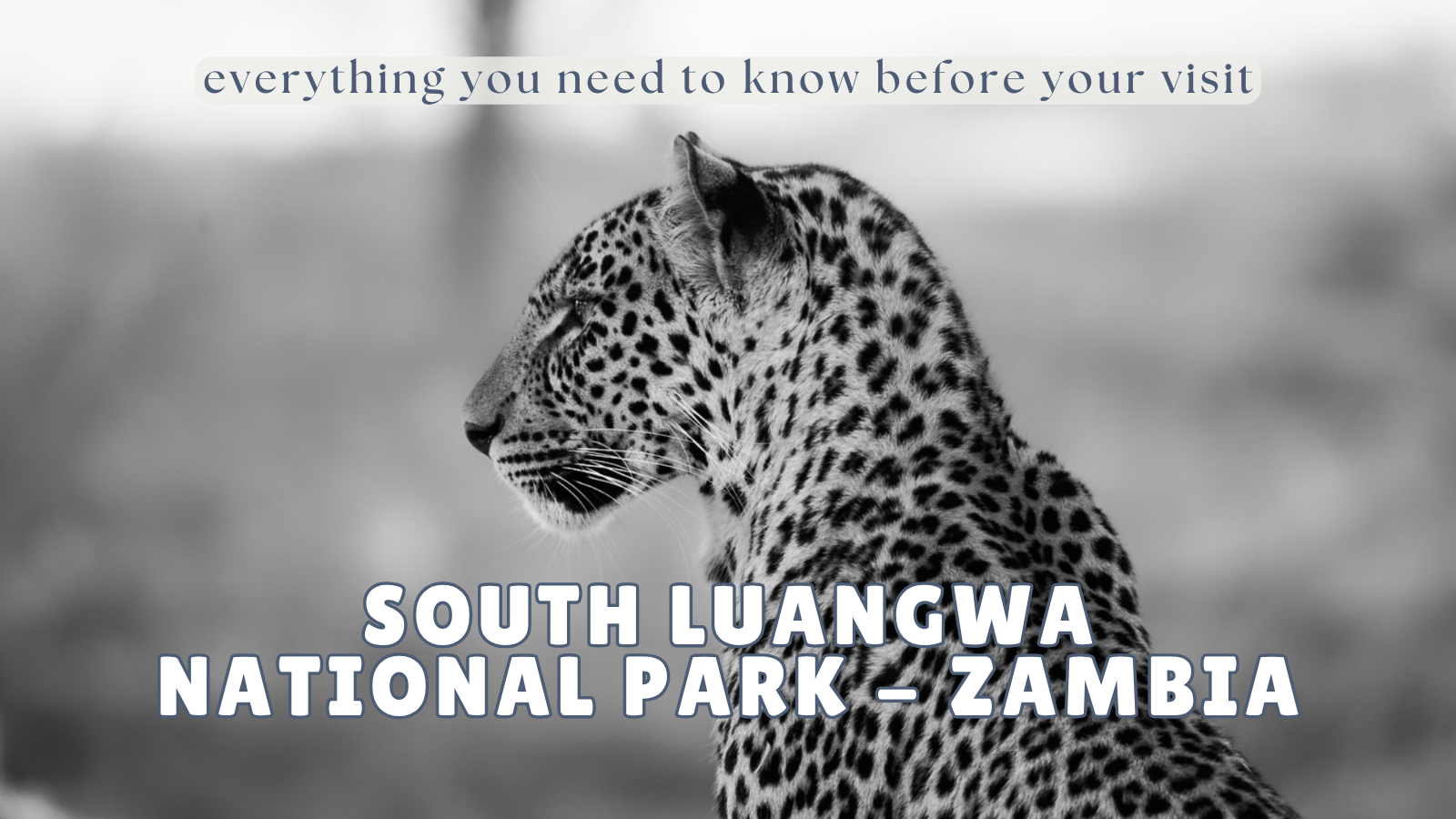
If you’re planning a wildlife trip to Zambia, South Luangwa National Park (SLNP) is probably on your list. It’s the country’s most popular wildlife destination. South Luangwa National Park is actually known for two things: the birthplace of walking safaris and its healthy population of leopards.
My husband and I spent 2.5 days exploring South Luangwa during our Southern Africa Road trip. In our itinerary, we self drove through Zambia’s national parks, although we also joined a few guided game drives.
The national park gave us some amazing wildlife sightings, including several leopards. However, we also saw some disappointing behaviour from other safari vehicles that overshadowed part of our experience.
If you’re planning a visit to South Luangwa independently, here’s everything I’d want to know… for ease, I’ve compiled all the information you’ll need to know before your visit!
Disclaimer: Some links earn me a small commission – same price for you, slightly less tragic bank balance for me.
South Luangwa National Park at a Glance

Location: Eastern Zambia
Famous four: Leopard population + walking safaris
Big Five?: 4/5 – no rhinos
Self drive: Yes, guide recommended at least once
Boat safari: No
Walking Safari: Yes
Recommended stay: 2 – 3 full days
Best time: April – October (dry season)
Estimated budget:
-
- Entrance fee $25 per foreigner
- Vehicle entrance $15 per vehicle
Why visit South Luangwa National Park?
South Luangwa National Park is probably Zambia’s best all safari destination. However, it is quite the trek if you’re coming from Lusaka. It is well positioned if you’re coming in from Malawi and making your way west through Zambia.
The park follows the Luangwa River, an important water source for wildlife during the dry season. As the landscape dries out, you’d find more animals concentrated around the river. And there are the leopards. South Luangwa has a reputation for leopard sightings – although as well all animal encounters, there are no guarantees but your chances are good!
The main reason why so many people make the trek to South Luangwa is for their walking safaris. This national park is widely considered as the birthplace of walking safaris and it is one of the signature experiences offered.
PLANNING YOUR VISIT
Understanding the layout of South Luangwa National Park
South Luangwa National Park is huge. You are definitely not going to be able to explore the entire park if you’re only there for a couple of days. Most visitors will base themselves around the Mfuwe area – where the parks’ main entrance is. You’d find a couple of lodges located inside the park, however they definitely come at a cost. Majority of the affordable campsites are located outside the main gates. This is an awfully busy area especially in the morning when everyone is headed out for their game drives. However, in Mfuwe, there’s plenty of dining options, independent shops and cafes you can explore between your game drives.
If you only have a couple of days to explore SLNP, I’d recommend staying closer to the main gate rather than Mfuwe to optimize your time.
Getting to South Luangwa National Park
There are a couple of different ways to reach SLNP, depending on whether you’re flying in or travelling overland.
Flying to Mfuwe
For most international travellers in Zambia for a short holiday, the easiest option is to fly into Mfuwe Airport. This town is the gateway to South Luangwa and is located 40 mins from the main entrance and many surrounding lodges. If you’re staying at a safari lodge, your accommodation will often arrange an airport transfer either as part of your booking or for an additional fee. This is by far the easiest option if you’re not overlanding.
Self drive
If you’re travelling through Zambia independently, South Luangwa National Park can be visited as a self drive. We were overlanding throughout Southern Africa so it was easy for us to drive to South Luangwa by road. If you have the option, I’d recommend it. You’ll also have the flexibility to decide how long/short you’d like to spend with the animals. The tracks throughout the national park are actually pretty good! There weren’t too many potholes and the roads are well maintained (compared to some others we’ve experienced). As always, I’d recommend a high clearance 4×4 if you’re planning to self drive around the park. Obviously, the main downside is trying to spot the wildlife yourself.
Driving Times
Driving from Chipata border (Malawi)
The road from Mfuwe to Chipata is in a rough state. It is covered in potholes and not enjoyable at all. For 110 kms, it will take you ±2hrs to drive it – if you’re driving at the correct speed for the conditions of the road!
Driving from Lusaka
If you’re travelling overland through Zambia, you can drive to South Luangwa from Lusaka. However, bear in mind that the journey will take the entire day. Once you arrive in Chipata and hit the T4 highway to Lusaka, it’s significantly better. We didn’t find the roads to be all that bad – considering we were just overlanding in Mozambique where the roads are another level. Although, if you’re not used to driving in these parts, you probably will think they are in bad condition.
Overlanding tip: Just be mindful of the traffic police around Lusaka. We were stopped after making a u-turn because the road we were supposed to take was blocked. I was threatened with jail time, given paperwork containing incorrect details and eventually paid a fee to leave. Do with this information what you will.
Driving from other Zambian safari destinations
South Luangwa can be combined with other safari destinations in Zambia like Lower Zambezi National Park and Kafue National Park. However, the logistics are quite substantial. It took us two days to drive to Busanga Plains – Kafue National Park as we had to overnight in Lusaka and continue on. Unfortunately, we had to skip Lower Zambezi this trip but many people we met did detour there before continuing west.
Guided tour
Being Zambia’s most visited national park, there are plenty of tour and safari companies that include South Luangwa National Park as part of their itinerary. If you’re not a confident driver, prefer everything already planned and arranged for you – that’s completely fine! A guided tour is a good option as those tours incorporate the game drives into the itinerary already. All you would need to do is show up.

How many days do you need?
2 Full Days: Enough for a few game drives and a good introduction to the park.
3 Full Days: My recommendation if you want to add a walking safari or have more flexibility around wildlife sightings.
4+ Days: Worth considering if South Luangwa is one of the main reasons for your Zambia trip. However, entrance fees + selfdrive/game drive fees add up quickly.
Where to Stay
There are a wide range of accommodation options ranging from campsites to simple lodges and luxury safari camps. We personally stayed at Track and Trail River Camp and opted for a campsite. It was a really nice campsite along the Luangwa River with private room options. It was definitely one of the nicer campsites we stayed in – and the price was reflective of this! I will say, they were very accommodating because we couldn’t arrive the night we intended to (border issues) and didn’t charge us for that night of our reservation.
There are plenty of other campsites and in Mfuwe, more affordable options. If this is your only safari experience, it may be worth spending more on accommodation that includes game drives, walking safaris, meals and transfers rather than organizing it independently.
Best Time to Visit
For a first safari experience, I’d recommend dry season (Apr – Oct).
South Luangwa National Park can be visited throughout the year… however, like most safari parks in Africa, the conditions can vary considerably. During the dry season, wildlife viewing is at its best. Animals concentrate around permanent water sources (or the river) and the roads are easier to navigate. The vegetation becomes thinner, making it easier to spot animals. This is also the classic safari season.
Park Fees
We visited SLNP in July 2025. I’ve included the prices we paid during our trip. In addition, I’ve done some updated research and included the updated prices at the time of writing (August 2026). At the time of visiting and writing, park entrance fees and activity prices are charged separately. Keep in mind that prices change regularly, it’s worth checking the Zambia Tourism website before your trip.
Park entry: $25 per person per day (entrance with a guided game drive)
Self Drive park entry: $30 per person per day (entrance for self drivers)
Vehicle (foreign registration): $15 per day (if doing a game drive)
Note: the permit isn’t valid for a rolling 24hr period and instead is only valid for a calendar day.

Know Before You Go
Here are a couple of things worth knowing before you visit South Luangwa National Park.
Park opening hours + Night Drives
The national park is open to visitors from 0600hrs to 1800hrs. So for self drivers, you need to be out of the national park by 1800hrs.
Whilst the official park hours are until 1800hrs, you can do an evening/night game drive. However, this can only be done as part of a guided game drive. We joined an afternoon game drive with Track and Trail River Camp and stayed in the park until approximately 1715hrs.
Walking Safaris
These are only offered by the lodges and campsites. You need to be accompanied by an experience guide. For your walking safari, you will drive to a part of the park before disembarking the vehicle and going on the activity. It usually takes about 2-3 hrs.
Big Five
Unfortunately, there are no wild rhinos in South Luangwa so you wouldn’t be able to spot all the Big Five.
The changes in temperatures
The best time to go on a safari is during Southern Hemisphere winter. So the mornings are actually really cold, especially with an open vehicle – don’t forget to rug up. However, on the other day, during the day – the temperature rises and it gets really warm. The key here is to layer up!
Avoid driving during the midday
There’s a reason why safaris are done in the morning and afternoon. Mid afternoon is way to hot to do anything, even in the winter months. The animals become harder to spot because they are hiding under the shade. The best is go around dusk and dawn where there tends to be a lot more wildlife activity.
Bring binoculars
Don’t assume you’ll be given one by the lodge. Even if you’re primarily interested in seeing the larger mammals, binos are really useful to have! Particularly for spotting birdlife. Occasionally, you might see something in the distance – could be a rock, could be a lion… at least you’ll be able to have a better look with binos before going over to investigate.
Bring cash
Despite checking with our campsite that we could pay by card, we weren’t able to! Many parts of the country still operate under a cash is king system so it’s always worth carrying enough with you. The national park entrance actually only accepts cash! It can be in Zambian Kwacha (ZMW) or USD. Smaller shops don’t tend to accept cards and those that do incur a commission fee of ±5% or more.
Don’t leave your vehicle unless you’re on an organised safari
I don’t know how many people we saw getting out of their vehicles during our time there. Even if you’ve had a check, avoid getting out of your vehicle because you might have missed a predator hiding nearby. This isn’t the place to jump out for a casual photograph…

Wildlife in South Luangwa National Park
Wildlife Sightings
Another complaint I’ve seen is that a lot of people are upset about not seeing a certain animal on their game drive. Remember, these are still wild animals so sightings are never guaranteed.
Leopards
Leopards are the most commonly associated animal with the park. Makes sense, the park has a reputation for excellent sightings. However, don’t arrive expecting to see one. They are still elusive animals. If you want to improve your chances, it’s worth joining a game drive as the guides generally know where they may be hiding.
Thornicroft’s giraffe
Whilst the leopards steal the headlines, you’ll find the Thornicroft’s giraffe here – endemic to the Luangwa Valley so you won’t find them wandering anywhere else in Africa! Keep an eye out for them on your game drives!
Best things to do
Go on a game drive
The classic safari experience. Morning and afternoon game drives allow you to explore different parts of the park while searching for wildlife. At different times of the day, you’ll see different animal behaviours and sometimes you might spot different species. If you’re staying at a safari lodge, these will often be included within your accommodation package. What we enjoy doing is joining at least one game drive so we can learn about the animals that live there, where they are found and their habits before attempting our own self drive.
Go on a walking safari
This is probably the most recommended activity to do while in South Luangwa. It’s one of the key experiences and it was developed here. The difference about a walking safari is that you’re boots on the ground – your guide will point out things that you usually would miss – tracks, dung, bird calls, broken branches… The experience gives you a chance to completely slow down and observe. Walking safaris are done with experienced guides and the experience can vary between operators. While you don’t cover as much ground, it’s a different sensation seeing animals from the ground.
We didn’t do a walking safari during our visit. While we were there, we heard about an elephant bull attacking a person on a walking safari, which made us reconsider doing one ourselves. Here’s not to say walking safaris are inherently unsafe… they are done with experienced guides who understand animal behaviours. However, we did do a walking safari in eSwatini and it was a stellar experience.

Go on a night drive
We found South Luangwa interesting after dark. Whilst we didn’t see many nocturnal species, we did witness an attempt hunt by a pride of lionesses which isn’t something you necessarily would see during the day.
Go birdwatching
The national park has recorded more than 400 species of birdlife. It’s a great destination for birders. During our game drives, we were joined by a Dutch lady who was an avid birder. We spent a lot of our time during our game drives just observing different birdlife and behaviours. Even if you’re not travelling specific for birders, I’d recommend you keep your eyes peeled!
Go on a self drive safari
My husband and I thoroughly enjoyed travelling through Africa and its many national parks, exploring them independently on a self drive. SLNP is no exception. If you rather the excitement of spotting your own animals, setting your own pace, stop whenever something catches your eye – it’s great. I’d recommend downloading an offline map like Maps.me so you won’t get lost in the national park!
Self-Drive vs Guided Safari
During our time at SLNP, we did both. That would be my personal recommendation to anyone travelling independently – do at least one game drive even if you’re primarily planning to self drive the rest of your trip.
Self drive gives you the freedom and is generally cheaper if you’re more than one person. However, the obvious downside is that you’re on your own to figure out where to find the wildlife. Whereas with a guided safari – the guide knows where the animals have been spotted recently and can probably spot things you’ll normally drive straight past.
My Recommendation: Do one guided game drive, learn the layout of the land, where the recent sightings have been, how to drive in a national park (!!!) before doing a self drive.
By following this, we managed to find a leopard on our own… we even saw a hyena and civet cat! So if budget allows, this would be the way to go. But of course, if you’re able to, guided safaris are great because you’ll see a lot more than on your own.
Pricing for Self Drivers
If you’re planning to use your own vehicle for a game drive, keep in mind that there’s an extra charge for all vehicles, especially for foreign-registered 4×4 cars which is USD$15 per day. Zambian registered cars are 34 ZMW $1.30. Just remember to keep your receipt in your car at all times to show proof of payment.
The price for two foreigners doing a self drive would be: USD$75 per day. (USD$30 x 2 + USD$15)

Our Experience
We were halfway through our Southern Africa overlanding adventure and I hadn’t seen a leopard yet. Coming to South Luangwa National Park was kinda a Hail Mary because if I didn’t see one here, then it wasn’t meant to be! Turns out it was the right decision for us. We had been fortunate enough to have a couple of sightings of leopards during our time there, even one with a mother and her two cubs. Another sighting: we saw a young male leopard practicing its hunting techniques on a nearby warthog.
However, we unfortunately did have some negative experiences in the national park. During our evening game drive, in a dried up riverbed, there was a pride of lionesses preparing to hunt a herd of puku. All the safari vehicles caught wind of the potential hunt. As it was dusk and starting to be difficult to see – several guides (and guests!!!) were shining bright white light at the heads of the different animals – essentially temporarily blinding the predators/prey. Our guide used red light – which doesn’t impact the sight of the animals. Whilst it was a shame that it was a failed hunt, it completely disoriented the animals and reduced the chances of the lionesses eating.
Another poor experience we had was whilst watching a young male leopard napping from a distance, a safari vehicle almost ran over the sleeping leopard – barely 2m from it. For 2 mins so their guests could take some photos and then drive off. Horrid behaviours.
All in all, it’s a fantastic national park to experience however the behaviours of some individuals leave a lot to be desired – although that can happen anywhere.
Is South Luangwa National Park worth visiting?
For the right reasons. For the classic safari experience with great wildlife viewing and a chance to do a walking safari, it’s a great national park. It’s also a fantastic addition to a longer Zambia or Southern Africa itinerary. However, as it’s quite remote, I wouldn’t simply visit South Luangwa because everyone online says it’s the best safari destination in Africa. I’d recommend it to anyone who wants to experience the bush and see some of the most iconic sightings.
TL;DR? Check out these FAQs
Is South Luangwa good for seeing leopards?
Absolutely. South Luangwa has an excellent reputation and concentration of leopards. Wildlife sightings are never guaranteed.
Does South Luangwa have the Big Five?
South Luangwa has four of the Big Five: lion, leopard, elephant and buffalo. There are no rhinos.
Can you do a walking safari in South Luangwa?
Yes. Walking safaris are one of the key experiences in South Luangwa – it is the birth place of the walking safari afterall!
Can you self-drive in South Luangwa National Park?
Yes. We self drove throughout the park. Although we highly recommend doing a game drive through your lodge at least once to understand the layout and spread of animals of the National Park.
How many days do you need in South Luangwa National Park?
We recommend spending at least two full days, although three days allows you to explore the park at a much slower pace. The actual national park covers a huge area so there’s always plenty to see!

Continue planning your African Adventure
If Zambia is just one stop on your Africa itinerary, these guides will help you plan the rest of your journey. From buying a 4×4 for an overland trip to budgeting for Namibia, Mozambique and Madagascar, they’re all based on our own experiences travelling independently across the continent.
Chimpanzee Habituation Experience (CHEX), Uganda – Spend an entire day with a troop of wild chimpanzees in Kibale National Park and discover what makes this one of Uganda’s most rewarding wildlife experiences.
Queen Elizabeth National Park, Uganda Planning Guide – Continuing planning your safari adventure? Head to Uganda next.
Southern Africa 4×4 Buyback Guide – Everything you need to know about buying, registering and selling a vehicle for an overland adventure through Southern Africa. Perfect if you’re planning a long-term road trip.
Namibia Road Trip Itinerary (2½ Weeks) – Our complete self-drive itinerary covering the country’s iconic highlights, from Etosha National Park to Sossusvlei and the Skeleton Coast.
Namibia Budget Breakdown – Find out exactly how much we spent travelling independently around Namibia, including fuel, campsites, food and activities.
Mozambique Overland Itinerary (16 Days) – A practical guide to planning an unforgettable road trip along Mozambique’s coastline, including beaches, diving and logistics.
Mozambique Travel Budget – A detailed breakdown of what our Mozambique road trip cost, helping you budget for accommodation, transport, food and activities.
Madagascar Budget Breakdown – Planning a trip to one of Africa’s most unique destinations? This guide covers our real travel costs to help you estimate your budget.

Leave a Reply