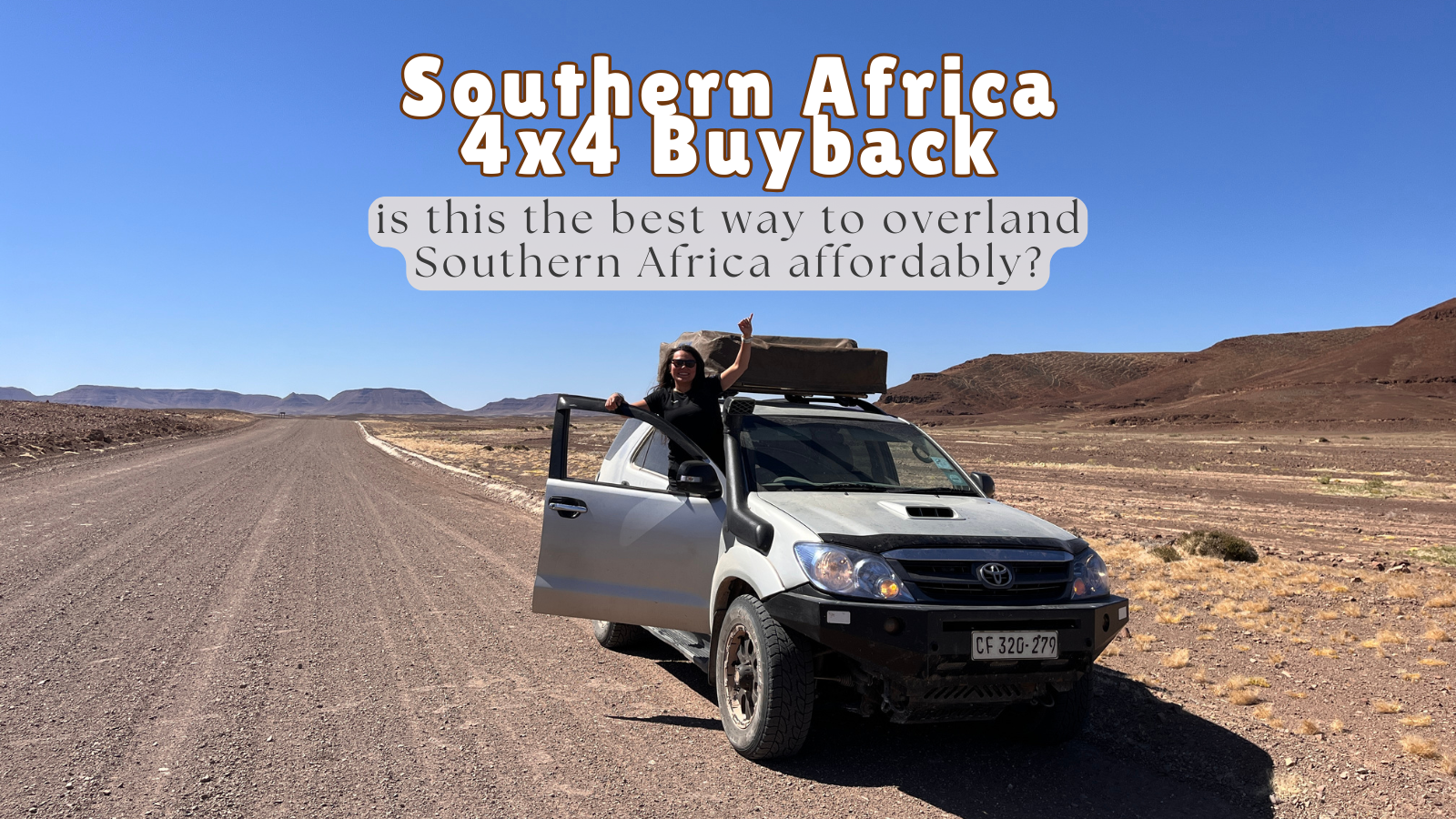
After 15,000km across nine countries, a Southern Africa 4×4 buyback can be one of the most cost-effective and flexible ways to overland the region.
If you’re planning a long overland trip through Southern Africa, you’ve probably come across something called a 4×4 buyback scheme. At first glance, it sounds a bit strange – you’re not renting but you’re not exactly buying a 4×4 either. It sits in the middle. The buyback model is becoming increasily popular with international travellers spending months exploring countries especially in the Southern African region.
We had spent months comparing rental vehicles, buying our own 4×4 and various schemes. In the end, we chose to do a 4×4 buyback scheme and spent 3 months driving more than 15 000 km through South Africa, Lesotho, Eswatini, Mozambique, Malawi, Zambia, Zimbabwe, Botswana and Namibia before returning to South Africa.
After living out of the vehicle for three months, crossing multiple borders and camping everywhere from national parks to remote bush camps, here’s what we learned about Southern Africa buyback schemes and whether they’re actually worth it.
Disclaimer: Some links earn me a small commission – same price for you, slightly less tragic bank balance for me.

So, what is a 4×4 buyback scheme?
A buyback scheme is essentially a long-term vehicle arrangement designed for travellers. It’s a great alternative to renting a 4×4 for several months – because that can add up quickly. Before you take the car, the company agrees to buy it at a predetermined price when you return it. So think about it this way, the difference between the purchase price and the guaranteed buyback amount is the cost of using the vehicle.
While every provider operates slightly differently, most schemes include:
-
- A fully equipped overlanding vehicle
- A copy of the registration and ownership paperwork
- Cross-border documentation
- Camping equipment
- Agreed buyback terms before departure
For many travellers who dream of overlanding, it bridges the gap between a rental vehicle and buying a vehicle outright.
How Much Does A Southern Africa Buyback Cost?
The total cost varies depending on vehicle type, how many rooftop tents and duration. In our case, a buyback worked out significantly cheaper than a comparable long-term rental while avoiding the complications of purchasing our own vehicle. For our three-month trip, the vehicle cost worked out to under €4,000. This included the difference between the purchase price and guaranteed buyback amount, making it significantly cheaper than the equivalent long-term rental options we compared.
Why we chose a Buyback instead of renting
When we were planning our ultimate roadtrip around Southern Africa, we realised that there were three options we could go for:
A. Long Term Rental
At face value, it is the most convienent option. It’s simple and no different to how you would rent a car for a single destination. Collect the vehicle, travel, return it. The main downside is the cost of the rental itself and all the other “miscellaneous costs”. For a multi-country trip, it would not include cross-border fees or insurance. Some companies may only include camping equipment at an additional cost.

B. Buying a vehicle outright
Buying a vehicle outright can work for long-term overlanders, but registration, insurance and resale create additional complexity.
I’ve always dreamt of owning a 4×4 and roadtripping around the continent or back to Europe. So buying a vehicle outright was a real consideration. On paper, it’s a very attraction option. In reality, there are just so many other costs associated with owning a vehicle – like back home. Depending on how long your trip is or where you intend on purchasing your vehicle, there might be challenges with registration, insurance, paperwork and eventually selling the 4×4 at the end of your trip.
We narrowed down our timeframe and figured for 3 months of overlanding, buying a vehicle didn’t make the most sense for us… much to my dismay. Yes, we even considered buying a vehicle in Europe and shipping it down but we weren’t sure if we wanted to commit to driving it back to Europe.
C. A Buyback Scheme
After going down a rabbit hole, I found the buyback scheme which seemed to offer more of a middle ground. We had access to a fully equipped overland 4×4 without needing to think about registration requirements or stressing to find a buyer at the end of our trip. For an overland trip of less than 9 months, it made sense! This is how Discover Africa 4×4 came into the picture. However, the main con of this is that if anything happens, the cost of repairs will be on you.
Quick comparison of all the options

Is a Buyback actually worth it?
In our case, very much so. If you’re only travelling for a few weeks, a standard rental is probably the easier option. In fact, some buyback companies have a minimum period. However, once you start looking into trips lasting a few months, the math will shift in favour of a buyback scheme. However, not enough that buying a 4×4 outright makes more sense. Of course, everyone’s itinerary is different but the longer your trip, the more attractive a buyback generally becomes.
In general, we found it provided:
-
- More flexibility than a traditional rental
- Less administrative hassle than purchasing a vehicle outright
- Better value for an extended trip
- The freedom to cross multiple international borders
Tip from experience: Make an excel spreadsheet with all the costs and options to decide which option will actually work best for you.
Life travelling with a Buyback 4×4
For one thing: FREEDOM. We had no limitations on where we could go. It felt like actual bliss.
What we weren’t expecting was how quickly we stopped thinking about the fact that the car wasn’t actually ours… Within a few days, Simba (our trusty Toyota Fortuner) wasn’t just our mode of transport but also our home on wheels. It carried us across mountain passes across Lesotho, remote stretches of Namibia, through the beaches and national parks in Mozambique and across thousands of kilometers of highway, gravel roads and dirt tracks.

You’ll take the pre-drive checks seriously
Something you might not know is that any breakdowns or mechanical damage are on you when you do a buyback. Through Discover Africa 4×4, Duncan actually takes you through all the pre-drive checks. It may sound like a hassle but it will actually help you uncover any minor issues with the vehicle before anything major happens. One morning, we found that our coolant was completely drained and took it to a mechanic. Turned out – we had a punctured radiator! Which, if you know, would be a huge issue if it’s not resolved quickly and if you drove hundreds of km’s on.
You’ll care for the car like it’s your own
So in a buyback scheme, you pay for the total cost of the car. Whilst you know you will be selling it back, you’ll take such good care of it whilst you have it. As I mentioned, any mechanical repairs are on you. I’d argue you’ll take better care of this car than you would your normal car back home. I mean, after all – it’s your home for the time you’re on the road.
Border crossings can be a hit or miss
Police and border crossings were our main concerns before leaving. And actually, that remained true until we returned the 4×4 back! Online forums and groups can make crossing borders in Africa sound very intimidating. For the most part, the majority of our experiences were straightforward. We did have two or three situations at the border that we were just over with.
Border crossings in certain countries are by no means quick. In some instances, you’re forced to use the border runners if not you’re going nowhere! Although having all your documentation in a folder ready to be handed over helped remove a lot of hassle and stress!
You’ll spend more time driving than you think
Back home, your navigation apps are usually pretty accurate. Well, not here. We found on average that the time taken was approximately 30% longer. On paper, everything looks really straightforward and easy. But don’t be fooled, Southern Africa is vast. One of the main mistakes you can make is underestimating driving times and trying to fit everything into your itinerary. Roads can be in poor condition, police checkpoints, wildlife sightings or you’re just not as familiar with driving in Southern Africa! It all takes a lot longer than you would think.
It doesn’t feel like an endless travel doco
I feel that social media often paints overlanding Southern Africa as a never ending series of sunsets, campfires and wildlife sightings. Those moments absolutely exist! We spent so many nights with a campfire, relaxing and had some of the most incredible wildlife sightings… but there’s always the other side to overlanding: long driving days, laundry on the road, border formalities, police run-ins.
I’m sure there’ll be days you think to yourself what did i get myself into?
Countries we visited during our trip

Over three months, we travelled through:
-
- South Africa
- Lesotho – A highlight of the trip and we cover the route and practicalities in our Lesotho overlanding guide.
- Eswatini
- Mozambique – Planning on visit? Our detailed Mozambique overlanding guide covers road conditions, driving tips and what to expect.
- Malawi
- Zambia
- Zimbabwe
- Botswana
- Namibia – if you’re planning your own route, our Namibia self-drive itinerary covers exactly how we spent two and a half weeks there.
One of the biggest advantages of a buyback vehicle is the flexibility it provides. Rather than following a fixed route, we could adapt our plans as we travelled and spend longer in places we enjoyed. In some instances, we had to cut out complete areas because we were running out of time, unfortunately. All the more reason to go back 😉
Was the 4×4 for the Buyback a good choice?
Our buyback vehicle was the Toyota Fortuner – nicknamed Simba. It absolutely handled everything we needed it to. Our roughest section was through Zambia’s Kafue National Park and through some parts of Mozambique. These routes were pretty rough! But Simba managed without an issue.
Overall, Simba was comfortable enough for long driving days – I mean 10+ hr drives. For the most part, we didn’t need to use the “4H (4 high range)” except once when we were a bit stuck in Namibia’s Sossusvlei. Apparent from that, it gave us enough clearance to get through some questionable roads!
For travellers considering a similar route, vehicle choice will depend on:
-
- Number of travellers
- Budget
- Camping style
- Planned destinations
- Amount of gear
Camping Set Up?
There’s no one perfect vehicle for overlanding Southern Africa but we had the basics of everything we needed. Through the buyback, Simba was also equipped with a full rooftop tent set up with:
-
- Camping Chairs + Table
- Cutlery
- Gas stove + canister
- Small fridge
- Emergency repair kit
- First aid kit
If you needed anything extra, like bedding/sleeping bags, you needed to purchase that yourself. We bought our bedding from a local store outside of Cape Town and it lasted us the whole way. At the end, we donated our bedding.

Things That Surprised Us
Southern Africa felt safer than we expected
There is so much nuance to answering if Southern Africa is safe. Before leaving, safety was one of our biggest concerns. After 15 000km across nine countries, we generally felt safe. Most of our time was spent in national parks, campsites and small towns rather than major urban centres. The main things to keep in mind: common sense, avoiding night driving and staying aware of our surroundings.
Campsites were better than expected
I honestly imagined that we would be roughing it. I’m used to wild camping on my road trips around Norway, so I was low key expecting campsites with minimal facilities. Oh, how I was mistaken! In some places, we did have very minimal campsites with some sad facilities. However, there were so many amazing campsites across Southern Africa that were exceptionally well maintained and offered facilities far better than we expected. Namibia had amazing campsites we encountered and we’ve reviewed our favourites separately. I genuinely think so many of these campsites have been better than some that I’ve been to in Europe.
Fuel was easier to find than expected
Our Fortuner ran on diesel. We actually bought a jerry can because we were unsure about fuel consumption. We only had to use it once in Zambia but that was also planned rather than as a surprise. We actually spoke to locals and kept up with the news to see if there were fuel shortages and where they were. For parts of Mozambique, they were running out of unleaded petrol but diesel was fine. In Malawi, diesel was the issue. However, we filled up whenever we had the opportunity so we could make it through the country. This isn’t really an issue, you just need to make sure to have a jerry can and plan your trips a little. Also follow the golden rule of: fill up whenever you can.
Who is a Southern Africa 4×4 buyback for?
It’s best for travellers who intend to overland for longer than 3 months and are looking for a fully equipped vehicle on a budget. If you’re someone who enjoys the open road, camping and exploring independently – I think this is the best decision you can make.
However, if you’re someone on a short holiday, primarily plan on staying in hotels and actually don’t like driving? Other options would work better for you!

Common Questions about Southern Africa 4×4 Buybacks
Is a buyback cheaper than renting?
For longer trips, often yes! For shorter trips, a rental may be more practical. My advice would be to make a spreadsheet and do a comparison on pricing to see what makes sense.
How long should your trip be before a buyback makes sense?
Many buyback companies have a minimum period of rent. With Discover Africa 4×4, the minimum period is 3 months. When I did the math, it did come out a lot cheaper with anything over 2.5 months (especially over peak season).
Can foreigners use a buyback scheme?
Absolutely, yes. Buyback schemes are specifically designed for international travellers. It’s how we managed to use it!
Can you cross international borders?
This will depend on your provided. For Discover Africa 4×4, we could travel to all the countries we visited plus Tanzania and Angola. However, it would definitely take you a lot longer to visit Tanzania and Angola if you intend to visit all 11 countries!
Do you need a 4×4?
Some people will say you might not need it. To that I say: wrong, you need a 4×4. Especially if you intend to do a similar route to ours, some roads are impassable without a 4×4. Sure, locals do it but their cars end up pretty beaten up. If you plan to do self drives in a safari park – only 4x4s are allowed.
Is Southern Africa safe for self-driving?
In our experience, yes. Common sense, preparation and situational awareness go a long way. Don’t drive at night as it’s a lot harder to see any dangers on the roads. If stopped by the police, cooperate.
What happens if the vehicle is damaged?
In instances of a buyback, you are actually liable to cover the damages and actually get it fixed. Think of it as owning your own car, you’re responsible. The buyback companies can give you support with what the issues may be but not actually fixing it.
Do you need a Carnet de Passage?
The nice thing about a buyback is that legally, it is treated as a rental so you don’t need one. There’s also a list of countries that the car can cross that is approved by the buyback company.
What is the best vehicle for a Southern Africa overland trip?
To my earlier note, anything that is a 4×4.
Can two people drive?
Yes. Just be sure that both your names are on the paperwork. For border crossings, you’ll just name one primary driver.
Can you wild camp?
Actually, no. Legally in all Southern African countries we have visited, wild camping isn’t actually allowed. We’ve met people who’ve done it, though.
How much driving should you expect?
This will depend on your route and where you choose to visit. To circle the 9 countries above, it took us 3 months and over 15000kms driven. A daily average of about 200 kms.
Is insurance included?
Depends on your buyback company. We had purchased normal travel insurance from our home countries that would cover this type of travel.
Can I sleep in national parks?
We slept in all the national parks we visited and it’s definitely the best experience! Our personal favourite campsites were actually the unfenced campsites – be careful because you might get an unexpected visitor!

Would we use a Southern Africa Buyback again?
Without hesitation. After travelling more than 15000 kilometres across 9 countries, a buyback scheme proved to be one of the best decisions we made for the trip. It gave us the freedom to travel independently, adapt our route as we went and experience Southern Africa at our own pace.
Whilst it is a big upfront cost, the along term cost compared to buying our own 4×4 or renting made such a big difference. If you’re planning an extended overland journey and weighing up whether to rent, buy or use a buyback scheme, it’s an option that deserves serious consideration. For us, it struck the perfect balance between flexibility, convenience and value, allowing us to focus on the adventure.



Leave a Reply