When planning an Antarctica adventure, most people don’t actually realise how vessel size can actually impact how you experience the continent. One of the biggest mistakes people make when planning a trip to Antarctica is focusing entirely on price. I get it. When you’re looking at a trip that can easily cost more than you ever imagined, it’s natural to sort results from cheapest to most expensive and go from there. But… I’ll let you in on a little secret. Whilst some prices may look really tempting, the experience may not be what you dreamt of. Unfortunately, not all cruises are built the same.
Picture this – you’ve just saved thousands by booking on a larger ship, only to discover that you won’t be doing as many landings as you thought. Yikes… it happens. Before booking my own expedition, I spent literal weeks comparing everything – ships, operators, passenger numbers and itineraries. As an engineer, I made an entire spreadsheet of almost all the options. What I’ve come to realise is that while pricing will dictate my itinerary, the size of the ship actually matters almost equally as much. If you’re trying to decide between an expedition vessel and a larger cruise ship, let’s break down what very few seem to explain 😉
Disclaimer: Some links earn me a small commission – same price for you, slightly less tragic bank balance for me.

Expedition Cruise vs Large Cruise Ship: Quick Comparison
|
Feature |
Expedition Ship |
Large Cruise Ship |
|
Passenger numbers |
Typically < 200 |
> 500+ |
|
Antarctica landings |
YesN |
No |
|
Zodiac cruises |
Extensive |
Limited or none |
|
Wildlife access |
Excellent |
Primarily viewed from ship |
|
Educational focus |
High |
Moderate |
|
Facilities |
Basic to comfortable |
Extensive |
|
Sea stability |
Lower |
Higher |
|
Overall immersion |
Excellent |
Moderate |
Antarctica Cruise Passenger Limits: Why ship size matters
Before comparing ships, here is one thing you need to understand. The number of passengers onboard directly impact your experience and what you can do in Antarctica.
That’s generic advice, so let’s dive in further. Most Antarctic tourism is regulated by the International Association of Antarctica Tour Operators (IAATO). IAATO is a self-governing body made up of different agencies and companies, setting strict guidelines designed to protect the fragile Antarctic environment and wildlife. Especially since visiting the continent is becoming more accessible.
One of the most important rules concerning landings which you might not know: IAATO guidelines limit shore parties to a maximum of 100 passengers at one time (unless otherwise stated). This is where the difference between ship sizes becomes significant.
So let’s say you’re on a boat of 270 passengers. This is what would happen:
– you’re divided into 3 groups of 90
– your groups would rotate around the activities
– Example: Group A may be doing a landing, Group B cruising on the zodiacs and Group C on the ship. And then rotate through it.
Now, this is a very simplified version of what happens but you get the jist. Another thing worth noting is that ships with over 500 passengers cannot do any landings. But we will get into that later.

My Antarctica Expedition Experience
I travelled aboard MV Ushuaia with Antarpply on a route covering Antarctica, South Georgia and the Falkland Islands. With less than 90 passengers onboard, we were able to maximise time ashore and adapt our plans when wildlife opportunities appeared.
Antarctica cruise ship experiences depending on size
Small Antarctica Cruises Under 200 Passengers
This is the classic and most common option. This is what most people would think of when they imagine an expedition cruise to Antarctica. Majority of the expedition ships can carry a range of 70 – 200 passengers. Although there are some that are even smaller/more intimate but come at a cost. These ships are purpose built polar expedition vessels. Generally, they are able to offer the most complete Antarctica experience. However, on certain ships – amenities onboard may be more limited.
More landings
For the majority of expedition ships, the goal is to do two landings per day. As there are fewer passengers, it is a lot easier to get everyone ashore efficiently. Each zodiac is generally limited to 8 – 10 people. When weather conditions change, times ashore may be shortened or plans need to be changed. Smaller passenger numbers provide more flexibility!
More zodiac cruises
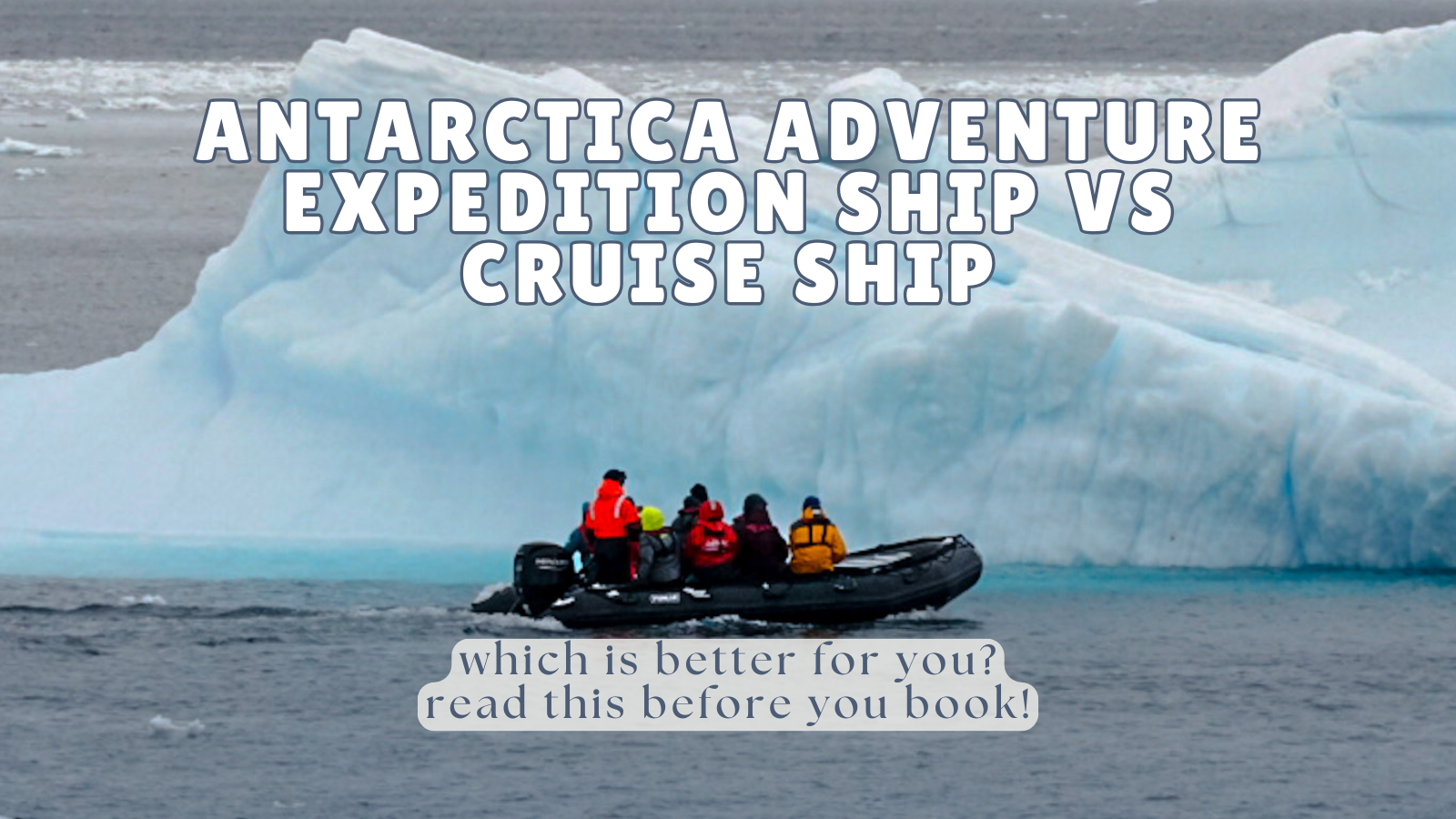
This truly does depend on the itinerary of your ship. Zodiacs are used to get between the ship and land. For many, it’s a highlight of their trip. It’s an interesting way to experience Antarctic waters and get close to icebergs, wildlife. When you’re at eye level with your surroundings, it will feel more immersive as compared to viewing from the ship’s deck where things appear smaller than they really are!
Educational experience
With a lot of expedition vessels, education is embedded in the experience. During sea days, we were given lectures and in the evenings after a landing – information about the wildlife we had just seen. As there is limited space for a big crew, you’d find that a lot of the crew members are actually scientists – biologists, polar experts, naturalists, psychologists. Everyone had a speciality and was so passionate about sharing their experiences or knowledge. You leave understanding Antarctica rather than simply photographing it.
Better wildlife encounters
For wildlife, my general rule is that less is more. When there are fewer people ashore at the same time, the animals aren’t as afraid and will come up closer to you as they are a lot more curious. Whilst we always tried to maintain distance with the animals, they didn’t necessarily care! But also as a smaller ship, the team tried their best to give us transparency and options. As Lucas always said “flexibility is the key to success”.
And this being said, it paid off. We managed to all work together to get some stellar wildlife encounters.
Greater focus on Antarctica
I can only speak for Antarpply but being a converted scientific vessel, there was a greater focus on lectures, information and wildlife. Whilst there wasn’t as much onboard amenities as some other larger companies – the experience felt more expedition based. The main attraction is the destination – seeing the wildlife up close and learning about them.
South Georgia
For South Georgia, ships with under 200 people can land at any site. However, special permission needs to be given to ships between 200 – 500 passengers. There are only 6 sites approved to handle that many passengers. As the weather can turn really quickly in South Georgia, there’s never a guarantee to be able to make a landing, especially if you’re already so limited on which sites you can visit! Similarly with Antarctica, only 100 passengers are allowed to make landfall on the island.
More time off the ship
There were less than 87 passengers onboard MV Ushuaia with Antarpply when we visited Antarctica + South Georgia + Falkland Islands/Isla Malvinas. This meant that everyone on the ship could get out at the same time. Our landings were long – I mean about 3 hrs for each landing as we didn’t have to rotate! We spent so much time on the ground rather than just staring at Antarctica through a window.

Mid Size Antarctica Cruises with 200 – 500 Passengers
Okay, so this makes the situation a bit more complex. The ships can still operate landings under certain conditions. However, the logistics of the landings become more challenging. As there is only 100 passengers that can do a landing on Antarctica, what cruise ships do is have a rotational landing schedule. It takes significantly longer trying to organise passengers to get them ashore. In terms of expedition experience – in comparison, your landing opportunities are shorter and less flexible. There are times were landings are not possible and you’ll need to wait for the next landing.
This doesn’t inherently make the mid size ships bad, just worth understanding the trade-offs. Everyone has a different priority in what they want to see on Antarctica. For some, one landing is “good enough” and others just want the privilege of saying they’ve visited.
More stable in rough seas
When we crossed the Drake Passage, I was out for 24 hrs during the crossing because of how our ship was being tossed about in the waves. Larger ships are generally able to handle ocean swell better. They will provide a smoother ride.
More onboard facilities
My friend had taken a more luxurious ship a couple of months after me… and gosh, her ship looked fantastic. There were multiple restaurants, gyms, rooftop swimming pools/jacuzzis, entertainment options and larger cabins. Onboard many of these ships, freebies like an expedition parka was given as part of the package. For some travellers, these features are important.
Better access to wildlife
Similar to an Expedition ship, a mid size ship will have intimate experiences with wildlife thanks to IAATO’s guidelines of 100 passengers ashore. So even on a mid size ship, you’ll only have a max of 100 other passengers on landing with you. So you’ll still have the opportunity for some amazing wildlife encounters!

Large Antarctica Cruises with over 500 passengers
This is where I started going down the rabbit hole. I had seen these unbelievable discounts with the major cruise lines. I am talking about a couple of thousand to visit Antarctica! However, it felt too good to be true. Turns out, it was. Sure, large cruise ships can visit Antarctica. However, those ships seem to only be passing through. Most of the larger cruise liners that visit Antarctica operate a scenic cruise rather than an expedition itinerary.
You’ll be able to see Antarctica but unable to make any landings. You’ll still float past and see icebergs, some wildlife and landscapes but be unable to set foot on the continent. Depending if that’s more you’re travel style, a large cruiseliner might be for you.
Lower entry prices
The way I understand it, is like this: larger ships have more people so the overall costs is shared amongst more passengers so the entry price can be lower. Because of this lower entry price, it’s what attracts people initially. But that being said – not all large cruise ships were cheaper than a smaller expedition ship. We certainly found that our expedition itinerary with Antarpply was by far the cheapest/most affordable by at least $5000 per person.
Make sure if you’re comparing cruises, you’re comparing like-for-like rather than apples and oranges!
Questions to ask before booking your Antarctica cruise
Let’s reframe how we approach Polar Travel. Rather than asking What’s the cheapest Antarctica cruise? Let’s try find what type of expedition is better suited for yourself. Try asking yourself these questions:
-
- What are my non-negotiable activities whilst on Antarctica?
- How much comfort do I want?
- Am I okay with comfortable but basic facilities?
- Is having facilities like a sauna, gym, pool and multiple hanging out areas a – want or a need?
- Do I want to spend as much time as possible on landings or would I rather just rotate groups?
Once you’ve decided what sort of ship you want to go with to Antarctica, the next questions would be:
-
- How many passengers are onboard?
- How many zodiacs does the ship operate at once?
- How much time will I be able to spend off the ship?
- Is this itinerary focused on exploration/wildlife or sightseeing?
- Does this itinerary deliver what I want out of my Antarctic cruise?

Is a Smaller Expedition Ship always better?
Not necessarily! Honestly, there are people I wouldn’t recommend a smaller expedition ship to simply because of the trade offs. A smaller ship usually means that the cabins are smaller, there’s a lot more movement in rough seas, there are fewer amenities and sometimes for a significantly higher price. While I absolutely loved and enjoyed our cruise with Antarpply, it definitely wasn’t for everyone.
The most important thing about planning an Antarctica journey is matching the ship with your expectations. If you’re expecting the most luxurious, activity filled, photo on the rooftop pool experience – then a smaller expedition ship will not meet that expectation. Whereas, if you’re looking for a small, science based expedition – then you might not enjoy a busy larger ship.
Which Antarctica Cruise would I choose again?
Having now experienced Antarctica, South Georgia and the Falkland Islands – I think I’d still choose an expedition vessel again. Not because the ship itself was extraordinary, quite the opposite. Our ship was good and basic, we managed to achieve what we set out to do – a tool that allowed us to access extraordinary places. Most of what made Antarctica memorable was actually what happened during our landings for me personally.
Whilst I wouldn’t mind experiencing all the really amazing amenities on offer on a larger ship, I don’t think the trade offs would be worth it for me.

Who should choose what?
Go for an Expedition Cruise if you:
-
- Want to step foot on Antarctica (never guaranteed)
- Want wildlife encounters
- Enjoy learning from experts
- Don’t mind a less luxurious experience
- Are okay without the luxury amenities/facilities
- Prefer adventure over luxury
Pick a Mid Size Cruise Ship if you:
-
- Mainly want to see Antarctica scenery
- Prefer luxury amenities
- Want a smoother Drake Passage crossing (never guaranteed)
- Don’t mind shorter landings
Choose a Large Cruise Ship if you:
-
- Don’t mind staying onboard
- You aren’t bothered about stepping foot on Antarctica
- Okay to have a limited itinerary
- Prefer sightseeing from the deck/viewing rooms

Frequently Asked Questions
Is an expedition cruise worth it in Antarctica?
Absolutely! If you’re a wildlife photographer, a wildlife lover or someone who wants to fully embrace the adventurous option, then an expedition cruise is perfect!
Can large cruise ships land in Antarctica?
Only ships with <500 passengers can make landings on Antarctica. Cruise ships with >500 passengers can sail through Antarctic waters but that’s really the extent of it. Keep in mind, only 100 passengers can go ashore.
What is the best size ship for Antarctica?
I think if you have the choice, the best option to look for is vessels with <200 passengers. These ships also give you more flexibility on your itinerary – especially if you want to visit South Georgia. However, if money is not an issue, then my recommendation is going for a ship that has less than 100 passengers onboard!
What is the maximum number of passengers allowed on Antarctica cruises?
There isn’t a set number. Cruise ships with over 500 passengers cannot do any landings. The maximum number of passengers that can be ashore on Antarctica is 100 passengers at any one time.
Is an expedition cruise worth the extra money?
Well, it depends on the company. We found the price of our expedition cruise to be on par with other luxury cruises!
Can you actually step foot on Antarctica?
Yes! It will be dependent on weather, however if your ship can dock but that is the goal! Expedition ships carrying fewer than 500 passengers can usually offer landings (weather permitting), while ships with more than 500 passengers sail through Antarctic waters without allowing passengers ashore.
Is the Drake Passage rough on small ships?
Possibly… Smaller ships generally feel the waves more than larger ships, making for a bumpier crossing. However, conditions vary from the “Drake Lake” to the “Drake Shake”… during the Drake Shake even large ships can experience rough seas!

Continue planning your Antarctic Adventure:
Still planning your trip? These guides cover everything from budgeting and packing to choosing the right expedition and making the most of your time in the polar regions.
How much does Antarctica cost? – A realistic breakdown of what you can expect to spend plus the hidden costs to plan for.
The Ultimate Antarctica packing list – Exactly what to pack for an Antarctic expedition – including clothing, camera gear and the essentials that are easy to forget.
MV Ushuaia review/Antarpply Expeditions – My honest review after sailing to Antarctica, South Georgia and the Falkland Islands, including the ship, cabins, food and overall experience.
South Georgia Travel Guide – Everything you need to know about visiting South Georgia – from incredible king penguin colonies and wildlife encounters to what to expect on an expedition cruise.



Leave a Reply