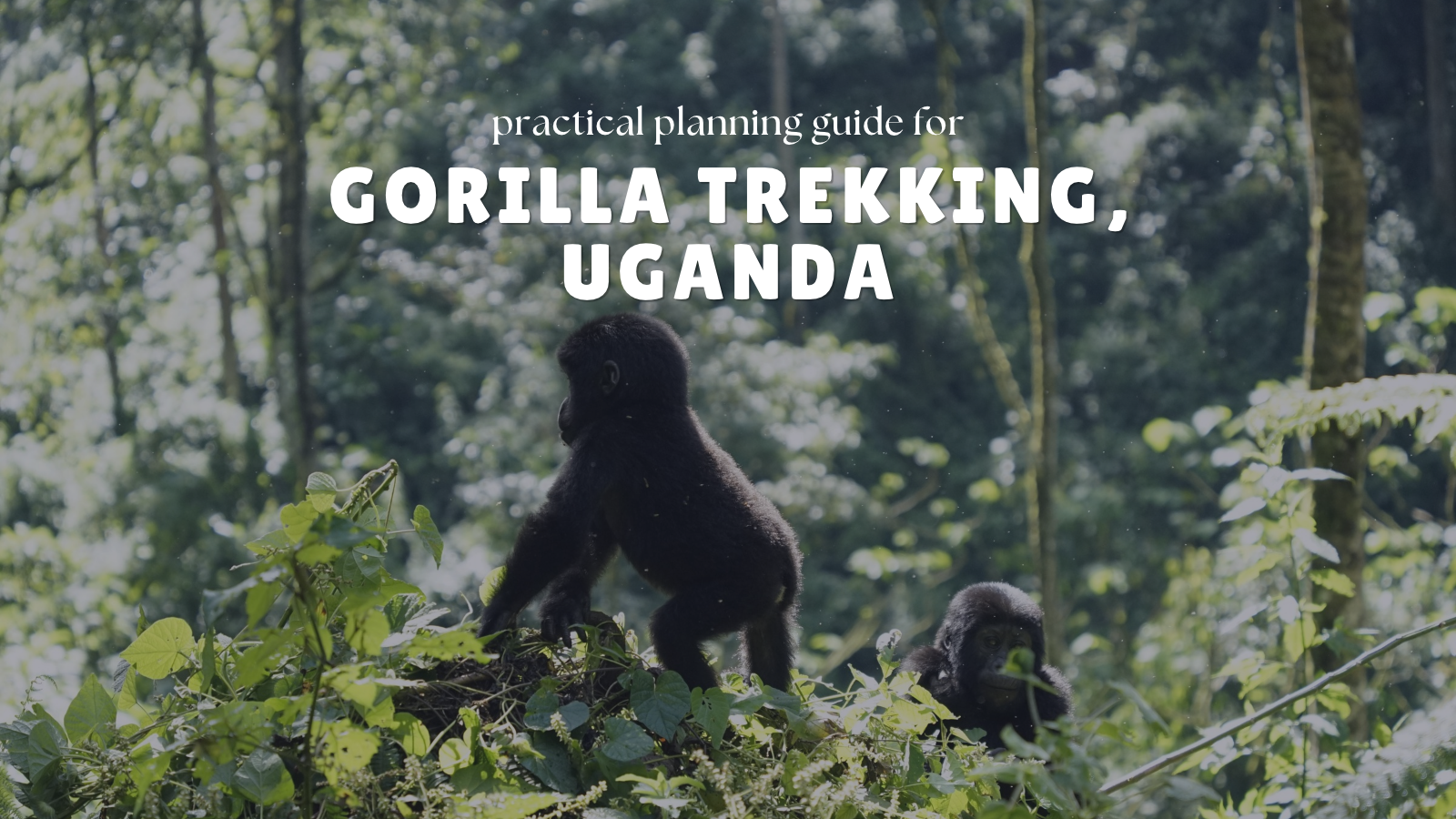
Gorilla trekking in Uganda deserves a spot in your Ugandan itinerary and on your wildlife experience bucket list. When my husband first told me about his gorilla trekking experience in Rwanda – it sounded like such a special experience. Rather than animal watching from a safari vehicle, you’re going into the forest on foot to find a specific animal. I’ve been keen to experience this myself ever since.
Uganda is one of the three countries where you can see the endangered mountain gorillas in their natural habitat. Famously, Bwindi Impenetrable National Park, in the southwest of the country, is home to roughly half of the world’s mountain gorilla population. The park is covered in dense forest, steep hills and thick vegetation. It’s easy to get caught up with the idea of seeing a gorilla in person but there’s a little bit of planning before you get there. Firstly, gorilla permits aren’t cheap and you’ll need to organise transportation and accommodation around your trekking sector.
This guide has been designed to walk you through what you need to know before planning your own gorilla trekking adventure in Uganda. Alternatively, I’ve shared some tour options if you decide to do that route.
Disclaimer: Some links earn me a small commission – same price for you, slightly less tragic bank balance for me.

Gorilla Trekking vs Gorilla Habituation Experience (CHEX)
Most people may not know this but there are actually two options to pick when it comes to gorilla experiences: Gorilla Trekking (the standard) and Gorilla Habituation Experience (GHEX). Both involve visiting mountain gorillas in their natural habitat however, the key difference is how long your spend with them.
For my visit, we opted for the standard gorilla trek. This is what the majority of travellers choose. It’s a solid option if you want to see mountain gorillas in the wild without spending the entire day in the forest. If you’re particularly interested in gorilla behaviours, photography or spending more time observing the group – the habituation experience is worth looking into.
Standard Gorilla trekking
Standard gorilla trekking involves hiking through Bwindi with experienced guides and trackers to find a habituated gorilla family. Habituated gorilla families are those that are accustomed to the presence of humans. Once the group has been located, visitors are allowed to spend up to one hour observing the gorillas. The trek itself can take a couple of hours or much longer, depending on where the family is that day. The cost of this permit is USD$800 (as of September 2026) per person. Considering its cost, the one hour limit might sound short but for most, it’s enough time to watch the gorillas.
Gorilla Habituation Experience (GHEX)
The Gorilla Habituation Experience offers a longer encounter. Visitors are allowed to spend up to four hours with the gorilla group. A difference here is that the gorilla group is undergoing habituation. Habituating a family is a slow process spanning a few years in which the gorillas become accustomed to the presence of researchers and humans – allowing for long term monitoring and eventually tourism.
The longer time in the forest can appeal to wildlife enthusiasts, photographers and anyone particularly interested in understanding gorilla behaviour. As of September 2026, this permit costs USD$1800 and is only limited to 4 people per day. Availability is extremely limited, so you’ll need to check the current arrangements with the UWA or a licensed tour operator beforehand.
Thinking of a chimpanzee trekking experience while you’re in Uganda? I wish I did the Gorilla Habituation Experience but I did the Chimpanzee Habituation Experience... it was hands down my favourite experience in Uganda.
If I had extra money to spend, I’d consider doing the Gorilla Habituation Experience. However! For most travellers who just want to see mountain gorillas in the wild, the standard trek is good enough.

Understanding mountain gorillas and conservation
Mountain gorillas live in social groups, led by a dominant silverback in most cases. A family can include females, infants, juveniles and other males. Within these groups, you’ll observe the standard behaviours – feeding, grooming, playing and resting… In addition, between the group dynamics and individual characteristics, there’s so much to observe.
Gorilla trekking is closely tied to conservation. Mountain gorillas face serious threats from habitat loss, disease and human activity. Protecting them requires sustained work by conservation organisations, park rangers, researchers and the surrounding communities. Tourism is a small part of that picture. However, it provides the revenue that supports protected areas and creates economic opportunities linked to keeping wildlife and forests intact. Tourism comes with its own challenges. Gorillas share ±96% of their DNA with humans, which makes them susceptible to human respiratory illnesses. Visitor numbers and interactions are tightly controlled for this reason.
PROTECTING THE GORILLAS: As gorillas are susceptible to human respiratory illnesses. You will need to wear your mask during your 1 hr with the gorillas to protect them.
During the trek, you’re expected to follow the rangers’ instructions, maintain the required distance and avoid visiting if you’re unwell. These rules are there to reduce risks to both visitors and gorillas. Responsible wildlife tourism means remembering that we’re visitors in their home. Getting a good photograph or approaching the animals never takes priority over their welfare.
Planning your gorilla trek in Uganda – Bwindi Impenetrable Forest
There’s a bit more to planning a trek than picking a date and rocking up. Permits are limited and accommodation options are spread across different areas. Most of these logistical details will be ironed out by your chosen tour company.
UPDATE AS OF 2026: UWA does no allow foreign non residents from purchasing gorilla or chimpanzee permits from them directly. You’ll need to organise your permits via a Ugandan registered tour company.

Securing gorilla trekking permits
You need to secure your gorilla trekking permit in advance. Each gorilla family can receive a maximum of 8 visitors per day. Across Bwindi Impenetrable Forest and Mgahinga Gorilla Forest, the UWA issues only ±150 gorilla trekking permits per day.
As of end of 2026, foreign non-residents must book gorilla and chimpanzee permits through tour operators licensed by the Uganda Tourism Board. Foreign Ugandan residents and East African Community citizens follow a different purchasing arrangements which can be found on the UWA website. Always verify your operator is properly licensed and ask for the official confirmation of reservation.
SECURING YOUR PERMITS: We went with Eco Adventures Safari as a package tour (since our DRC tour had to be cancelled).
Alternatively, you could reach out to Ezra – Private Trip Uganda +256 7098 83164 who we used to secure our chimpanzee permits in Kibale National Park.
If you are planning on visiting Uganda during peak season or have fixed dates, I’d recommend arranging your permits as quickly as you can before organising the rest of your trip. If you’re booking your gorilla trek through a tour operator, check included in the quote. The permits, transportation, accommodation, meals and any other services may be priced separately.
Your trekking sector
Bwindi is divided into four main gorilla trekking sectors: Buhoma, Ruhija, Rushaga and Nkuringo. Each has its own trekking headquarters and habituated gorilla families, so the sector assigned to your permit matters when booking accommodation and arranging transport.
- Buhoma is in the northern part of Bwindi. One of the park’s established areas.
- Ruhija is in the eastern part of the park.
- Rushaga is in the south. Another one of the park’s established areas. Also associated with the Gorilla Habituation Experience.
- Nkuringo is in the southern part of Bwindi.
Before booking your accommodation, confirm your permit allocation. The distances between the different sectors are not close, so you’d want to avoid booking a lodge on the wrong side of the park. The terrain and trekking conditions can also vary, and the gorilla family you visit may be a short walk away or require a much longer hike. If you have particular mobility or fitness concerns, discuss them with your tour operator before booking rather than assuming one sector will guarantee an easy trek.

How much does gorilla trekking in Uganda cost?
Like so many wildlife experiences, gorilla trekking is not a cheap activity. The permit alone is substantial. For foreign non-residents, permits are currently listed at USD$800 per person since September 2026, according to the official Uganda Wildlife Authority (UWA) website. As tariff periods can change, check if the tariffs have changed before booking.
The overall cost can quickly rise once accommodation, transportation and other logistics are involved. Your total budget will depend on how you travel. If you’re joining an organised safari, the package may include your permit, transfers, accommodation, meals and a guide. If you’re arranging the trip yourself, you’ll need to account for each of those elements separately.
OUR cost breakdown
We ended up visiting the gorillas as part of a private tour (as our plans to visit the gorillas in DRC fell through). In total, we paid USD$1750 per person for 4 days. This included our gorilla trekking permits + golden monkey permit, park entrance fees, all accommodations, transportation, a guide and all meals. Other additional costs that you would need to consider are:
- Porter fees and tips, if you choose to hire a porter.
- Travel insurance and any other trip expenses.
- Visas and international flights
Getting to Bwindi Impenetrable National Park
Bwindi is in southwestern Uganda, and getting there is part of the planning process. Many travellers reach the park by road from Kampala/Entebbe – often as part of a wider Uganda itinerary. We travelled from the Cyanika border from Rwanda. Either way, the drive takes several hours. Just be sure to allow sufficient time rather than trying to squeeze it into an already packed itinerary. I would strongly recommend spending the night before and after your gorilla trek to give you some breather.
Where to stay near Bwindi?
The sector you visit will depend on which one is assigned by your permit. If you’re going with an organised tour, you need not worry about accommodations. With our tour, we stayed at Rushaga Gorilla Havens Lodge about 30 mins from the main entrance Rushaga sector.
RUSHAGA GORILLA LODGE: Stay near the Rushaga entrance in this beautiful lodge.
Preparing for your gorilla trek
Gorilla trekking isn’t a technical mountain climb. But don’t be mistaken, you can’t turn up in sandals expecting a leisurely stroll through the forest. Depending on where the gorilla family is located, you could be walking for a few hours over steep, uneven and muddy ground. Bwindi’s terrain can be challenging, particularly after rain, so a little preparation goes a long way.
What should you expect during your Gorilla Trek? Check out my post for a complete breakdown of what to expect on your Gorilla Trekking Experience.

How difficult is gorilla trekking?
The honest answer is that it depends on the day. Some groups are found relatively close to the starting point, while others require a longer hike through thick forest. Trackers work to locate the gorilla families but the animals move around, there are no guarantees. You definitely don’t need to be an experienced hiker but it helps having a reasonable level of fitness.
If you struggle with steep slopes, have mobility concerns or aren’t confident walking on uneven ground, let your tour operator know before your trek. They can explain what assistance may be available and help you understand what to expect, although they can’t guarantee the difficulty of your particular route.
What to wear for gorilla trekking
Okay, so… goes without saying, this isn’t a fashion show. Think practical rather than fashionable. The forest is humid, vegetation can be thick and the weather can change quickly. What you want your clothes to do is: protect you from scratches and insects. I’d recommend:
-
- Long trousers and a long-sleeved top: protect your skin from branches, stinging plants and insects.
- Sturdy hiking boots: pick boots with good grip and ankle support – make sure you’ve broken them in.
- Gaiters: useful for keeping mud, debris and insects out of your boots.
- Gardening/hiking gloves: I wish I had these. They’ll protect your hands while navigating through the foliage and rougher sections of the trail.
- A waterproof jacket: rain is always a possibility in a rainforest.
- A small daypack: for your water, snacks for before or after the gorilla encounter, rain protection and other essentials.
- Camera and spare batteries: the forest can be dark, so make sure your equipment is ready for low light conditions.
GOOD TO KNOW: You won’t be allowed to eat or drink while in the immediate presence of the gorillas. The ranger will let you know when and where you’re able to have your refreshments.
When is the best time to go gorilla trekking in Uganda?
You can actually go gorilla trekking throughout the year so there’s not one season you need to plan around. However! What you’d want to keep in mind are the wet and dry seasons because they can affect the trail conditions – trails can be muddier and slippery after the rain. Generally, the drier periods are December – February and June – August. However, Bwindi Impenetrable Forest is a tropical forest after all, so rain is possible at any time. A drier month doesn’t guarantee a dry trek, and you should bring waterproof gear regardless of when you visit.
I’d choose your dates based on the wider Uganda trip you want to take, permit availability and your budget, rather than one perfect month. If your dates are fixed, secure your permit first and plan the rest of your itinerary around it.

Is gorilla trekking in Bwindi worth the money?
Gorilla trekking is expensive. There’s no point pretending otherwise. Between the permit, tours and other costs – it’s a substantial addition to a Uganda trip. As always, I’d recommend considering if this extra cost within your budget and is it an experience you want to do…
For travellers who are interested in wildlife – seeing mountain gorillas in their natural habitat, it’s such a special experience. Of course, you’re not guaranteed a particular interaction or photograph… and it can take some work in finding them. For me, that’s why I enjoy seeing animals in their natural habitat – you gotta work for your experience.
If the cost is stretching your budget, look at the total expense of the trip before making a decision. You may be able to save money on accommodation or transport. Maybe even a tour company with a complete package might be more economical than trying to do this independently. Absolutely, don’t cut corners on permit legitimacy. And if you’re deciding between Uganda and Rwanda, compare the overall trip costs and logistics rather than looking at the permit price alone.
What’s my take on gorilla trekking in Uganda?
Gorilla trekking was one of the wildlife experiences I was most excited about during our trip to Uganda. It’s easy to understand why so many travellers make the journey to Uganda specifically to see mountain gorillas.
UGANDA IS MORE THAN JUST PRIMATES. You can experience the traditional safari drive in several National Parks in Uganda – especially places like Queen Elizabeth National Park. It’s worth a check out to extend your Ugandan itinerary.
I’d encourage you to set your expectations – wildlife doesn’t work to a schedule. You might have a relatively easy hike or spend hours making your way through the forest. Sometimes, you’ll capture photographs you’re thrilled with or maybe decide to put your camera down and just observe the gorillas.
If you’re planning a wider Uganda adventure, I’d also consider combining gorilla trekking in Bwindi with chimpanzee tracking in Kibale National Park. We did the chimpanzee habituation experience in Kibale, which gave us a very different perspective on primate behaviour and conservation. The two experiences complement each other well, especially if you’re interested in learning more about our closest relatives in the wild.

Still have questions about gorilla trekking in Uganda?
Planning a trip? Here’s where to start:
Accommodation: Find somewhere to stay with Booking.com. Whether you’re after a centrally located hotel, a cosy guesthouse or somewhere with a mountain view, compare your options before booking.
Looking for budget accommodation? My favourite backpacker accommodation website is HostelWorld with some fantastic options all around the world.
Tours & Experiences: Fancy borrowing my plans? Browse GetYourGuide and Viator for day trips, guided tours and experiences worth adding to your itinerary.
Transport: Travelling within Europe? Compare routes and tickets with Omio. Globetrotting around Asia – your best friend will be Trip.com
Travelling in South East Asia? I would recommend having a look at Trip.com for tour options and 12Go.Asia for transportation tickets (ferries, boats, buses).
Car Rental: Want a little more freedom to explore? Compare rental options with DiscoverCars and check the pick-up location, insurance terms and mileage allowance before committing.
eSIM & Internet: Stay connected without hunting for a local SIM card at the airport. Airalo eSIM has plenty of options or Saily eSIM is another solid option.
Travel Insurance: I always recommend looking into travel insurance before a trip. Compare policies that cover your activities, medical expenses, cancellations and any other risks relevant to your plans.
Leave a Reply