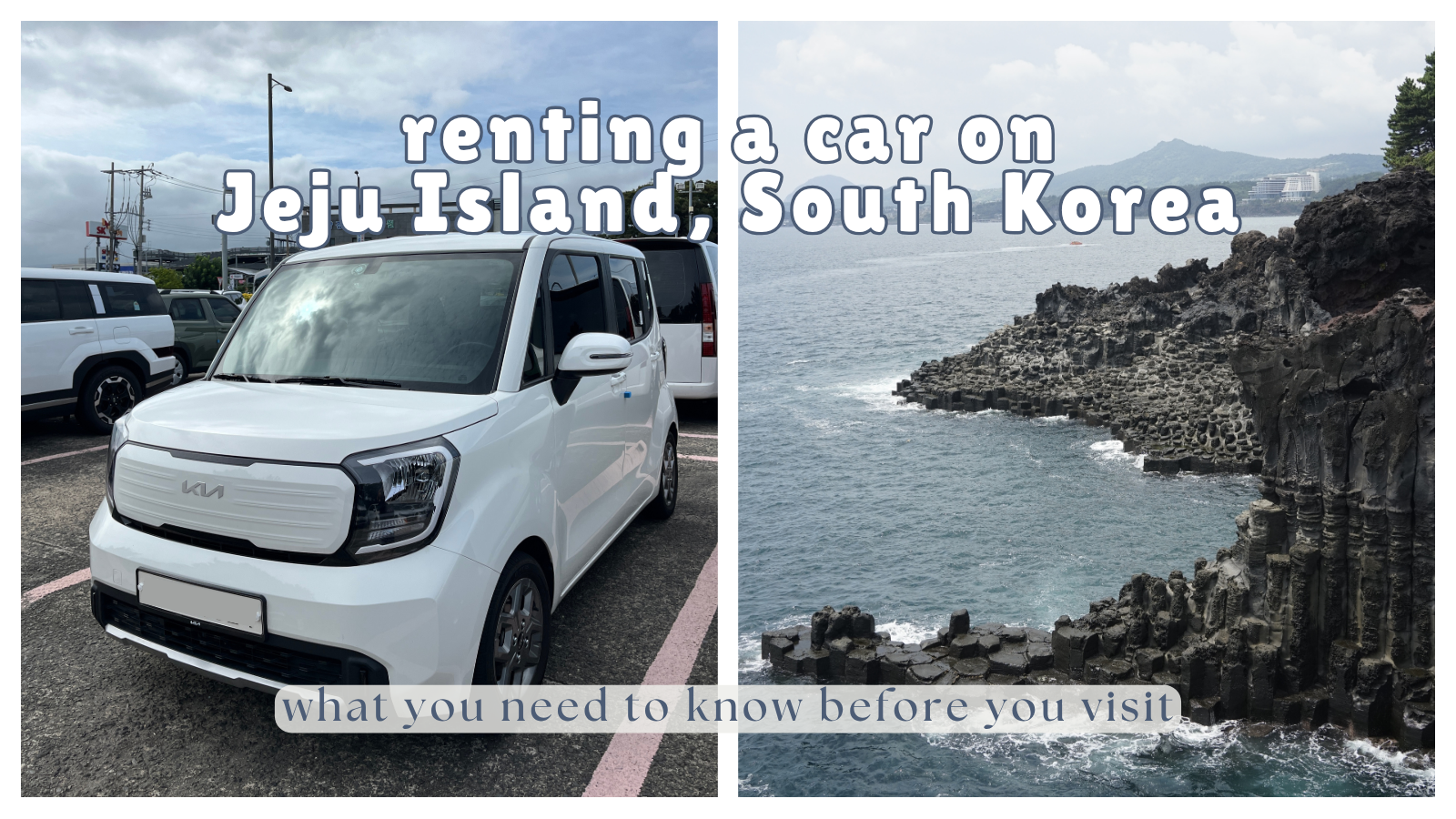
I’ve just returned from 5 days travelling around Jeju Island in South Korea and my main advice for anyone going is: rent a car… Jeju is surprisingly large and the places you’d want to visit are scattered all over the island. Having your own car means exploring at your own pace, stop at different viewpoints or cafes when you spot them and change your plans when the weather turns. Most importantly, it means not spending hours on figuring out bus connections.
Driving in Jeju isn’t as clear cut, I found. As someone who has driven all over Southern Africa, I was a little intimidated by driving in Jeju. It didn’t feel as plug and play – picking up your rental car and following Google Maps. There were a couple of things I wished I had known before arriving… and I’m here to share those lessons with you.
Read on if you’re planning on renting a car or if you’re unsure if you need to rent a car!
Disclaimer: Some links earn me a small commission – same price for you, slightly less tragic bank balance for me.
Renting a car in Jeju? Don’t forget:
-
- International Driving Permit
- Original driving licence
- Passport
- Credit card
- Naver Map downloaded
- Travel insurance check
- Time for the airport shuttle and rental process

Do you need a car in Jeju Island?
If your plan is to explore beyond the main towns, I would personally recommend renting a car. Sure, you can travel without one. There are public buses, taxis and organised tours – these can work perfectly well if you only plan to visit a few attractions. However, having a car gives you so much more flexibility. We found that many of the attractions aren’t clustered together and take time to get between them.
Having a car allows you to do plenty! Like exploring the island independently, visiting several attractions in one area, randomly stopping somewhere scenic, driving one of Jeju’s many coastal roads and travelling at your own pace. I reckon if you’re visiting Jeju for several days and want to see different parts of the island, I’d rent a car if you’re comfortable driving abroad.
Is driving in Jeju difficult?
In the beginning, I felt like I was completely out of my depth. I couldn’t understand most road signs, the constant change in speed limits and just being unfamiliar with the roads made it feel more complicated than it actually was. After a day of driving, it wasn’t as daunting as I made it out to be since I had become more familiar.
Like most of Europe, you’re driving on the right hand side of the road and the general road systems are straightfoward. Once you’re out of the busier areas around the cities, driving can be quite relaxing. It’s navigation and understanding how long journeys actually take that actually is a bit more challenging. At first glance, Jeju looks fairly compact but distances are deceptive. You can spend a surprisingly large chunk of your day driving if you plan poorly.
That’s why I’d strongly recommend planning your itinerary geographically. Don’t look at a map and think: These places look close! I can visit them all today.” But more on that later…
Renting a car at Jeju Airport
The most common way to arrive on Jeju island is by flying into Jeju International Airport. Naturally, most visitors will collect their rental cars near the airport. Something worth noting: your rental company’s actual office + car park may not be directly outside the airport terminal. Many rental companies operate from locations a short distance away, with dedicated shuttle buses operating between the airport and rental centre. So don’t panic when you arrive and realise your rental car isn’t sitting outside the terminal waiting for you! Follow your rental company’s instructions for where to find the shuttle.

Give yourself time for the rental process
Like most rentals go, I’d allocate more time than you think. Because you’ll probably need to:
-
- collect your luggage
- find the rental company’s shuttle
- travel to the rental centre
- complete the paperwork
- inspect the car
- set up navigation
- work out how to drive the car + get used to it
- figure out where you’re going
If you’re arriving after a long flight, don’t immediately schedule a packed sightseeing itinerary. Your priority is getting oriented.
Automatic or manual car?
Personal preference: I’d rather drive a manual.
However, in South Korea, rental calls are almost always automatic transmission. I didn’t recall an option to select manual during the rental booking process. In many ways, automatic may be a better option since it lets you concentrate on the roads rather than changing gears. If you are unsure what transmission you’ll be getting, it’s always worth reaching out to the rental company to confirm.
What side of the road does South Korea drive on?
South Korea drives on the right-hand side of the road – like 75% of the world. If you’re from the UK, Australia, Singapore or another country where you normally drive on the left, this is something you’ll need to consciously think about when you first get behind the wheel. Take the first 15 – 20 mins slowly. The roads in South Korea are well marked, there’s always signs on the roads so it’ll be easy to remember which side to drive.
It’s worth noting that the roads surrounding the airport are pretty busy. If you’re arriving at peak traffic time and that makes you nervous – give it a while to calm down before hitting the road. It’ll get better with practice!

Korean road signs: what do you need to know?
I was quite worried about how I would be able to navigate the roads in Jeju. Fortunately, major road signs are generally in Korean with English below, particularly around popular tourist areas. You’ll also see familiar international road symbols. But you’ll eventually encounter some Korean only signs. If you’re unsure, pull over (safely) and decipher it with your translation app. That being said… this is where having reliable navigation becomes much more important!
Road camera
I was a little taken aback by this but the car is fitted with a road camera that automatically records when you start the car. It’s not something I’ve particularly used back home. But it’s useful for the company to see if you had broken any rules or were in any accidents during your rental period.
Car insurance in Jeju: what should you get?
Honestly, this is one place I’ve learnt to never skimp on for a few pounds a day. Rental car insurance options vary between companies so it’s always worth reading the T&Cs carefully before accepting or declining coverage. The part I always check is the excess/deductible. Other line items worth paying attention to are: collision damage, theft, tyre/window damage, roadside assistance and exclusions.
Tip: If you have travel insurance, verify that rental cars are covered under your agreement and what type of coverage you’ll get.
We’ve made it a force of habit to document any existing damages – it’s a 5 min job and it can save a lot of stress later. I document it with both photos and videos.
What to check before leaving the rental centre
This is something you’d want to do before leaving the rental company’s car park. Otherwise, it’ll be easy for them to argue that any damages were sustained by you. Before driving away, I always do this quick checklist:
Take photographs or video of the car before driving away.
-
- front
- rear
- sides
- wheels
- mirrors
- windscreen
- interior
Rental car checklist
-
- Photograph the entire car
- Check existing scratches/dents
- Check tyres
- Check fuel level
- Confirm automatic/manual
- Check where the lights and indicators are
- Set up your navigation
- Save your accommodation
- Confirm how to return the car
- Ask about tolls
- Ask what to do in an emergency
- Check the rental company’s emergency number
I know it sounds like a lot but it will give you a piece of mind while on the road. Take a deep breath in and enjoy your road trip knowing you’ve already covered yourself!
Returning your rental car
I would advise on avoiding dropping the car off at the last possible minute if you’re catching a flight. Remember that you may need to:
-
- refuel
- return the car
- have it inspected
- take the rental shuttle
- get to the airport
- check in for your flight
The car inspection and return are really efficient. By the time you arrive into the parking bay, there is already a team inspecting the car. Just worth knowing that Jeju Airport can also be busy. I’d rather have an extra hour at the airport than be frantically trying to find a petrol station while watching your departure time disappear.

Navigating in Jeju and South Korea
Back home and in many parts of the world, I’m accustomed to navigating with Google Maps. However, in Jeju and the wider South Korea, definitely don’t rely on it! You’ll come to find that you can’t actually navigate with Google Maps, especially for driving routes. The app has some serious limitations in South Korea. I’ve come to find out, it’s because the South Korean government restricts the export of map data overseas.
Instead, you’re better off downloading South Korea’s equivalent to Google – Naver Map. It’s probably the most useful navigation app for travelling around South Korea and provides a much better map and routing options. You can search for destinations using:
-
- English
- Korean
- copied Korean place names
- business names
Parking in Jeju
Parking was one of the things I found considerably less stressful than I expected. Many major tourist attractions have designated parking areas and you’ll also find public parking around restaurants, cafés and beaches. However, don’t assume every attraction has unlimited free parking. In busier areas, particularly around popular attractions and beaches, parking can fill up!
My general advice: if you’re going somewhere popular, arrive earlier in the day.
Generally, I was a little confused with some of the parking options, especially around some small cafes or restaurants. Many cars were parked on the side of the roads and didn’t feel like actual car parks. What’s worth doing is checking with the staff if you’re actually supposed to park there rather than leaving the car somewhere that looks convenient.
Once you’re on the road
What about petrol stations?
Petrol stations are pretty abundant all across the island. They are usually situated along major roads. However, they may be a distance between them. Don’t make the mistake of waiting for the fuel light to come on before looking for one. If you’re heading into a quieter part of the island, fill up when you have the opportunity. This is especially important if you’re planning a coastal drive.
As always, check what type of fuel it takes before leaving the rental centre. You’ll most commonly receive a document with this highlighted so it’s hard to miss.
There are two types of petrol stations we found on Jeju. Self and a normal petrol station. Self petrol stations are essentially self-service where you fill up your car independently and there are no service attendants. I did struggle trying to use the machine despite it being in English. However, if you’re planning to fill up your car, opt for the full tank (150 000 KRW) option. This isn’t necessarily the amount you’ll pay for your fuel. The machine can place a temporary 150 000 KRW pre authorisation on your card and then charge the actual amount of fuel used. Alternatively, you can fill up either by how many liters or by the cost.
A “normal” petrol station has an attendant there filling up your car. Petrol at these stations costs a little more compared to a self-service station.
What are the roads like?
Jeju has quite a range of road types – major multi-lane roads to narrow country roads. I found the country roads pretty straightforward to drive compared to the main routes. That’s mainly because of how many lanes they have and how signage intensive it was. You might not find that, however. There are several different speed limits and they change quite often – from 30 (school/silver zone), 50km/h to 60km/h or 70km/h. Personally, I felt like the changes in speed limits was constant and with all the speed traps around, something you really need to keep an eye on!

Tolls?
One thing that makes it really simple is that there are not tolls or toll booths on the island! So you’re free and easy driving around without having to worry. Although, it may still be worth carrying some small cash for parking.
Turning right at a red light?
One thing that confused me was that in South Korea, you are legally allowed to turn right at an intersection provided there are no oncoming cars and pedestrians are at the crosswalk. It took me some time to get used to and even so – still felt wrong doing!
Should you use a rental car’s built-in navigation?
Personally, I abused the car’s built-in navigation system. It already uses the Naver navigation so it was really up to date of what the roads would look like and which lanes I would need to be in. I’d recommend you use it. But definitely have Naver Map app installed on your phone as a backup. Just ensure that your phone is mounted safely and you aren’t physically holding it while driving.
Do you need an International Driving Permit for Jeju?
Yes!!! Especially if you’re visiting South Korea as a foreign traveller. I’ve never had to hold an International Driving Permit (IDP) throughout my travels… however in South Korea, it is a requirement. When picking up your rental car, you’ll need to present your IDP alongside your valid domestic driving licence. You’d need to sort out your IDP back home, before your fly.
There’s a lot of discourse online about some rental agencies accepting a 3-year valid IDP under the 1968 Vienna Convention. But not everyone will. It’s best to have a 1-year valid IDP (1949 Geneva Convention) instead. You can only obtain an International Driving Permit from your home country (or country where your license is from). Not all countries can obtain an IDP. You can find a quick list of countries which can obtain an IDP here or alternatively check with your local traffic authority.
These are also a list of other things you’ll need when renting a car in Jeju and South Korea:
-
- your driving licence is valid
- your IDP is valid during your travel dates
- the name/details match your passport
- you meet the rental company’s minimum age requirements
- you have the required payment card for the rental
Planning your road trip around Jeju

How long does it take to drive around Jeju?
This is what tripped me up. Just by looking, I would’ve thought you could easily drive the whole island in a day. I mean – yes you could but it will take a lot longer than your expect. The island itself is 70 km lengthwise (W-E) and 40 km widthwise (N-S). It took approx 1.5 hrs to get from Jeju Airport to Seogwipo. I think the amount of traffic lights and varying speed limits really do factor into your driving time. So, a better way to think about Jeju is by region.
Southern Jeju
Seogwipo → Jungmun → Sanbangsan. This is an easy region to explore over a day or two.
Western Jeju
Aewol → Hallim → Hyeopjae → southwest coast. Again, very manageable as a dedicated day.
Eastern Jeju
Seongsan → eastern coastline → surrounding attractions. Better treated as its own day.
Northern Jeju
Jeju City and the surrounding coastline.
Do you need a Korean SIM or eSIM?
I’d absolutely recommend having reliable mobile data. You’ll be using and abusing the Naver Map, translations, finding spots along the way and checking the weather app constantly. While you could probably get by without an eSIM, it will dramatically reduce your stress levels being able to easily access information. If you’re travelling around South Korea for more than just Jeju, an eSIM can also make sense for the rest of your trip.
I’ve got a special discount for you if you sign up to Airalo – use discount code CAROLI5774 for $3 off your first purchase.
The biggest mistakes to avoid when driving in Jeju
Trying to see the whole island in one day – Jeju is bigger than it looks.
Relying on Google Maps – Download Naver Map before you arrive.
Planning attractions without checking their location – Look at the entire day’s route.
Underestimating driving time – A 30 km journey isn’t necessarily a 30 min journey.
Booking somewhere based purely on how cheap it is – Check whether it has parking and whether the location actually works for your itinerary.
Forgetting your International Driving Permit – Sort this before travelling.
Leaving the fuel tank until empty – Fill up before heading into quieter areas.
Driving tired – If you’ve spent all day sightseeing, don’t force yourself to drive another two hours because you added “one more attraction” to the itinerary.

Is renting a car in Jeju worth it?
Hands down, yes. Having a car made our Jeju road trip soooo much more easier. While we had a general idea of where we’d be visiting that day, it gave us the flexibility to change plans according to weather or if we found something interesting along the road. We could drive close to viewpoints, spend as long as we wanted at an attraction, stop for coffee when we felt like it and head back to our hotel when we’d had enough. That’s exactly how I think the island should be explored.
Sure, you might see a lot more with a tour group but that’s just it – you’re kinda “stuck” with that group for the duration of your tour and there’s not really any flexibility built into the itinerary. You could definitely manage with public transport but some places are just a bit more enjoyable when you have freedom and flexibility.


Leave a Reply