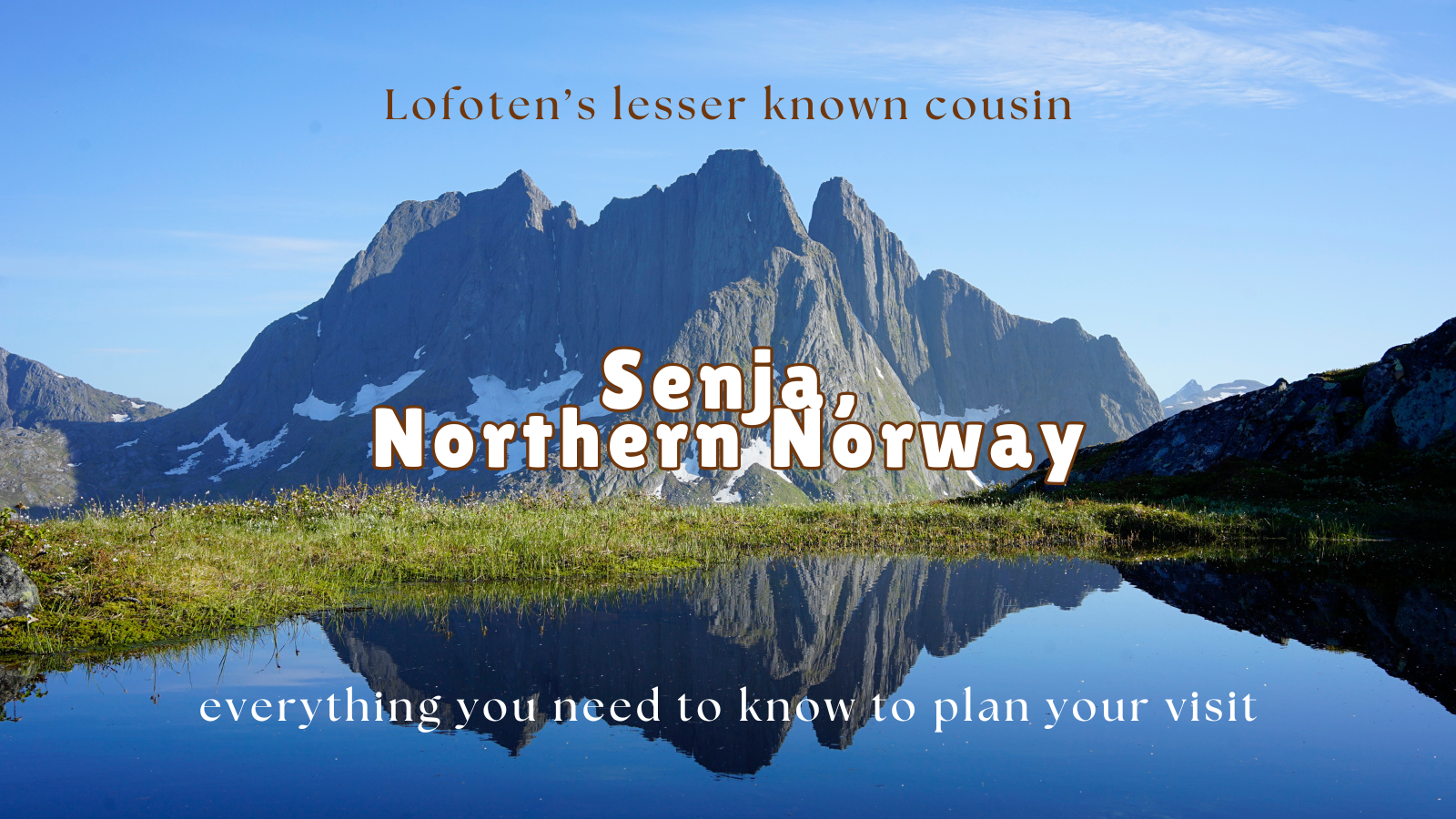
Planning a trip to Senja, Norway? This complete Senja travel guide covers everything you need to know: how to get there, where to stay, when to visit. If you’re looking for a quieter, less crowded alternative to Lofoten, this is it!!!
Senja – Norway’s second largest island (after Spitsbergen, Svalbard if you count the whole country). Somehow, it still flies under the radar. It’s big, wild and ridiculously dramatic. Yet, you can drive across it in a few hours. It’s famous for its mountainous skyline. It is the type of island people imagine Norway looking like: jagged peaks, picturesque fishing villages, narrow fjords and hikes for days.
During the peak of COVID, I kept my travels local to Norway. What a fantastic decision that was… It might actually be one of my favourite places in the country. So why spill the secret? You might know its more famous cousin – Lofoten. And it is an absolutely beautiful part of the country but the overtourism it is facing is becoming a significant issue. It is straining local infrastructure and harming the fragile Arctic ecosystem we have.
Understandably, I fit into this issue of writing things like “Visit Lofoten!”. To address this, here is my offer as a Lofoten alternative: Senja. But let’s keep in mind: responsible tourism starts with us. Here is your guide – everything you actually need to plan a trip, built around the idea of creating a proper Norwegian summer: slow travel, long days spent outdoors and spending time appreciating nature.
I’ve already covered a lot of the hikes here. This is for everything else.
Disclaimer: Some links earn me a small commission – same price for you, slightly less tragic bank balance for me.
Why Senja over Lofoten?
I wouldn’t say one is better than the other. They are both unique in their own way. Apart from the overtourism issue that Lofoten is going through, the islands aren’t too dissimilar. Same same but different – let’s put it that way.
Lofoten is really iconic, which means it is also more crowded. Of course you can find places without anyone but for all the iconic attractions, it’ll be really busy. Because it has been travelled to more, there is more information out there – guides, suggestions, accommodations, cafes, infrastructure. It is an easier island for first timers to the region…
Senja is still relatively “quiet”. This doesn’t mean it is not busy, but it feels less polished. It’s a better option if you’re looking for space, hiking and quiet. That being said, even when I visited in 2022, there was still a lot of campers in the area but you could definitely find plenty of hiking trails that were empty. Maybe it was because I was hiking at midnight?
If hiking is a big part of your trip, this is where Senja really stands out: quieter trails + fewer people. I’ve broken down the best ones in my Senja Hiking Guide.

Where is Senja?
Senja is an island in northern Norway, located in Troms region. It is around 3 – 4 hours drive west of Tromsø. The island sits above the Arctic Circle, meaning it experiences the midnight sun in summer and long daylight hours from May to September. To be honest, even in late spring and early autumn, you’ll still have long days.
Midnight sun: a phenomenon where the sun doesn’t go below the horizon so you get unlimited daylight. Even at midnight, it looks like it’s the late afternoon. Unlike some misconception, it is still the same sun.
Best Time to Visit Senja (Weather & Seasons)
I was incredibly lucky when I was there in the summer of 2022 because the entire time I was there, the temperatures were over 15deg C. There were plenty of days that hit 23degC – which doesn’t sound like much but it was a scorcher! Generally, I’d say if you want to be outdoors, the best time to visit would be May through to September. If you want to experience the midnight sun, June – August would fit best.
General temperatures: prepare for temperatures from 12degC through to 20degC in the summer.
Although it is best to keep in mind that this is also the peak holiday season for Norwegians and Europeans. So the roads will be busy, accommodations might not be readily available and rental cars are expensive!
I would advise visiting during the shoulder season if you’re able to. There are fewer people, the weather is lovely and everything does not feel overly expensive… although, this is Norway after all, so it will still be expensive. Just keep in mind, no matter what time of year it is, rain is always a possibility!

Packing tips
The Norwegian weather along the coast can be turbulent. All throughout the year. The wind can be really strong and sometimes you’ll get rain. Sometimes, a lot of rain.
Pack yourself a good quality waterproof and weather proof jacket to use on your hikes. Bring plenty of layers – a tshirt, thermal, fleece and jacket should do you.
How to Get to Senja, Norway
Most common option: Fly + drive
The closest major airport is Tromsø Airport (airport code: TOS). You can get here by flying with any of our major airlines – Scandinavian Airlines (SAS), Norwegian Airlines or Widerøe.
Once at the airport, you can rent a car and you’re off. The actual time taken to drive to Senja depends on which route you take.
Route one: Ferry route
I would recommend taking this route for a shorter drive to Senja. It will involve a ferry crossing: Brensholmen → Botnhamn ferry or Route 181. It’s a reasonably short ferry, only taking about 35mins. When I took the ferry in 2022, the ferries were only operational in the summer months. However, I’ve just confirmed this: the ferry is now operational year-round (except on public holidays). The cost for a standard car is approximately 228 NOK and free for passengers. The drive is very scenic, meandering along the coast.
Check here for the Brensholmen → Botnhamn ferry schedule
Route two: The long way around
This drive is through the cities and it takes about 4 hours to drive to the northern part of Senja. You’ll drive to Finnsnes, crossing the Gisundbrua/Gisund Bridge. However, if you’re taking this route, you have the option to slowly discover other parts of the island and Ånderdalen National Park. This route may be your option if the ferries are cancelled due to weather or it is a public holiday.

Do you need a car in Senja? (Getting Around)
In these parts of Norway, I would recommend renting a car. Here’s my argument for it… Having a car will give you the freedom to explore different parts of the island and stop in beautiful scenic spots along the way. Thinking of hiking at midnight? Not a problem. Want to stop at a random arctic beach for a dip? Sure, go on. Want to drive endlessly to admire the scenery? That’s what our landscapes are for.
Unfortunately, while there is some public transport options, they are extremely limited and a bit impractical for a roadtrip like this. They are not as regular as you would expect.
Roads are generally good. As they are country roads, they can be narrow and winding. Just be careful and don’t try to take the turns too quickly. We do have some wildlife (elk) but there is also a lot of farm life around. In the summer, you’ll have endless golden light so there’s no real rush. In the winter, roads can be icy and daylight is limited.
Generally, fuel is available. Regardless, my best advice is to always fuel up when you get the chance to. While the distances aren’t massive, you do use a lot more fuel whilst meandering through the mountains.

How many days do you need in Senja?
If you want to see the highlights, you could probably do it in 3 days.
However, if you want to take your time, do all the hikes and slow down, I’d say about 5 – 7 days. But that’s considering if you like lounging on the mountain tops and you’re not trying to rush between locations! That being said, everyone is different.
If we meet in the middle, 4 – 5 days might actually be the sweet spot. You can combine this with visiting Tromsø for a week long getaway.
Accommodation
Wild camping
In Norway, we have something called allemannsretten: the right to roam. It is something that is unique to us. However, I’ve seen so many people abuse it. So allow me to properly introduce it to you.
General rules to wild camping anywhere Norway:
-
- Be considerate & respectful wherever you go.
- Be at least 150m from houses
- If you’re camping on farmland, it is polite to ask the owner if you’re allowed to camp there
- Stay up to 2 nights, max.
- Leave no trace. Actually, you should leave the place better than you found it.
- Take all your trash with you. Yes, this means your toilet paper. Please don’t discard it on the ground!
- If nature calls, try find a restroom. If you are out of luck, you should go at least 200m from any freshwater sources or streams.
- Open fires are prohibited from April 15 to September 15.
Majority of the land in Norway is public so anyone has access to it. No, this doesn’t include someone’s backyard – that’s still private. What it does include are the forest, beaches, national parks, mountains. Camping in a park is not allowed and is frowned upon.
When I wild camp, I try to go somewhere off the main road and be hidden from public sight if possible. Sometimes, it’ll mean parking my car (legally) and hiking to a spot. Our right to roam is valid to people, not cars or motorhomes. What that means is that you shouldn’t decide to go 4×4 just because you feel like it.
Campsites
These are a staple when doing a road trip around Norway. You’ll find campsites dotted along the place and they are a great option if you don’t have all your own camping supplies. They have facilities so while you’re on a budget, you don’t have to sacrifice all the creature comforts.
At these campsites, you can either pitch your tent or rent one of the cabins (hytte) onsite – which include bunk beds and occasionally a kitchenette. They are a more affordable option if you don’t want to splurge on a rorbuer.
Traditional Cabins (rorbuer)
There are little cabins dotted along the Norwegian coast and Scenic Route.. You’ll also see the iconic rorbuer (traditional fishing cabins once used by fishermen). Many of these are available for rent. These are a lot more comfortable and a very scenic option. Of course, they do cost quite a bit more than wild camping. A great option if you don’t feel like “roughing it” or bringing your own camping gear.
For some of the popular spots, it might be worth reserving ahead of time. But sometimes you might get lucky because there are a few locally owned cabins that aren’t online. Just look for the word hytte on a small wooden sign and you’re on the right track.
Hotels
Yes, in some towns, these are an option too! Whilst they are more expensive, they might be the most comfortable option. Although, I would argue they aren’t necessarily as cosy as a hytte.

The backbone of your trip: Norwegian Scenic Route Senja
A lot of the best hikes actually sit just off this route, which makes it really easy to combine driving with short (or very steep) detours. If you want specifics, I’ve mapped them out in this guide to hiking around Senja.
Once you get onto the island at Botnhamn, you’ll be cruising along the Norwegian Scenic Route: Senja. And boy, is it scenic!!! The main part of the route runs between Botnhamn and Gryllefjord (±80km) and takes almost 1.5hrs to complete. Truly, it isn’t a long route but you’ll spend such a long time discovering little fishing villages on roads that offshoots from the main route.
Like many good scenic routes, there are a few stops that make the journey so beautiful:
-
- Tungeneset: a boardwalk along the coast with an unbeatable view of Oksen – but more popularly known as Devil’s Jaw
- Bergsbotn: This 44m long viewing platform gives you a view over Bergsfjord.
- Ersfjordstanda: You’ll come to learn that we have white sandy beaches in Norway too… except they are Arctic beaches. It looks so tropical, you might forget it is freezing!
- Plenty of beautiful hikes.
What else can you do?
Realistically, you could spend your entire trip just hiking. If that’s your plan, I’ve already done the groundwork for you here best hikes in Senja guide. Now you need to figure out some “filler” things to do between your hikes. Honestly, I can’t consider them as filler things because you can spend your whole trip just around it.
Enjoy the midnight sun to its fullest
There was a few occasions where I did start hiking until 9 pm. Yes, at night. Why? Because I could and the sun was still up so why not. There are almost no people on the trail, you can take your time and find a spot to just sit at for hours. Literally, what I had done so many times.
Go for a swim under the midnight sun. Why not! I find it so peaceful at “night”. Depending on where you’re from, you might not have this experience back home so you might as well fully enjoy it. After all, this is what makes northern Norway different.
Join a tour
I understand not everyone is as comfortable exploring the mountains or going down back roads like I am. And that’s completely fine! There are quite a few tour companies on the island that you could join. I’ve found a few companies with good reviews and interesting activities for ya! Click through above to discover more.
Chase beaches
Like I said, you will come to find that we have some tropical looking beaches in Norway, especially in the Arctic. But don’t be fooled, while it may look nice, warm and very inviting – it can be freezing! Water temperatures don’t warm up too much around the country but in the summer it gets about ±15 deg C.
Drive with no agenda
Yep. This is the main activity. Between my hikes, all I did was get in the car and drive around. Discovering little hamlets and just going wherever there was a road! You’ll pull over constantly. It’s safe to say, you’re suppose to!
Hiking in Senja
Hiking is one of the main reasons people come to Senja. It was what attracted me to the island in the first place. The trails are steep and the views are ridiculous. The number of times I hiked and I had the views ALL TO MYSELF. Spoilt. If you love spending time in nature, I honestly cannot recommend hiking in Senja more. I’ve put together a detailed breakdown of the best routes: including difficulty, trail conditions and tips here: Complete hiking guide to Senja.

Other things worth noting:
Weather (again)
Like many places along the Norwegian coast and mountainscapes, the weather can change really quickly. Don’t underestimate the weather and always check the forecast before heading out. If you’re already on the trail and the weather turns, there is no shame in turning back. The last thing you want is to be stuck on the mountain, underprepared and exposed to the elements.
Horseflies
Horseflies are horrible. We call them klegg and their bites are so painful. They will follow you during your hike and once you stop, they will attack. I lost count how many bites I had within my week of being up in Senja. Gross. My only suggestion to them is to wear a long sleeve top/pants to avoid them landing on your skin!
Distances
Sometimes on the map, driving distances may look short on the map… in reality, it might take you a bit longer than expected. Our speed limits at 80 km/h on country roads and with the windy roads, you might drive slower.
Hikes
A lot of hikes in Norway actually have an aggressive incline. So before you head out, either check out the sign boards or Alltrails for the trail information so you know what to expect.
Things take time
You will be stopping every 5mins because everything is unbelievably gorgeous. Accept and embrace it.
Public WIFI
Sometimes, this isn’t the easiest thing to find. In some accommodations, there might not be any WIFI so you’re better off having an eSIM. Airalo has been a trusty one for me during my travels.
So, see you in Senja?
Senja has such a special place in my heart. Before visiting, I didn’t know too much about it but ever since that COVID summer, I haven’t been able to stop talking about it. While it doesn’t have the same level of infrastructure as Lofoten (and thankfully not the same amount of visitors, yet), it is a beautiful part of the country.
While I can tell you exactly what to do and where to go, Senja is best explored at your own pace. There’s no need to go between curated stops. Figure things out as you go. Pulling over when something looks too good to be true and you build your own version. If you want a proper Norwegian summer, this is somewhere I can recommend.

FAQs About Visiting Senja
Is Senja worth visiting?
Yessssss!!!!! Especially if you want a quieter alternative to Lofoten with equally dramatic scenery. The crowds are less and the views are stunning.
How do you get to Senja?
The easiest way is to fly to Tromsø, rent a car. Then either take the Brensholmen–Botnhamn ferry or drive via Finnsnes.
Do you need a car in Senja?
Unfortunately yes. Public transport is limited and not practical for exploring the island.
When is the best time to visit Senja?
June to August for summer and midnight sun! Or May and September for fewer crowds.



Leave a Reply