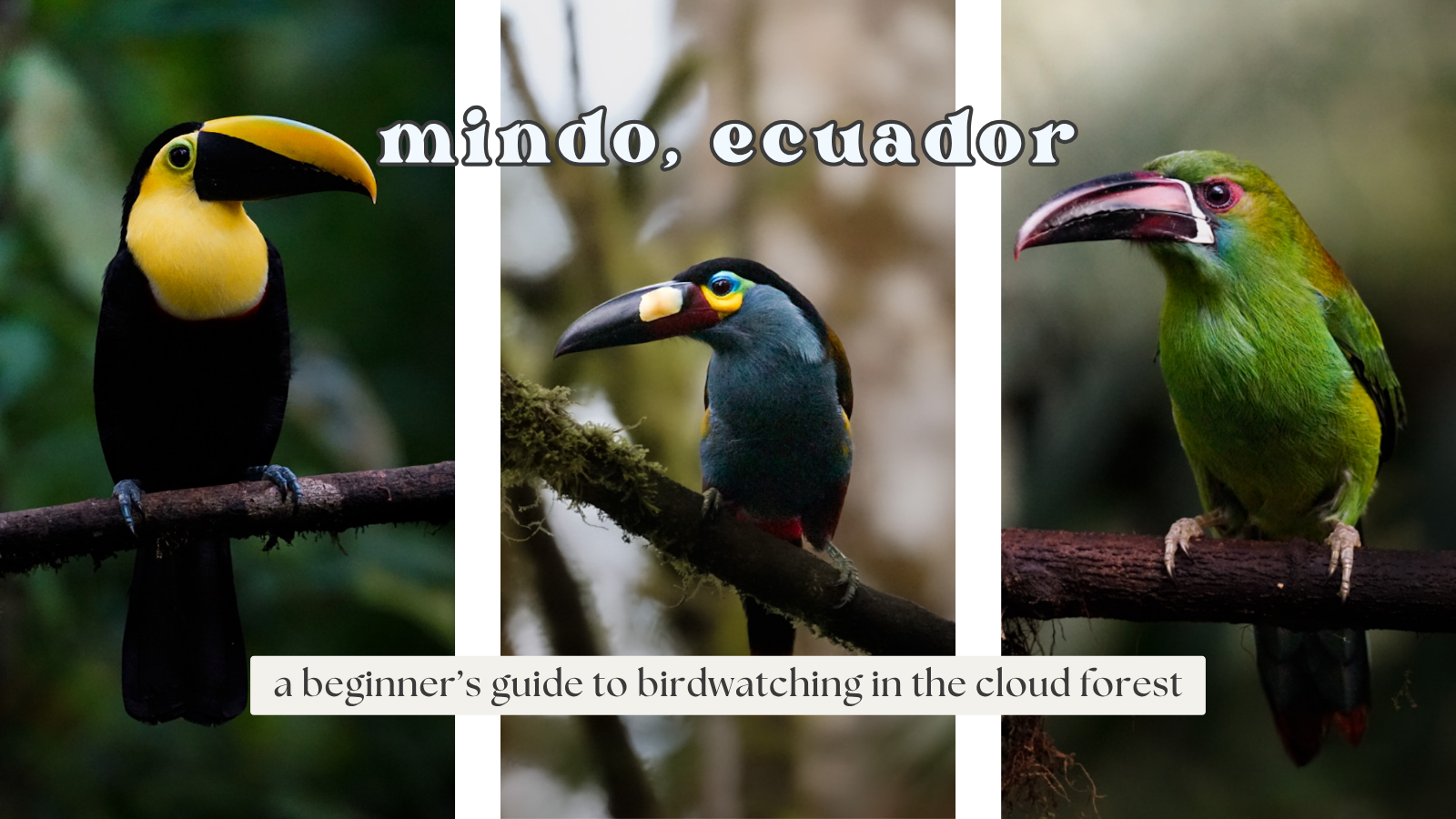
Birding in Mindo may be one of the best birding experiences you can have in South America.
Have you heard that I identify as a birder now? Let’s not get that extreme but I have found a new appreciation for our feathered friends. It’s one of those things that hits you as soon as you turn 30. Yikes. But in all seriousness, it’s an amazing hobby to have. The downside for others is that you’ll keep telling everyone how cool birds are.
My obsession started as a joke because I was practicing wildlife photography on the birds at home. Fast forward a year and I’ve found myself waking up before sunrise in Ecuador… excited to see some birds. I had previously introduced some affordable birding locations in South America… Something worth knowing is that Mindo can either be affordable or cost a pretty penny to go birding. It truly depends on what you’re trying to see and how serious a birder you are.
We tried to experience both affordability and a specific birding tour. Actually, Mindo was my first proper birding tour. Now, I can see why people enjoy it. In Mindo, incredible birdlife exists everywhere from lodge balconies to roadside feeders and short forest trails.
Disclaimer: Some links earn me a small commission – same price for you, slightly less tragic bank balance for me.

Why birding in Mindo, Ecuador is so special
Mindo sits in Ecuador’s cloud forest within the western slopes of the Andes. It is part of the Chocó bioregion, one of the most biodiverse ecosystems on the planet. Within a relatively small area, over 500 bird species have been recorded here. This is thanks to its range in altitude, from 1000m to 3000+m above sea level.
What makes Mindo special is just how accessible birding is. You don’t need to be a hardcore expeditioner trekking for days. A lot of birdwatching around the world can feel intimidating to beginners. Mindo doesn’t feel like that at all. We saw so many amazing species from short forest trails, feeders, lodge balconies or lodge birding hides. I think anyone would be a birdwatching convert after visiting Mindo.
Is Mindo good for beginner birders?
Yes, I would definitely say so. It’s probably why so many people become interested in birding after visiting. But what makes Mindo special is that beginners and experienced birders can enjoy the same locations together.
One of the biggest challenges for beginners is that birdwatching can sometimes feel… unrewarding. You spend hours looking into trees… wondering what everyone else is seeing.
Mindo is the opposite of that. The amount of bird activity here means new birders are rewarded early. You’ll constantly notice movement, colour and sound around you. Even if you don’t know what species you’re looking at, the experience still feels exciting. The feeders throughout Mindo also make things far easier for beginners. Instead of spotting distant silhouettes high in the canopy, you’re often seeing birds up close with incredible views. You’ll probably end up spotting several lifers!
Lifer = a bird species seen for the first time in your life.

It’s the kind of place where:
-
- hummingbirds dart past your head,
- tanagers gather around fruit feeders,
- toucans suddenly appear in nearby trees.
For experienced birders, Mindo still has enormous appeal. Species like the Andean cock-of-the-rock, long-wattled umbrellabird and golden-headed quetzal are genuine target birds for many visitors.
Best birds to see birdwatching in Mindo, Ecuador
Hummingbirds are usually the gateway obsession here. Many lodges and reserves have feeders attracting multiple species throughout the day, making it one of the easiest places to observe and photograph them closely. Beyond hummingbirds, you also have a good chance of seeing:
-
- toucans and toucanets
- tanagers
- motmots
- quetzals
- woodpeckers
- flycatchers
A lot of people wonder if it’s worth it and my answer will always be yes. You’ll see many interesting species. Many of which you might not have seen before.

For my more experienced birders, you’ll have a realistic chance of seeing:
-
- Andean cock-of-the-rock
- long-wattled umbrellabird
- plate-billed mountain toucan
- crimson-rumped toucanet
- golden-headed quetzal (!!!)
Do you need a birding guide in Mindo?
Apps like Merlin Bird ID have made self-guided birding much more approachable. Just keep in mind that it can’t identify a lot of the birdsongs yet… Many reserves are well set up for casual visitors. If your goal is simply to enjoy birdwatching and experience the cloud forest, you can absolutely do that without hiring a guide.
That being said, hiring one will significantly increase the number of species you see.
Experienced birding guides can identify calls almost instantly, locate difficult species and know where specific birds have recently been active. If your goal is to maximise species count, identify the birds accurately or even see specific birds – then yes, a guide is going to be valuable. Although not all guides are created equally. You can find all agencies offering a basic birding tour but it’s a lottery if your guide speaks English. One thing that disappointed us about Mindo was the lack of birding-specific tour agencies. We did find Sandra from Mindo Birds of Paradise Tours.
For many travellers, the best approach is combining both:
-
- independent birding at feeders and trails
- a few guided mornings for harder to find species
Best time for birdwatching in Mindo?
What I’ve been told is that birdwatching in Mindo is good all year round. Seasonal variation exists. But it’s not the kind where timing incorrectly could mean missing out entirely, from what I understood. You do have the drier months of the year (June to September) which makes the trails easier as they aren’t muddy. But you can still spot plenty of birds during wet season. You’re after all in the cloud forest, so moisture is expected regardless so it doesn’t seem to impact the birds as much.
Best time of day for birding
The more important factor is time of day. Expect early mornings in Mindo! The best time of day is to be on location by 6:00 am. Most birding tours start at 6:00 am and go to about 10:00 am. Birds are more vocal, feeding and moving through the forest more in the mornings. Late afternoon (3:00 pm) can also be productive, though typically less intense than the morning window.

Bird photography in Mindo
Even if you’re not a serious bird photographer, Mindo is one of the most rewarding places to work with birds. The lodges and reserves have actually created setups specially designed for photography, with natural perches and close viewing opportunities.
For me, the biggest challenge quickly becomes storage space. The hummingbirds alone are addictive to photograph and extremely challenging subjects with constant movements. One moment they appear almost motionless and the next they vanish. I lost track of how long I spent sitting beside feeders trying to photograph them perfectly.
If you’re interested in wildlife photography, Mindo is honestly one of the best beginner-friendly places to practice. It’s also worth noting that patience still applies. Even at feeders, bird behaviours vary.
Is birding in Mindo worth it?
Mindo has a reputation within the birding community for a reason. It offers biodiversity and accessibility which is hard to find in some other places. If you’re new to birdwatching or an avid birder, the outcome is usually the same… you’ll leave paying far more attention to your environment than before. The only issue is that it will probably ruin birding for you but in the best possible way.
My experience birdwatching in Mindo
I personally thought I would do other activities in Mindo as well. Turns out, that wasn’t the case. Within the day, I had planned a couple of birding tours, started waking up before the sun and got excited over any birdsong or movement! Please don’t look at how many photos of the same hummingbird I’ve taken because I thought – maybe the lighting is better now…. Honestly, I think if you’re unsure about birding, Mindo will change your mind about it.
Tips that will genuinely improve your experience
Birding in Mindo is less about covering distance and more about slowing down. Moving too quickly often means missing subtle movement or birdsong entirely. More often than not, it’s a slight flick of a leaf or a branch shifting that gives a bird away before you ever see its colour. And while some people turn their nose up at feeders, they’re far from “cheating”. I believe they’re one of the best ways to observe behaviour up close, especially for species that would otherwise stay hidden deep in the canopy.

Quick summary about birdwatching in Mindo:
Is Mindo good for beginner birders?
Yes. Mindo is one of the best places for beginners because many birds are easy to see at feeders and along accessible trails.
Is Mindo good for birding?
Yes. Mindo is considered one of the best birdwatching destinations in South America…! Thanks to its biodiversity, accessibility and huge variety of species… 500 + odd species!
Do you need a guide in Mindo?
No, but hiring a guide will significantly increase your chances of spotting and identifying rare species.
What birds can you see in Mindo?
Common highlights include hummingbirds, toucans, tanagers, Andean cock-of-the-rock, plate-billed mountain toucan and long-wattled umbrellabird.
When is the best time to go birding in Mindo?
Early morning (6:00 am to 10:00 am) when bird activity is highest.. Birding is good year-round.

Leave a Reply