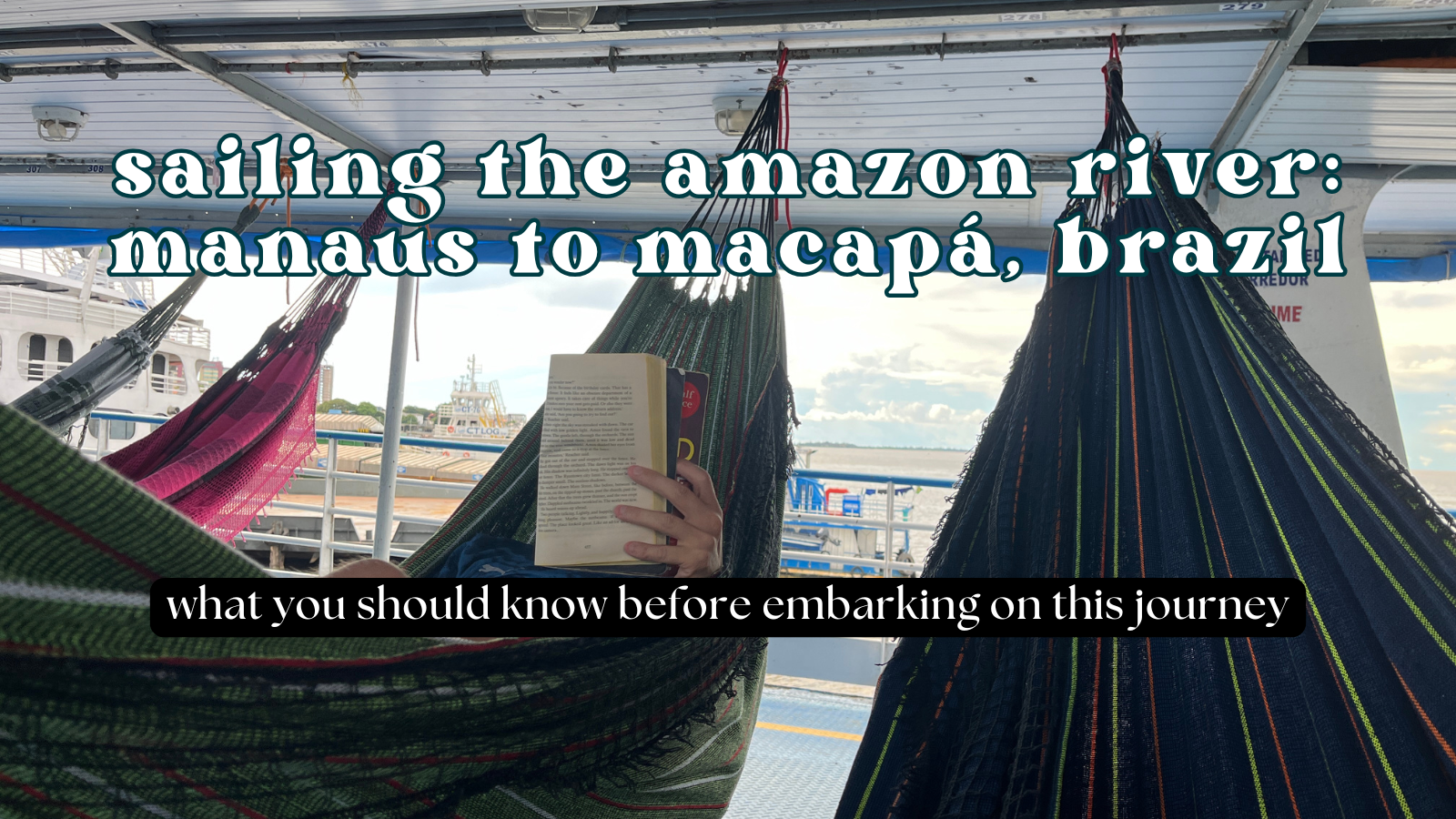
Taking a slow ferry down the Amazon River is what feels like one of the few last “raw” travel experiences left in the world. When I say raw, what I mean is = uncurated, polished or adjusted with tourists in mind. In the age of when people are chasing packaged travel for convenience, others are looking for the complete opposite. That’s us. We wanted to travel through the Guianas without flying as flights are costly… Instead, we opted for the route through the Amazon. It’s truly an experience.
No luxury. No itinerary. Figuring it out as we went. Not being on a tour. Just a cargo boat, a hammock and days sailing through the heart of the Amazon. If you’ve found yourself here, you’re probably trying to figure out the same thing everyone else is searching: Is it worth it? Is it safe? And how do you actually do it??
This is also a great jumping board if you are looking at overlanding to the Guianas. You can easily add this on before visiting the Guianas or after, depending on your route. This guide is designed to answer everything you actually want to know… I’m not here to romantize anything for you 😉
Disclaimer: Some links earn me a small commission – same price for you, slightly less tragic bank balance for me.
What’s the route?
Manaus → Santarem → Santana
Okay, let’s clear up a misconception: you cannot book this as a single journey. There isn’t a direct ferry between Manaus and Macapá. Secondly, you’re actually going to be looking for Santana, rather than Macapá.
Best practice: have some time in Manaus between when you arrive and when you intend of leaving.
Best practice ii: Connections might not align properly so you want to have some wiggle room in your itinerary rather than trying to fit everything on a schedule.
Of course there’s so many different route options you can go for but this is the most commonly used: Manaus to Santarém, then Santarém to Santana (the port city just outside Macapá). Sounds really simple and straight foward but the reality is quite different. But it’s nothing too wild. Things do follow somewhat of a schedule, but it’s not really on time.

How long does the whole journey take?
Well, the answer is gonna be vague. It took us 5 days to do the entire route, with an overnight in Santarem. It will depend as well if you decide to take the “speedboat” or the “local ferry”.
Our itinerary breakdown: Manaus → Santarem (41 hours)
-
- We boarded the ferry in Manaus at 0900hrs on 6th March.
- Departure was 1200hrs (scheduled was 1100hrs).
- Slept onboard for 1.5 nights
- Disembarked at Santarem on 8th March at 0200hrs.
Our itinerary breakdown: Santarem → Santana (37 hours)
-
- We boarded the ferry in Santarem at 1530hrs on 8th March.
- Departure was 1830hrs (on time departure).
- Slept onboard for 2 nights
- Disembarked at Santana on 10th March at 0445hrs.
Going downstream of the Amazon will be faster than going upstream. In reverse, expect to add a couple of days of travel.

How do you purchase tickets for the ferries?
The following information is for ticket purchases for hammocking on open decks. There is an option to purchase the cabins however, I did not experience this at all so can’t give you any information on them, unfortunately.
The best (and often the cheapest) way to do it is actually at the ticket offices. If possible, buy the tickets the day before your intended departure. It wasn’t peak travel season for us so we were able to get our Santarem → Santana tickets a couple of hours before departure without an issue.
You are able to purchase your tickets off Yjara Viagens. To be honestly, I love the website since it has a pretty good overview of the schedules and estimated travel time. But once again, it doesn’t always depart or arrive on time. Prices will vary on the ferry, timings and your route.
The estimated prices per person as of April 2026 are:
-
- Manaus → Santarem Speedboat: 500 BRL (USD $100 / £75)
- Manaus → Santarem Local ferry: 130 – 240 BRL (USD $26 – 48 / £20 – 36)
- Santarem → Santana Local ferry: 300 – 500 BRL (USD $60 – 100 / £45 – 75)
The nuances of the local ferry
Boarding the ferry
We lucked out both our ferries not being too busy. However, if you will be travelling more during public holidays or during a festival, it is advisable to get to the ferry terminal 2 – 3 hrs before departure to snag a good spot on the ferry. We generally were onboard 2.5 hrs before departure.
Sleeping onboard
If you opted for the “cheapest” ticket, you will be sleeping in a hammock onboard the open deck. However, it is BRING YOUR OWN HAMMOCK (and ropes). But don’t stress, you can easily find shops selling hammocks near the ferry terminals. We purchased ours in Manaus at this shop, located on the left of the “Porto do Manaus AM” sign. It cost us 50 BRL for a hammock and 10 BRL for ropes (each) (60 BRL = USD $12 / £9). You can find cheaper hammocks but we felt like ours was a good compromise.
If the area is packed, you will be hanging quite close to your neighbours. There is no privacy and no where to store your luggage so if you’re travelling with a few people, you could strategically position yourselves. We kept our backpacks between us and slept with a bumbag of our cash, wallet and passports.
Where is the best place to hang your hammocks?

This is what worked best for us. It almost feels like a science on where it’s best to have your hammock. Some ferries have multiple levels.
Stern = back. Bow = front. Port = Left. Starboard = Right
-
- First floor are where cargo and cars/motorbikes go
- Second floor is usually where the kitchen is.
- Some ferries, the second floor also can be enclosed with windows and might have an aircon.
- Stern are often where the toilets are located.
- Stern of the top floor = there’s a “bar” playing incredibly loud music
We found that the best location was on the third floor (open deck), in the middle. It’s located away from the staircases, from the toilets, not on the same floor as the kitchen (where there’ll be a queue). Although, the con: if it rains, there’s only blue tarpaulins that will block the rain. Can lead to a noisy nights sleep! We don’t think you’ll need the aircon because while it is hot during the day, there’s a nice breeze throughout the day.
Tip: On some boats, the charging points are between hammocks, on others, there’s only a handful at the end. Look out for their location while you set up your hammock. Bring something to put your electronics in while they are charging. My bumbag worked as my cable was too short.
Toilet & Shower Facilities

Okay, there’s one thing you should know about Brazilians. They shower multiple times a day – makes sense, we did as well because of the heat and humidity! So of course, there are shower facilities onboard. It’s a shower/toilet situation. You will need to bring your own towel and soap. There are not too many hooks to hang up your things.
Tip: I don’t think this is a tip but bring a pair of Havaianas for the toilet situation.
The water used is from the river – if you’re wondering why it looks brown. For brushing my teeth, I used water from my water bottle to be on the safe side. I did feel a little sticky after showering but it could be the humidity as well. Some ferries have cleaner toilets than others. They are generally cleaned pretty often and are well stocked with toilet paper. Don’t flush the toilet paper in the toilets, use the bins.
Comfort level
It actually wasn’t so bad. You sleep in a hammock diagonally but of course after a few days, my back was feeling it. There are a couple of benches dotted around the ferries. We usually just hung out in our hammocks. It could be quite warm during the day but there’s a constant breeze. At night, it actually felt kinda cold? I used my sarong/canga to cover myself. There is no entertainment onboard so bring some things to keep you company.
Food and meals onboard

Yes, there is food onboard and it’s actually really nice. We kept skipping breakfast because we slept in so I couldn’t tell you what was served for those.
For our Manaus → Santarem, lunch and dinner were served at set times and buffet styled. You would pay for your meal by weight. You have your rice and beans staple, two or three choices of meat and a salad. It usually came up to about 25 BRL per person (USD $5 / £3.70).
For the Santarem → Santana ferry, it was a set menu of two choices. A meat, rice, veggie and salad. A very hearty serving of it! We had the soup option for dinner one night and it was really delicious. That was a set price of 25 BRL per person (USD $5 / £3.70) as well.
Tip I: if you have dietary requirements, I would advise bringing some food onboard. If you don’t eat pork, there are options to avoid it. However, if you’re a vegetarian, it’s a bit trickier.
Tip II: at some stops, vendors come on board selling snacks, drinks and other options. So if you forget to stock up, there are opportunities.
You can also purchase some snacks at the kiosk onboard – even beer and soda are available. It was about 8 BRL (USD $1.70 / £1.20) for a can of Brahma.
WIFI & Connectivity
I honestly could not believe how goooood the internet was onboard. We assumed we wouldn’t have any connectivity so downloaded everything beforehand. Turns out on the ferries we took, that wasn’t an issue. We were live streaming from deck and doing phone calls to our parents without an issue. My husband was even streaming an Ipswich Town game on his iPad. WILD! On our first ferry, WIFI was 50 BRL for 40 hrs and on our second is was 35 BRL for the duration of our trip. Honestly, not bad at all. Although it felt like it defeated the purpose of being “unplugged”.
Luggage or backpacks
It didn’t seem like there was a limit on how many bags or how big your backpacks could be. The best practice is to have your backpacks between your hammocks. we used ours as a small “table” during the day and locked our backpacks during the night.

Power and Charging
There are limited power outlets. On our ferry from Manaus, there were quite a few of them dotted around so we “claimed” one and put that between our hammocks. On our ferry from Santarem, there was only 2 at the end of the row or hammocks. You’ll need to bring something to put your phone/iPad in while charging as the ports are located on the ceilings.
However, bringing a power bank would be a great idea! If you have the space for it, maybe an extension cord but we didn’t find the need for it.
Language
I think this goes without saying – Portuguese is the main language of communication. Please don’t expect people to speak English. This isn’t designed for “tourists”, it’s how locals get around. You should have Portuguese downloaded on your offline translator app.
Safety
It is generally very safe. Like I said, it’s how the locals get around. It’s very family orientated with kids and families onboard. Of course, like everywhere, there’s always a risk of petty theft. I slept with my bumbag with valuables and locked my backpack with our electronics – we had no issues. Whilst going to meals, we brought our smaller backpacks or took turns watching it as the other person would roam.
Money onboard
While they have amazing internet connection, it is best to have cash on you. On our boat from Manaus, they accepted card payment for internet but not our beers. Meals were cash only. Our boat from Santarem was cash only. If you’re relying on using your card, you’re in for a bad time. There’s an ATM in Santarem and Manaus so cash is available, you just need to plan ahead.
Who is this actually for?
If you enjoy slow travel, seeing how local communities live and really want to take your time just to observe your surroundings… I’d probably recommend this to you. It’s not the most comfortable way to explore the Amazon River. Neither will you actually see too much wildlife but it’s an interesting experience nonetheless. If you’ve got the time to do it, it’s a great option to kick off your overland journey to the Guianas. There’s a couple of towns I would’ve liked to see and explore while I was there but we thought we didn’t have enough time… It’s also great if you’re looking for a non-touristy experience and are comfortable with just the basics.
You might want to skip this if you prefer structured travel, need comfort or privacy… or if you’re too tight on time!

A Reality Check of what to expect:
The scenery may be repetitive, you are spending days just sailing down the Amazon River. The novelty of that actually might wear off. It’s very slow travel and things don’t always happen on time, you probably won’t arrive to your port without delays. There’s no constant stimulation so it can feel like a long travel day.
We usually just spent our time taking naps, preparing social media content, watching shows/movies, playing cards, watching the world go by.
Sleeping could be uncomfortable. Sometimes we struggled finding a comfortable position. We had some rain showers at night and the sound of the tarpaulin was really loud and annoying. I was worried about our backpacks and electronics getting wet but it was fine for the most part. Just felt a little restless with interrupted sleep.
So… is it actually worth it?
That depends entirely on what you’re looking for. If you’re after comfort, efficiency or something that feels easy… yea, this probably isn’t it.
But if you’re drawn to experiences that feel a little unpredictable, a little unpolished and completely different from the way most people travel. Then this is one of those rare journeys that stays with you long after it’s over. I would argue this is a very “Type 2 activity”.
TL;DR? Manaus to Macapá Amazon Ferry (2026)

Is there a direct ferry from Manaus to Macapá?
No and this is one of the most common misconceptions. You’ll always need to change ferries in Santarém.
How long does the journey take?
Most people complete it in 5+ days, but it can stretch longer depending on waiting times between ferries. Planning for flexibility here makes a big difference.
Do I need to book tickets in advance?
Not usually. Usually, you’ll be able to go to the port and arrange tickets locally. It’s often cheaper and more in line with how the system actually works.
Are there cabins available?
Some boats offer private cabins but they’re limited and significantly more expensive. The majority of passengers travel in hammocks.
Is it safe to sleep in a hammock with strangers?
Generally, yes. It’s a communal environment and feels surprisingly normal once you settle in. Like anywhere, keeping your valuables close is key.
What should I absolutely not forget?
A hammock, something to charge your devices and snacks.
Is there internet or phone signal?
Surprisingly, yes! Although I think this depends on your ferry. We had connectivity for both our ferries. You might pick up a signal near towns.
Can I do this if I don’t speak Portuguese?
Guys, I don’t speak Portuguese and we were fine. While it helps to know some basics, it’s generally a no issue. Download Portuguese on your offline translator.
Will I see wildlife?
Despite being on the Amazon River, not in the way people often imagine. You’ll see some birds and river life but this isn’t a wildlife safari. It’s a transport route. That being said, we did see some river dolphins.
Is the slow ferry better than the speedboat?
“Better” depends on your priorities. The slow ferry is about the experience. The speedboat is about getting there quicker.
Who is this journey actually for?
Travelers who don’t mind discomfort, uncertainty and slowing down. If that sounds like you, it’s likely to be one of the most memorable parts of your trip.


2 responses to “What is it like on the Amazon River Ferry: Manaus to Macapá”
[…] Alternatively, you can cross overland from Brazil. If you’ve got the luxury of time, this is quite a nice option as you may spend a few days sailing down the Amazon River on local ferries. […]
[…] to get here! It’s at least 8 steps to get yourself to Angel Falls… We had already sailed down the Amazon River for almost a week, but travelling via a curiara feels more immersive. You’re closer to the water, closer to […]