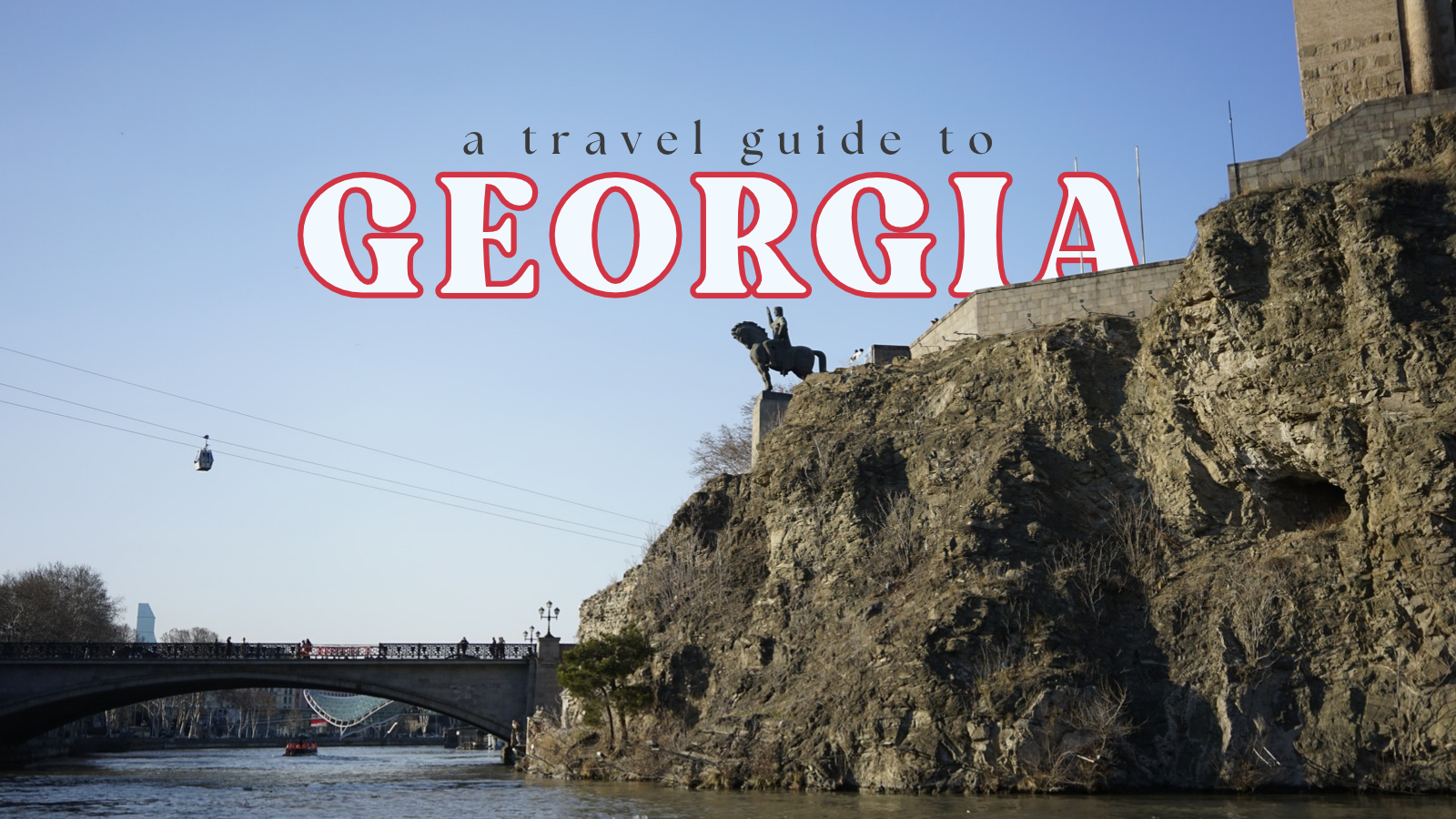
Georgia felt like such a wildcard for me. It was one of those countries that I knew I’d only scratched the surface. During my trip, I had only gotten the chance to visit a small part of it – spending the majority of my time in Tbilisi and heading north to Kazbegi to see Gergeti Trinity Church. There are plenty of places in Georgia that I haven’t been to yet, but plenty have made their way onto my list.
Before visiting, I had heard the usual things: endless wine, cheap prices, the hidden gem of Europe. I expected it to be good but I wasn’t expecting it to become one of my favourite countries in the Caucasus. It feels culturally like a mix bag of European, Asian and the Middle Eastern cultures which is part of what makes travelling here so interesting. I can see why Georgia has become such a popular destination – Georgian food and wine are a bonus.
This Georgia travel guide is based on my own trip, when I spent about a week travelling around Tbilisi and Kazbegi. Unfortunately, I haven’t been everywhere in the country yet, so I’m not going to pretend otherwise. Instead, I’ve included the places I actually visited, the places I’d consider adding on a longer trip, how much I’d budget and how I’d get around.
Disclaimer: Some links earn me a small commission – same price for you, slightly less tragic bank balance for me.

Quick Facts about Georgia
One thing that is evident is that Georgia has a long history. It spans from the ancient kingdoms through the medieval Georgian Kingdom and centuries of Persian, Ottoman and Russian influence. The country was incorporated into the Soviet Union in 1921 before declaring independence again in 1991. Another thing you’ll notice pretty quickly is that Georgia has its own alphabet known as Mkhedruli. Georgian script looks completely different from Latin or Cyrillic. You’ll see it everywhere from street signs to restaurant menus.
Last updated: September 2026
-
- Currency: Georgian Lari (GEL)
- Capital: Tbilisi Population: ± 4 million
- Official Language: Georgian
- Also spoken: Russian, English
- Majority Religion: Georgian Orthodox Christianity
- Time Zone: Georgia Standard Time (UTC+4)
- International Airport: Tbilisi International Airport (TBS)
Is Georgia worth visiting?
Updated for 2027.
Yes. Easily. It’s significantly grown in popularity over the last few years – for good reason, it’s such an intriguing country. Somehow, despite the explosion of tourism through social media, it still reminds grounded. Its capital, Tbilisi, has something for tourists, digital nomads and backpackers whilst remaining local.
Personally, I found Georgia as a whole lives up to its expectations. The country has such a rich culture, mountain scenery, beaches along the Black Sea. Oh, and the food is delicious. That being said, Georgia is no longer the ultra cheap destination raved about, although its still fairly reasonable compared to most European countries. While travelling on a budget, I still found plenty to do whilst in country.

Georgia on budget travel?
Look, I’d still classify Georgia as a relatively affordable destination. I wouldn’t say prices are as cheap as parts of Central Asia especially in Tbilisi as the city has become increasingly popular with tourists and digital nomads. But you could definitely visit Georgia without spending a fortune. There are plenty of hostels and guesthouses, public transport is inexpensive and eating out can be reasonable… I ate out in so many different places and splurged a bit food but I’ve no regrets. Generally, a huge Georgian meal with wine can cost less than a casual dinner in London. But imported products, cocktails and trendier cafés in Tbilisi can push prices up quickly.
Curious to find out how affordable Georgia is? Check out: The Budget Breakdown: Backpacking Tbilisi, Georgia
Your biggest costs will probably depend on how much you move around. Getting into the mountain regions can involve private transfers, organised tours or shared 4WDs, which will obviously cost more than jumping on a city bus in Tbilisi. For me, Tbilisi is a good city for travelling on a budget. You can walk around a lot of the central areas, the metro is cheap and there are plenty of restaurants and cafés at different price points A rough mid-range daily budget in 2026 might look something like:
-
- Budget backpacker: £25–40
- Mid-range traveller: £50–100
- Higher comfort level: £120+
Where Is Georgia?
No, I’m not talking about Georgia, the US state. Somehow, this still causes confusion for many. We are exploring Georgia, the country in the Caucasus region that straddles between Europe and Asia. It borders Russia, Armenia, Azerbaijan and Turkey… Even though it’s landlocked, it has a coast along the Black Sea in the west. Its location is the crossroads of some pretty major empires and trade routes over the centuries. You can see all this influence bleeding into its cultures, cuisine, architecture across the country.
How long do you need in Georgia?
If you’re mainly based in Tbilisi and planning on taking a day trip to Kazbegi, I’d recommend giving yourself about 5 days. This will allow you to explore Tbilisi without racing around and have some day trips to the Georgian countryside. Tbilisi isn’t really a city that needs rushing. Some of my favourite moments were just wandering through old streets, stopping for wine, sitting in hidden courtyards and ending up in random bakeries.However, if you have the luxury of time, I think a longer Georgia itinerary gives you more breathing room to add on another region.
A realistic split for a trip looks something like this:
-
- 3 – 4 days: Tbilisi + one day trip
- 5 – 7 days: Tbilisi + Kazbegi + Kakheti
- 10 days: Add Kutaisi/western Georgia
- 2 weeks: Add Svaneti and/or Batumi
Is Georgia safe?
Tbilisi felt comfortable to walk around during the day and evenings – even in less touristy neighbourhoods. Violent crimes against tourists are relatively uncommon. But I’d maybe reconsider driving in Georgia if you can? The way locals drive can be very different to how it is back home, especially up in the mountain passes.If you aren’t comfortable driving in chaotic conditions, tours or marshrutkas may be less stressful than renting a car yourself.
Georgia is generally a straightforward country to travel around, but there is an important caveat at the moment: the political situation can change quickly. Protests have been ongoing in Tbilisi and demonstrations can sometimes escalate or disrupt traffic. If you’re visiting, check the latest government travel advice before you go and avoid demonstrations rather than trying to see what’s happening. I’d also stay well away from Abkhazia and South Ossetia and the areas immediately around their administrative boundary lines.
Best time to visit Georgia
The landscapes of Georgia change depending on the seasons.
-
- Spring and Autumn: Cooler weather. Best for exploring cities, wine regions and cultural sights.
- Summer: Hiking and mountain activities but cities become too hot.
- Winter: Skiing in northern Georgia’s mountain resorts.
If visiting Kazbegi and Gergeti Trinity Church is high on your list – pay attention to the weather leading up to your trip. Mountain conditions can change quickly. You may see the church either surrounded by clouds or with a clear view of Mount Kazbek.
Navigating Georgia
Getting around Georgia from my experience is fairly straightforward, particularly if you’re sticking to the main tourist route between Tbilisi and the more popular destinations. Once you head into the mountains, public transport becomes a little less predictable and you’ll need to be more flexible. I wouldn’t plan everything months in advance. Having an idea of where you want to go and how long you have is useful. But like all good trips, I think leaving yourself some wiggle room can make things easier.
Visas
Georgia has a relatively generous visa policy. Citizens from Norway, UK, EU, USA, Australia, Singapore and several other countries can enter visa free for an extended period. The exact rules depend on your nationality! This can change at any time so I’d always advise checking the current requirements before travelling. For the most up-to-date information, check the official Georgian government visa information.

Getting around Georgia
Similar to many countries in the region – Georgia has a mixture of different transportation options. There are trains, buses, marshrutkas, taxis and private transfers connecting the main tourist destinations. For the route I travelled, getting from Tbilisi towards Kazbegi involved travelling by road – however, I took a tour for this section. If you’re planning a longer trip around the country, I’d look at each journey individually rather than assuming one form of transport will work everywhere.
Metro
Within Tbilisi itself, there is a metro network with two lines and about 20 odd stops. It’s not the most extensive but still a good option for getting around.
Trains
If you’re looking at more intercity train, Georgia has a railway network that connects Tbilisi with several other major cities including Batumi, Kutaisi and even to Yerevan in Armenia! The trains are generally comfortable and a good option rather than spending a long time on bumpy Georgian roads in a marshrutka.
Marshrutkas and Buses
Marshrutkas are shared minibuses and one of the most common ways to travel around Georgia. If you’ve travelled elsewhere in the former Soviet Union, you’ll probably already know what you’re getting yourself into. If not, think of them as inexpensive shared minibuses that generally leave once they’re full or according to a rough timetable. They’re useful for reaching smaller towns and places that aren’t connected by train. The downside is that information can sometimes be confusing if you don’t speak Georgian or Russian.
Walking
I found walking to be one of the best ways to explore Tbilisi because you never quite know what you’re going to find around the next corner. The city has enough hills and stairs to remind you that you’ve been walking, though, so don’t assume you’ll be having a completely flat city break.
Taxis and Ride Share Apps
Ride share apps (like Uber, Bolt or Yandex) are useful in Tbilisi and remove much of the hassle of negotiating taxi fares. Outside the capital, taxis and private drivers become more important.

Must See Destinations
Tbilisi: Georgia’s Capital
I genuinely really enjoyed Tbilisi – actually spent most of my time here. The city is an eccentric mix of old balconies, churches, Soviet architecture, modern buildings, cafes and plenty of restaurants. The city can be broken down into neighbourhoods and each one has their own personality. My friends and I spent our days exploring Old Town, visiting Mother of Georgia statue and eating our fill of Georgian cuisine… I took a day trip to Kazbegi whilst my friends visited Guduari for skiing.
Tbilisi Old Town
The Old Town is the obvious starting point for exploring Tbilisi. The narrow streets, colourful wooden balconies and old churches make it a great area to wander and get lost in. We spent quite a bit of time just walking through the streets, stopping for food and drinks along the way rather than trying to tick off every sight.
Narikala Fortress & Mother of Georgia
Narikala Fortress sits above the Old Town and is one of Tbilisi’s most recognisable landmarks. Unfortunately, it was closed for renovations during our visit. But it gives you a beautiful viewpoint over Tbilisi. If you’re already exploring the Old Town, it’s quite easy to cross the river to Rike Park, take the cable car up and time your visit for sunset. The Mother of Georgia statue, officially known as Kartlis Deda, is also up here and has become one of the city’s iconic landmarks.
Sulphur Baths
Tbilisi means warm place in old Georgian. There are several hot springs running under the city hence its name. Not surprisingly, there are also a few sulphur baths located around the city. The domed bathhouses sit beneath the Old Town and have been part of the city for centuries. You can book private rooms if you want a more relaxed experience, and there are several bathhouses to choose from.
Chronicle of Georgia
The Chronicle of Georgia is slightly outside central Tbilisi, easy to reach with a tour or by taking a ride share out to the monument. The monument itself is made up of enormous stone columns depicting scenes from Georgian history and Christianity. We visited as part of a private tour, which I actually think was worthwhile because there is a lot of symbolism behind the carvings that I would have completely missed by simply turning up and looking at them. The monument is also perched above the Tbilisi Sea, so there’s a pretty good view to go with it.

Kazbegi: Into the Caucasus Mountains
Kazbegi had been on my list ever since I first saw photographs of Gergeti Trinity Church sitting above the mountains, so I knew I wanted to make the trip from Tbilisi. The official name of the town is Stepantsminda, although most travellers still refer to the area as Kazbegi.
The famous church you see in photographs is Gergeti Trinity Church, perched on a hill with the Greater Caucasus Mountains behind it. And yes, it really does look like that in person when the weather cooperates. Stepantsminda is also very close to the Russian-Georgian border, which is something that feels slightly surreal when you’re standing there looking at the mountains.
Getting from Tbilisi to Kazbegi
There are a few ways of getting to Kazbegi… You can either rent a car and drive the Georgian Military Highway through the mountains and explore Kazbegi independently. A budget option is travelling via marshrutka. Alternatively, you could join an organised day trip or private transfer.
If you’re deciding to travel independently, I’d suggest staying in the region overnight or for a couple of days to explore it if your schedule allows! Unfortunately, day tours spend most of the day driving. That said, not everyone has unlimited time. If your trip is only 4–5 days total, a day trip still makes sense.
Other places to add to your Georgia itinerary
I haven’t visited the destinations below yet, so I’m not going to write them up as though I have. These were places I’d added to my own list while planning the trip, but ultimately I decided I would rather spend more time actually enjoying Tbilisi and Kazbegi than rush through Georgia trying to see everything.
If you’re planning a longer trip, though, these are the places I’d consider.
Svaneti
Svaneti is one of the regions I’d most like to visit on a return trip. It’s one of Georgia’s main hiking regions with dramatic mountain scenery, remote villages and the medieval defensive towers. Mestia is the main town and base for most travellers exploring the region. The region offers hiking routes ranging from shorter day hikes to longer treks.
If hiking is one of your main reasons for visiting Georgia, I’d look closely at Svaneti when planning your itinerary. It’s considerably further from Tbilisi than Kazbegi, though, so I wouldn’t try to squeeze it into a short 4 – 5 trip.
Kutaisi
Kutaisi is Georgia’s second largest city and can make a useful base for exploring western Georgia. It’s also well positioned for visiting places such as Gelati Monastery and Prometheus Cave. I haven’t made it to Kutaisi yet, so I’d personally look at it as part of a wider western Georgia itinerary rather than prioritising it over Tbilisi if you’re short on time.
Batumi
Batumi sits on Georgia’s Black Sea coast and is probably the biggest contrast to the mountain scenery around Kazbegi. It’s known for its beaches, long waterfront boulevard, casinos, modern skyline and nightlife, alongside an older historic centre. If you’re travelling during the warmer months and want to add some time by the coast, Batumi is worth considering. It’s also a very different side of Georgia from what I experienced in Tbilisi and Kazbegi, which is partly why I’d like to get there on a future trip.
Also, after speaking to some travellers, it seems like Batumi is a popular spot along the journey from Turkey to Tbilisi.
Georgian Cuisine
I think we know how I think the best way to experience any country is through your stomach – Georgia is no different. The country has plenty of speciality restaurants showcasing the best of Georgian cuisine alongside more modern restaurants and wine bars. Just keep in mind that the portions in Georgia can be very generous. I’ve learnt this the hard way. You’d be forgiven for thinking Georgian cuisine and Azerbaijani food are the same because they are both in the Caucasus region. Whilst they do share a lot of the same ingredients, the cuisine is quite distinctive. Both are absolutely delicious.
It’s worth noting that over time, it may feel repetitive, especially if you’re travelling in the region long term. Similar to being in any country for too long! Staples to the cuisine are bread, cheese and meats. Delicious but still… But one thing that can never feel repetitive is Georgian wine. Really delicious.
Khachapuri
Khachapuri is Georgia’s famous cheese filled bread and comes in several regional variations. Adjarian khachapuri is probably the most recognisable outside Georgia. It’s boat shaped and filled with cheese, butter and topped with an egg. I would highly recommend sharing this with someone as it’s extremely filling.
Khinkali
In so many cultures, you’ll find a version of a dumpling. Khinkali are Georgia’s answer to dumplings. Traditionally filled with meat, herbs and broth. You can actually find several different types of fillings now, especially vegetarian versions. There’s a particular way of eating them. You pick them up by the doughy top, bite a small hole and drink the broth before eating the rest. The little dough handle isn’t generally eaten, so don’t worry about trying to polish off the entire thing.
Badrijani Nigvzit
These are slices of aubergine filled or rolled with a walnut and garlic mixture. They’re usually served as a starter.

Georgian Wine
Okay, so… there’s a friendly rivalry between Georgia and Armenia about who was the first to make wine. I had done tours in both countries and this is what I’ve come to find out… Georgia has the oldest wine making traditions – you’ll find evidence of wine production dating back thousands of years. Armenia has the oldest full scale winery.
The traditional Georgian method involves fermenting wine in large clay vessels called qvevri, buried underground. It’s a pretty different approach from what you might be used to seeing in more modern wine producing regions. Kakheti is the country’s main wine-producing region, so if you’re interested in wine, this is somewhere I’d consider adding to a longer Georgia itinerary. You can actually join wine tasting tours to visit the region to make it easier for yourself.
You don’t need to be a wine expert either. Georgian wine is simply another part of the country’s food culture and you’ll see it regularly when eating out.
Cultural Nuances
The Georgian Supra
The supra is a traditional Georgian feast and is about considerably more than just sitting down for dinner. A toastmaster, leads the meal and makes a series of toasts throughout the evening. Food and wine are shared communally and the meal can continue for several hours. If you’re ever invited to one, definitely go for it! It’ll be a full cultural immersion!
Religion and visiting churches
Georgia is predominantly Georgian Orthodox Christian. It’s one of the oldest church institutions in the world and deeply ingrained in the country’s history and culture. Personally, I found it to be quite different to other branches of Christianity, especially when it comes to visiting their religious sites. It’s important to note that whilst visiting the religious sites, dress respectfully. Women are to cover their heads, shoulders and knees. Some churches have stricter rules around trousers or tight fitting clothing. When in doubt, carrying a scarf is an easy way to avoid being turned around for not being dressed appropriately.
The Georgian Alphabet
One of the first things you’ll notice in Georgia is the Georgian alphabet. It looks completely unfamiliar if you’re used to Latin or Cyrillic, but you don’t need to learn it to travel around the country. In Tbilisi and the main tourist areas, you’ll find plenty of English signage and people working in tourism who speak English. Learning a couple of Georgian words is still appreciated, though. Even getting as far as gamarjoba (hello) is better than immediately launching into English and hoping for the best.
Can you visit Georgia without a tour?
Absolutely. I think for a few people, they might have the impression that Georgia may be a difficult country to navigate and travel simply because it’s an ex-Soviet country. However, that could not be further from the truth. It’s one of the easier countries for independent travel.Tbilisi is simple to navigate, transport is manageable and tourism infrastructure is well-developed enough now that travelling around isn’t particularly difficult.
You do not need expensive private tours to enjoy Georgia. However, if you’re someone who prefers comfort over figuring things out, then it may actually be something to consider.
Solo Female Travel in Georgia
Georgia is generally a manageable destination for solo female travellers, particularly if you’re comfortable travelling independently. Tbilisi has plenty of cafés, hostels and other places where it’s relatively easy to meet people. The main tourist areas are also quite well established.
As with anywhere else, I’d still use the usual common sense! Particularly when drinking, getting into taxis late at night or travelling alone outside the main tourist areas. For me, one of Georgia’s appeals is that it can still feel like you’re having a bit of an adventure without making every part of the trip unnecessarily difficult.

What Surprised Me Most About Georgia
Sometimes a destination gets so hyped online that you arrive wondering whether the actual place can live up to all the photos. Georgia mostly did.
I loved the combination of the mountains, the food and wine culture… and I’m not a city gal but I really loved Tbilisi. The capital had plenty of personality without feeling like it was trying too hard to be a tourist destination. And despite becoming more popular, Georgia still felt accessible to independent travellers without needing a huge budget.
It’s definitely not perfect, though. Some of the roads can be… interesting and once you get away from the main tourist routes, the infrastructure can still feel a little rough around the edges. But I reckon that’s the appeal of Georgia for me. It hasn’t been polished into a completely predictable tourist experience YET so best to explore it before it gets on too many people’s radar!

Leave a Reply