I first came across the Salar de Uyuni back in 2017 during my first trip to South America. At the time, I had no idea just how extraordinary this continent was or that it was home to the world’s largest salt flat. Unfortunately, after my backpack was stolen in Puno (Peru), I never got the chance to visit Bolivia… so Uyuni Salt Flats became one of those “one day” travel dreams.
Fast forward to this year (2026) and I finally did it!
During rainy season, it transforms into the world’s largest mirror or mirror of the sky, creating the surreal reflection effect you’ve probably seen all over Instagram. In the dry season, it becomes an endless white desert stretching over 10,000 square kilometres in southwest Bolivia. Either way, it’s one of the most iconic landscapes in South America.
When I travelled from San Pedro de Atacama, I found the logistics surprisingly confusing? It’s a little overwhelming with all the different tour options, starting points, varying pricings, altitude being a factor… If you’re researching about how to visit Uyuni Salt Flats, welcome – you’ve come to the right place. Big sister Caroline has done the groundwork for you. So let’s plan your Uyuni adventure properly 😉
Vamos.
What is the Salar de Uyuni?
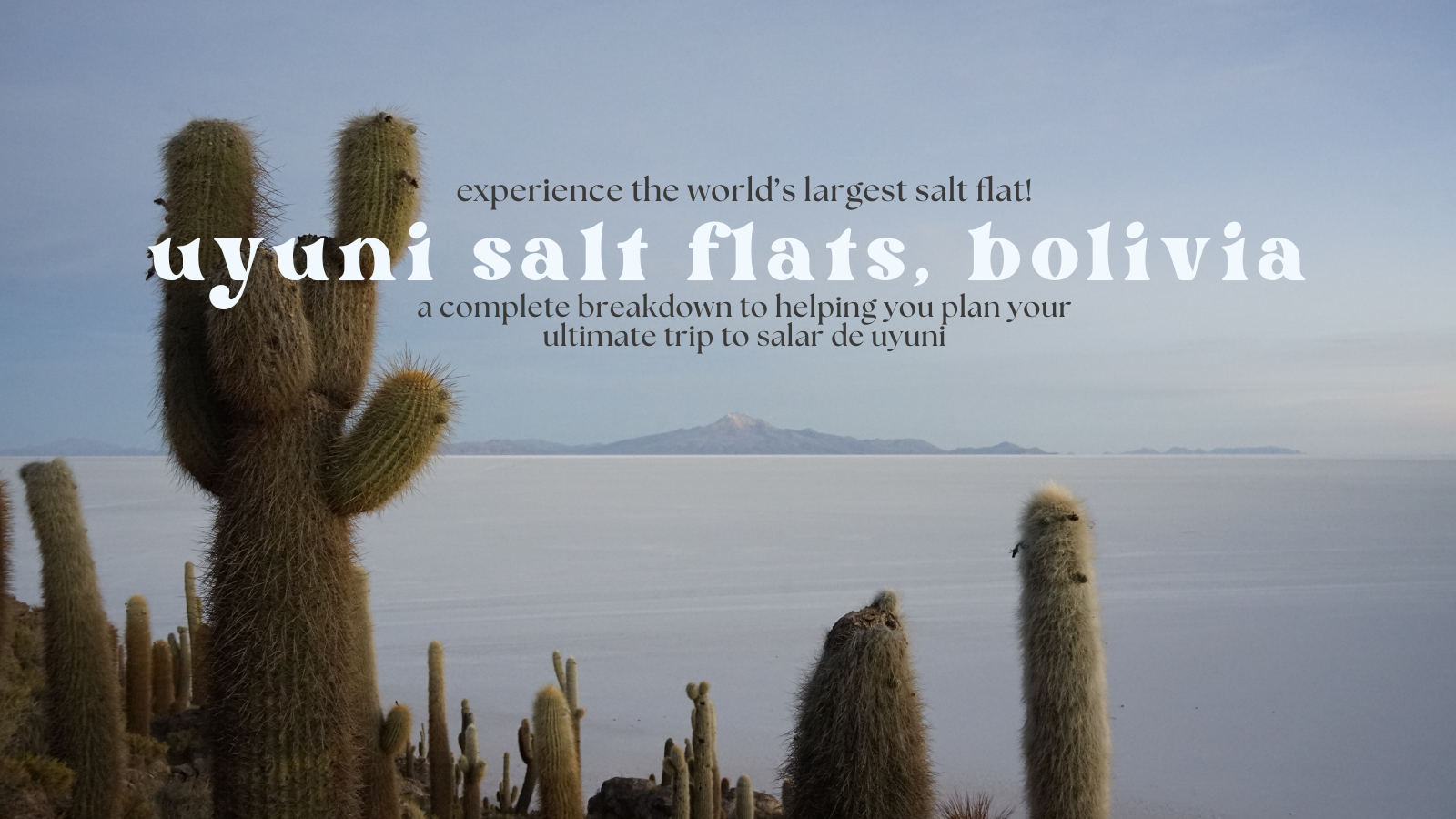
You might only know it as a salt flat… but it’s the largest of its kind in the world. It formed from prehistoric lakes that evaporate thousands of years ago. It sits at quite the altitude – 3656m above sea level to be precise. The landscape is surreal. Bright white salt as far as the eye can see. Literally – it can take 2 hours by car to cross! Also there’s a cacti covered island in the middle of it all, which to me blew my mind a little. I mean why is it there? 😀
While we do talk about the Uyuni Salt Flats, if you’re visiting from the Atacama, Chile, you’ll see a lot more than just a salt flat. Think technicolour lagoons, flamingos, altiplano communities.

Why the Uyuni Salt Flats Tour is so popular?
While I think the landscape is amazing… I think part of the reason why the Uyuni Salt Flat tour is so popular is partially because of the journey. Crossing remote deserts in a 4wd isn’t something a lot of people have experienced. Especially if you’re doing more than just the one day tour to the salt flats, the evolving landscapes juxtapositioning against itself is just so otherworldly. We did spend a week in the Atacama but still, everything felt so beautiful and different. Visually, this was such a striking and different 3 day tour.
How to get to the Uyuni Salt Flats
There’s two main ways to start your tour to the Uyuni Salt Flats.
Start in Uyuni, Bolivia.
Of course. It is located in Bolivia after all! For more backpackers, this would be the traditional starting point. Especially if you’re coming by bus from La Paz, Sucre, Cochabamba or Oruro.
Only Bolivian agencies can operate in the Salar de Uyuni region so the tours from here are cheaper. Also as Bolivia is a cheaper country overall than Chile, tour costs are lower. It’s a great option if you’re short on time or only want to visit the Salt Flats.
Start in San Pedro de Atacama, Chile
While it’s not the most traditional starting point, I’d argue it’s the more scenic option. Tour costs are higher from the Chilean side but if you’re coming up from this way, it just makes sense. You can visit Uyuni by taking a tour (3D2N or 4D3N) or doing the border crossing yourself to Uyuni and taking a tour from there.
If you’ve got time, I would highly recommend taking the tour. Logistically, it’ll be easier. Depending on your route, you could do a one-way tour and continue on your journey through Bolivia.

Uyuni Tour Options Explained
This isn’t necessarily confusing but there’s a lot of options… or at least a lot of agencies selling similar options. Let’s break them down.
1 Day Uyuni Tour
This can only be done from Uyuni, Bolivia. You’ll mainly be focusing on the salt flats, either visiting for sunrise or sunset. This is the best option for you if you’re on a tight schedule, not bothered about seeing the other landscapes or travellers who just want to see the salt flat itself.
3 Day / 2 Night Uyuni Tour (The Classic)
Generally, the tours are very similar. We took this tour from Atacama to Uyuni as a one-way trip. It’s the classic itinerary. If you’re travelling Uyuni to Atacama, the itinerary would be the same, only reversed.
It typically includes: the Salt Flats, Incahuasi Island (cactus island – weather dependent), altiplano lagoons, geysers, hot springs, volcanic landscapes and flamingos. When people talk about doing the Uyuni Salt Flats tour, this is usually what they are referring to.
4 Day / 3 Night Uyuni Tour
Okay so, many people think this is the same as the 3D2N tour but stretched out longer. This isn’t true. You will do the exact same as the 3D2N tour. It’s only the last day that’s different. After everyone on the tour says “bye”, you’ll get back into the car in the evening and start driving back towards your original destination. This option is basically for those who need to get back to your original departure point for whatever reason.
The Classic Itinerary: 3 Day Uyuni Salt Flats Tour

As we did our tour from San Pedro de Atacama, Chile to Uyuni, Bolivia over 3D2N – this is the itinerary I will be sharing. This is just an overview. Just keep in mind, while the area is relatively small, you are driving off road so it takes a long time to get around. You will be spending a lot of time in the car.
Day 1: Border Crossing + Altiplano Lagoons.
It was a very early morning departure to get to the border. What most people don’t really realise is that all of the sights you’re gonna see is in Bolivia. But regardless, that doesn’t change how impressive it all is. On this day, you’ll get to dip yourself in a hot spring, see a few high altitude lagoons… a lot of flamingos in a lagoon.
At the end of the day, you’ll arrive at your accommodation for the night just before dinner. It’s simple but cosy. You won’t have the earliest start the next day.
Day 2: Desert Landscapes + Rock Formations
A more relaxed start to the morning and you will be exploring more rock formations than lagoons and salt flats today. You will be covering long distances today so more time will be spent in the car. Keep your eyes peeled! You might see some Andean wildlife – plenty of llamas!
If you’re lucky, you might be able to catch sunset over the salt flats before heading to your accommodation for tonight… you’ll be staying in a salt hotel! Yes, it is exactly what it sounds like… a hotel made entirely of salt.
Day 3: The Salt Flats
Your wake-up time will completely depend on whether you’re visiting during rainy season or dry season. During dry season, you’ll visit Incahuasi Island (island in the middle of the salt flats and fulllll of cactus) so you will wake up and leave before 4am to catch the sunrise at the viewpoint.
If you’re visiting in rainy season, you wouldn’t be able to reach the island so you get a bit more of a sleep in! You’ll mainly be spending most of the day on the salt flats, exploring it, doing the funny photos with the dinosaurs… until it’s time to start heading to Uyuni. You’ll probably visit the train cemetery before being dropped off.
If you opted for the 4D3N tour: on Day 3, you’ll start heading back to SPdA, sleeping at the same accommodation you stayed on Night 1.
Best time to visit the Uyuni Salt Flats?
I don’t think there’s a right season… both seasons are vastly different. We visited first week of January 2026 to try to see the mirror effect but unfortunately, we didn’t quite see it at its full glory.

Rainy Season (December–March)
The Altiplano Winter. Supposedly, this is when the famous mirror effect appears. Our friends who had visited a few days before us actually managed to see the mirror! We did manage to see some reflection but not quite to the same extent. This famous mirror effect happens when a thin layer of water sits on the salt flat, reflecting the sky.
Our guide did say to us with climate change, he’s noticed that the seasons aren’t as defined. Last year, they didn’t get rain until late February or March. So this would impact when you see the mirror. Let’s just say, there’s no guarantee, especially when it comes to the weather.
Another thing is: even though you might have rain and water on the salt flats, there’s another element to keep in mind… wind! We managed to find a spot where you could get a reflection but unfortunately it was too windy to see it.
Dry Season (April – November)
The southern hemisphere winter is when you get the best night skies. So if you want to see the sky in its full glory, this would be the time to come view it. Although, do keep in mind the moon cycles. You’ll have full access to the cactus island and see the hexagon patterns in the salt flats but of course, that means you won’t get the mirror effect.
Being the winter time, the temperature will be cold! So pack for that.
How much does a Uyuni Salt Flats tour cost?
As I mentioned above, tours starting in San Pedro de Atacama will cost more than compared to their Uyuni counterparts. This is because only Bolivian companies are able to operate tours within the Salar de Uyuni. We only looked at tour prices leaving Atacama and going to Uyuni for 3D2N. For the most part, tours ranged between 220 000 – 280 000 CLP (USD $250 – 320). The itinerary was the same, the main differences was if you wanted a private room or shared. We ended up paying 240 000 CLP per person (280 USD). One of my friends did find a tour for 180 000 CLP (USD$210).
The tours operated with a similar (if not same) itinerary. They included a guide/driver, meals and accommodation. You had to bring some extra cash, recommended 300 BOB (USD$40) to cover for national park fees, souvenirs, toilet stops etc.
Note: While asking around a couple of agencies, it seemed that while they offered “english speaking guides”, they aren’t actually english speaking. The agencies have no control over that. Most of the Bolivian guides only spoke Spanish so be aware of that. Even if the agencies say otherwise.
What are the accommodations really like?
They aren’t luxury experiences. Depending on how much you pay or what type of tour you book, you might be sharing rooms with other travellers. The rooms are basic but comfortable. There is basic heating, which we didn’t need in January. As we were travelling as a couple, we had private rooms with ensuite for the two nights. The salt hotel was a lot nicer than I expected. Probably a nicer experience compared to some friends over the years.
There was wifi at all our accommodations. Mind, it wasn’t strong enough to stream a show but it sufficed to send a couple of messages to loved ones or to keep your Duolingo streak. We did have to pay for ours.
Is the Uyuni Salt Flats Tour safe?
I would say yes. I would probably say the main danger is how remote it is, altitude and your driver. Some tour operators actually choose not to have any tours over public holidays because of the potential danger of drunk drivers. I’m not saying your driver is drunk (maybe, I wouldn’t dismiss it) but there may be other drunk drivers on the road making the journey dangerous for you.
Note: There are no tours running over the New Year period so plan accordingly!
I was quite paranoid about the drivers before taking the tour if I’m honest. But the company we went with – Sajama Expeditions was really good. We had Fernando and he was such an amazing driver – extremely careful, cautious and all around a very nice person. So the moral of the story is: choose a reputable operator.

Altitude: What You Need to Know
Depending on which direction you’re travelling, you might already be acclimatized or you’ll need to before going on the tour.
- Uyuni: ±3650m
If you’ve spent some time in the Bolivian highlands or Uyuni, you should be acclimized. - San Pedro de Atacama: ±2400m
It would be a good idea to spend some time around SPdA, visiting Piedras Rojas (±4000m) or Tatio Geyser (±4300m) to acclimatize more.
On your 3D2N tour you will reach an altitude of over 4800m. The most common symptoms to look out for:
- Headaches
- Nausea
- Fatigue
- Shortness of breath
- Loss of appetite
The general rule of thumb when you experience altitude sickness is to stop ascending, rest at your current altitude and consume plenty of fluids. However, if symptoms persist and you start feeling disoriented, extreme breathlessness, unable to walk in a straight line – then you should consider descending immediately.
Note: your tour driver should have some oxygen on hand to help you.
Here are some tips that helped me manage altitude sickness. Keep in mind, these are personal and not everyone would need to follow this or want to:
- Coca tea
I usually sip on coca tea throughout the time I’m at altitude to help manage my symptoms. - Stay hydrated
- Avoid alcohol while at altitude
- Move slowly
- Spend time acclimatizing if possible.
What to pack for a Uyuni Salt Flats Tour
If you’re doing a one-way tour, you’ll be bringing your entire backpack with you anyways. You won’t be able to access your main pack as it will be tied on the top of the car throughout the day. The best idea is to have a smaller pack with you in the car with any essentials you might need. Keep in mind, I did my tour in January so the days + nights were definitely warmer.
General items:
- Sweater (you can buy plenty of alpaca sweaters in Atacama or Uyuni)
- Waterproof layer
- Sunglasses
- Lip Balm + SPF 50 sunscreen
- Reusable waterbottle
- Power bank + Spare camera batteries
- Walking boots

Is the Uyuni Salt Flats Tour Worth It?
Short answer: Yes!!!!
Long answer: It’s not going to be comfortable. It’s dusty, remote, unique, surreal.
I think it honestly depends on what type of traveller you are. I reckon if you love a good adventure, you’re a photographer, backpacker or even an overland traveller – this is your jam!
Unfortunately, I think more luxury-focused travellers or those who need more infrastructure, maybe want an English-speaking guide… this might not be for you. Although, I’m sure some tours might actually fit your expectations!
Got other questions about Uyuni?
Can you do it independently?
I wouldn’t say you could. I’m not certain but by the looks of it, you need a permit to drive in this area. We never saw overlanders drive this route.
How cold does it get?
In the winter, temperatures can drop to -10degC at night and hover around 5 to 10 degC during the day. In the summer, it was closer to 5degC at night and 15 to 20degC during the day.
Are showers available?
Yes! In the accommodations we had, we had an ensuite. However, hot water isn’t guaranteed.
Is 3 days too long?
If you’re planning on seeing all the attractions, I don’t think you can do it any shorter. Unless you only want to see the Salt Flats then it can be in a day (from Uyuni). However, if you plan to either go Atacama > Uyuni or Uyuni > Atacama, your only option is 3 days 2 night tours.
Is it better from Chile or Bolivia?
It depends on your travel route! You will see the same attractions so I wouldn’t say any one direction is better than the other.
Let’s sum it up
After waiting almost nine years to finally stand on the Salar de Uyuni, I can honestly say it lived up to the hype. The Uyuni Salt Flats aren’t just a pretty photo spot… they’re remote, raw, a little uncomfortable… and completely surreal. Between the endless white horizon, flamingos in technicolour lagoons, salt hotels and sunrise at nearly 5000m, this is one of those travel experiences that genuinely feels different. Wild and beautiful.
If you’re debating whether a Uyuni Salt Flats tour is worth it, take this as your sign. Plan it well, respect the altitude, pack properly and give yourself the full 3 days if you can. It might feel overwhelming to organise but once you’re out there in the middle of the world’s largest salt flat, none of that will matter. Trust me… some travel dreams are worth the wait. Vamos.
Leave a Reply