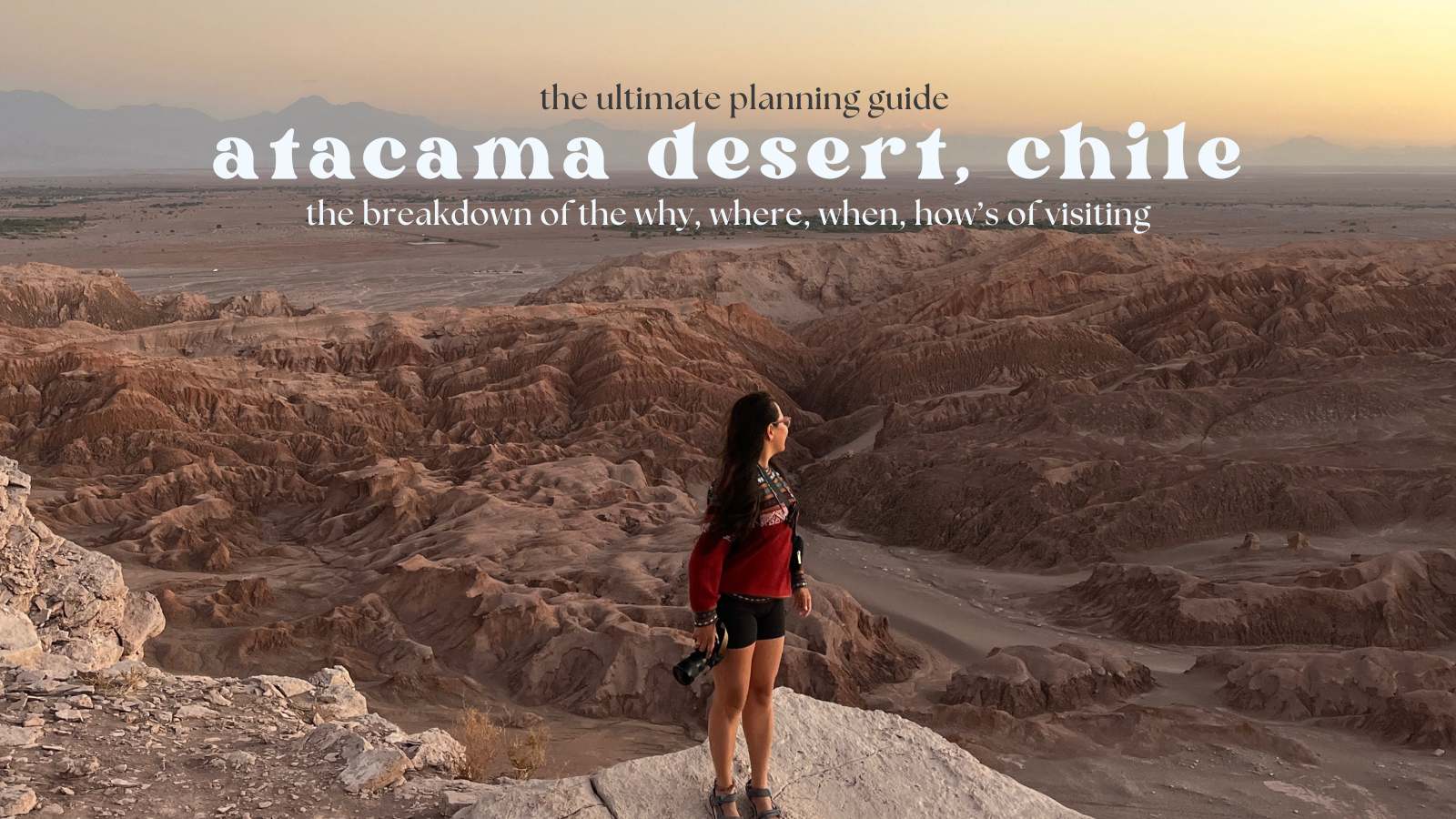
I had heard about the Atacama in passing a couple of years ago, during my first trip to South America. Over the years, I kept seeing more photos pop up and it looks so otherwordly. Since we’ve been exploring Chile for about a month independently, I thought – maybe it’s time to see this amazing place for myself?!
Picture this – volcanoes dominating the skyline, flamingos dotted all across high altitude lagoons, multicoloured rock formations? Wow, huh? It’s described as the driest non-polar place on earth but there’s so much to explore in these parts. After spending a week exploring the majority of what the Atacama has to offer, I’ve designed this guide to be your one stop shop when planning a trip here.
-
- What makes it unique
- The best experiences in the Atacama
- How to get to San Pedro de Atacama
- How to get around (car vs tours)
- When to visit
- Altitude and practical tips
I spent 6 days exploring Atacama with a rental SUV so you know this is built from my experience 😉
Atacama Desert Quick Facts
- Base town: San Pedro de Atacama
- Elevation: starts at 2,400m+ with several attractions exceeding 4000m
- Ideal stay: 4 – 7 days
- Best for: Otherworldly landscapes, stargazing, flamingos, salt lagoons
- Closest airport: Calama (CJC)
Where in the world is the Atacama?

The Atacama Desert stretches across northern Chile, running along the Pacific coast between the Andes Mountains and the ocean. It’s often described as the driest non-polar desert in the world. Did you know that some weather stations having recorded virtually no rainfall?
Here’s a bit of technicality for you. When we walk about the Atacama Desert, that’s actually referring to the lower region closer to the coast. The Atacama that you’re thinking of is actually the Atacama Altiplano. Altiplano = high altitude plateau region. The Atacama Altiplano is located in Northern Chile, bordering Bolivia and Argentina.
The best place to base yourself is San Pedro de Atacama (SPdA). It’s a small desert town centrally located within driving distance to several attractions. It’s the logistical hub where you can arrange tours, accommodations with plenty of food options.
Continuing your journey — Gateway to Bolivia: Salar de Uyuni.
For many travellers, Atacama and Uyuni are paired together into one extended Altiplano experience.
How to get to San Pedro de Atacama?
Getting to San Pedro de Atacama
As a note, our rental company and a few other people told us that Calama isn’t the safest town. Apparently, lots of rental cars get broken into whilst people are grocery shopping. If possible, make your way to San Pedro de Atacama rather than spending a night there.
Option 1: Overland Transportation
You can book a bus from Santiago, La Serena and a few other Chilean towns to Calama. Mind, the journey will take upwards of 18 – 24+ hrs. The buses are pretty comfortable but it might be worth looking at the price of flights as they could be very similar. There are a few places you might want to visit to break up the journey.
From Calama, you’ll need to take a shuttle to get to San Pedro de Atacama. There aren’t any public buses from what I’ve seen.

Option 2: Flying
If you’re low on time, opt for flying to the Atacama. The main (and only) airport you’ll fly into is Calama (CJC). San Pedro de Atacama is located just an hour east from Calama. Major airlines like LATAM, Sky Airlines and JetSMART will fly here from various major Chilean cities (and potentially other major South American cities).
Upon arrival to Calama Airport, you’ll be greeted with plenty of tour agencies offering transportation to San Pedro de Atacama. So there’s no real need to prebook any transport. Price and service wise, they are all generally about the same. The journey takes just over an hour to get from Calama to San Pedro de Atacama.
One way – 13 000 CLP per person
Return – 25 000 CLP per person
Is the Atacama Worth Visiting?
Absolutely, I reckon it is! It is quite a unique part of the country… and the continent! I’ve visited some beautiful places in the world and I’d say that the Atacama is special. There’s quite a high density of surreal landscapes within relatively short driving distances. In a single day you can:
- Walk through moon like valleys
- Visit ancient petroglyphs
- Watch flamingos in salt lagoons
- Watch the sun set over the moon…
It is quite cinematic!
What to Do in the Atacama?
This isn’t a day by day itinerary (that deserves its own post)! The following are some of the core experiences you can do in the Atacama. We had done a majority of them and they are spectacular.
Valle de la Luna (Moon Valley)
You’ll probably hear this time and time again but the Atacama is famous for otherworldly landscapes. Whether it feels like you’re on the moon or Mars, it is a sight to behold. You’ll find several sites that are home to intricate rock formations, massive dunes and viewpoints.
Piedras Rojas and Altiplano Lagunas
You’ll have constant supply to surreal landscapes. Deep red mountains in the background contrasted by turquoise lagoons and white salt lakes. It looks like a painting. In some locations, you might be lucky and have a flamingo or few in the foreground. Visually, I found it quite interesting that you’ll be driving through straight, flat road and suddenly the landscape in the distance changes dramatically with lagoons and peaks.
Tatio Geyser
Geysers are interesting if you haven’t been before. Although, the smell is pretty foul – think rotten eggs because of the intense sulfur smell. This is another site that sits over 4300m so keep that in mind.

Wildlife around the Atacama
Now, you might not plan an entire trip revolving around wildlife spotting in the Atacama but there’s a chance you’ll spot some amazing animals. I recently became a birder but did you know that you’ll able to spot 3 species of flamingos here? The Andean, Chilean and James flamingos. You’ll probably see plenty of llamas, vicuña and alpacas on the roads. They aren’t wild and belong to someone but they do roam freely. You might also get lucky seeing a lesser rhea (South America’s largest flightless bird) and a fox.
Stargazing
Unfortunately for us, our visit coincided with an upcoming full moon so you won’t get to the sky in its full glory. We had been lucky to see some amazing skies in Botswana. It truly is an incredible site. When we had done it, it felt like we were in a snow globe filled with stars. That’s probably the best way I could describe it. If you haven’t been stargazing, definitely try to align your visit with a new moon.
Laguna Cejar
There’s no short supply of salt lagoons throughout the region. Some are open for swimming and others are just for looking. However, if you’re interested in experiencing what it feels like to swim in extremely salty water (similar to the Dead Sea), then this is your opportunity to!
Getting around the Atacama
Probably the main decision you’ll have to make while planning! While there are some attractions you can rent a bicycle to visit, the majority of them are quite a drive away. The furthest attraction is 150 km one way. There are two main options to pick from: renting a car or booking tours.
Option 1: Renting a Car
We opted to rent a SUV for 6 days with full insurance. Including fuel, it came to be £320 total (£27 per person per day). Driving itself is relatively straightforward with majority of the roads being paved and well marked/easy to navigate. There were quite a few gravel/salt roads but only when you’re turning off towards the attractions.
For the independent traveller, I felt that renting a car gave us the freedom to do what we wanted and gave the flexibility to change our plans or take it easy.
Option 2: Booking Tours
Tours are widely available and easy to book in San Pedro. Although, depending on the agency, it can be a hit or a miss. It makes a lot of financial sense to book a tour if you’re a solo traveller but also if you’re short on time. If you’re trying to do as much as possible in a short time – tours are a good option. Some agencies offer packages where they bundle a few tours together at a lower cost.
It’s easy for an agency to take control logistics-wise if you’re not comfortable driving on some of the gravel roads but also with early starts (ehem – 4am for El Tatio Geyser), it might make more sense to go for a tour.
Cost Comparison (2 People)
- Couples/Friends: It’s up to you as the difference is minimal.
- Groups of 3 or more: Renting becomes cheaper.
- Solo Travellers: tours usually make more sense.
There’s no universal answer! It truly depends on your travel style and how independent you want to be.

When is the Best Time to Visit the Atacama Desert?
We visited from 30 December to 7 January so probably the main period that most people might be thinking of visiting.
Booking wise: This was a very busy period! We were booking things a week before arriving and a lot of affordable accommodations (with a kitchen) were sold out. Highly recommend booking accommodation and car rentals early!
Full moon: While we are flexible with our schedule, we unfortunately were visiting right in the middle of the full moon phase so we weren’t able to go stargazing, unfortunately. If you’re dead set on experiencing the night sky, use Time&Date to plan when the new moon phase is.
Top Tip: the best time for stargazing in the Southern Hemisphere is in the winter (June – August).
Weather wise: days were very warm/hot. We were experiencing ±30 deg in San Pedro de Atacama. At Piedras Rojas (4200m in elevation), it dropped to 18 deg. Being at altitude, there was a cooler breeze. It was cooler in the evenings but not cold.
Altiplano Winter: This was something I learnt about. While it is summer in the South Hemisphere, the Altiplano experiences its own climate. It’s the Altiplano Winter meaning there is a chance for heavy rainfall during this period which can impact roads/attractions. It was completely fine for us, we did have rain but only a drizzle for 30 mins one afternoon.

Realistic advice for the Atacama
It is a desert, whilst at extremely high elevation so there might be a couple of things you need to consider.
Wear sun protection
This is a good idea anyways but at a higher elevation, the UV rays are more intense so it is best to protect yourself against it. I recommend SPF 50+ sunscreen, lip balm, a hat and a UV shirt (if you have one).
Water – bring more than you need!
There are not very many shops scattered around the region. Whilst you think you may not be exerting yourself as much, the altitude and heat will dehydrate you quicker. Keeping yourself hydrate will also help your body recover and cope with altitude sickness.
Acclimatize beforehand
The side effects of altitude sickness can begin at 2500m. San Pedro de Atacama sits at approximately 2400m. Don’t be surprised if you start feeling breathless or light headed. Attractions such as Piedras Rojas and Altiplano Lagunas are at 4200m – a climb of almost 2000m! I would suggest planning your visits with ascending altitudes to allow your body to acclimatize before going further.
Offline maps
Reception can be spotty out in the Atacama and WIFI may not be readily available so download offline maps. The roads themselves are straightforward and signed so you will be fine without offline maps. However, I prefer the peace of mind it brings. While the timings may not be the most accurate, the directions are pretty good. My go-tos are Google Maps (offline) and Maps.me.
Be mindful of when you visit
We originally had plans of spending New Years in Salar de Uyuni. Which did not happen. We came to find out that a lot of tour companies don’t operate tours to the Salar over new years due to safety concerns – drunk drivers. So we ended up spending more time in San Pedro than planned, which was fine. But if you’re tight on time, just keep this in mind.

Let’s start planning your Atacama Adventure!
The Atacama Desert isn’t just one attraction, it’s a collection of surreal landscapes scattered all over.
There’s no right way to explore this region. You can explore it independently. Or can join guided tours… maybe a mix of the two?
You can move quickly or take your time to acclimatise.
What matters is taking into account your travel style and how your body reacts to altitude. In the end, no matter what you do, it will be absolutely be worth it.

Continue planning your Atacama Trip From Here
I’ve got a bank of information to share and felt like it may be a little overwhelming dumping it all here. This guide aims to lay the foundation for your trip planning to the Atacama. But don’t fret, here are some more resources for you to continue planning your Atacama adventure.
Coming soon: 6 Day Atacama Desert Self‑Drive Itinerary (Routes + Distances)
Coming soon: Budget Breakdown of Atacama Adventure, Chile
Coming soon: Cost comparison: Rental Car vs Tour?
Planning your Chile adventures:
This is a bank of information I’ve compiled to help with your Chilean adventures planning.
- A Guide to Chile’s Marble Caves – Capillas de Mármol, Puerto Río Tranquilo
- How to Get to Puerto Rio Tranquilo, Chile: The Complete Guide
- How to Border Cross from Los Antiguos (Argentina) to Chile Chico (Chile) on Foot
and stay tune as there’s plenty more Chilean resources I’m whipping up!
Leave a Reply