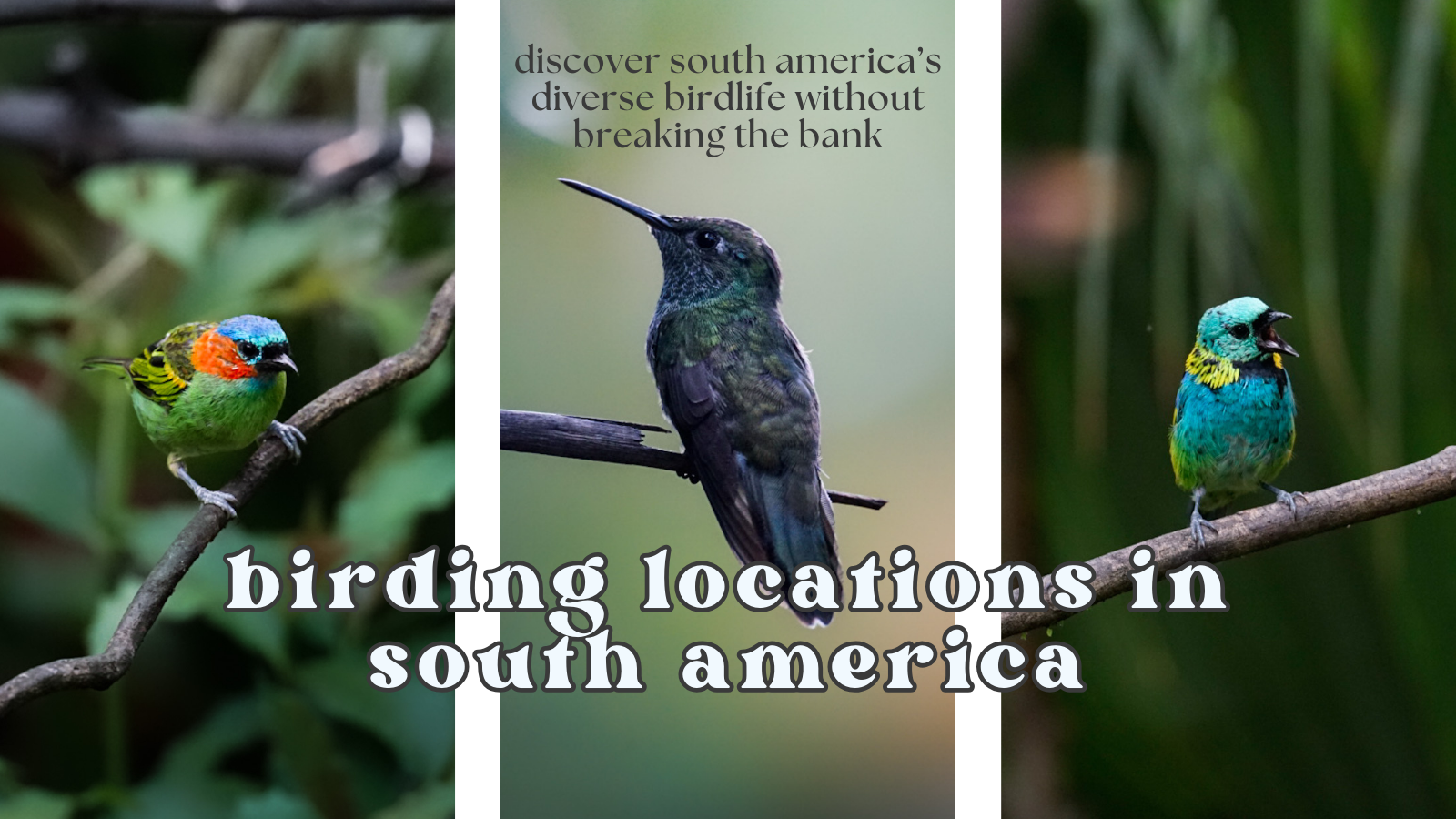
Fully transparency here… I recently got into birding, hence this post. It started because I wanted to practice using my new telezoom lens and well, here we are. Birdwatching in South America. Never really thought I would be a birder but let’s be honest, birdwatching really does just sneak up on you. Over the last year, we have seen some incredible birdlife while on safaris in Southern Africa. So in a way, I assumed birding is an expensive hobby and potentially something you need to design your entire trip around.
Turns out – it doesn’t have to be.
South America is known as “the bird continent”, home to nearly a third of the world’s total bird species. If you’re already travelling through the continent, there are a few places you can spend an afternoon birding and by the end of it, you would’ve walked away seeing toucans, tanagers, hummingbirds, parrots and a bunch more… While I’ve seen so many amazing birdlife in the Pantanal (on a jaguar safari), this guide focuses only on affordable, easily accessible birding locations on the continent.
No specialist tours. No luxury lodges. Just practical information: costs, logistics, how to get there and what you might see.
Tweet tweet! – that’s bird for “let’s dive in”.
Why Birding is a great backpacker activity
Need some convincing why? Backpackers are already set up for birding, you just don’t know it yet.
- Probably already awake at sunrise thanks to overnight buses or noisy dorms.
- You’re in South America – an already diverse continent!
- In the search for a low cost activity that doesn’t involve booking a tour.
- You quite like animals/wildlife already.
Yep, sounds like birding is for you. If you do it right, birding won’t cost you very much but it will force you to slow down. Force you to observe more. Sometimes the random afternoon you spent watching birds might turn out to be … memorable. Rather than just rushing around, you might take it easier and realise all the life around you.

Why Birding in South America is perfect for beginners
If you’re like me and you’re just discovering your new passion of birdwatching, South America is a gold mine. As mentioned, it’s home to over 3500 species of birds – that’s almost 1/3 of the world’s population! The continent is massive so you will find all sorts of birds, it’s got a hugh biodiversity.
Unfairly, I find colourful birds to be so mesmerizing. The closer you get to the equator or somewhere tropical, the more colourful the bird species are. But that doesn’t mean you only need to go to the national parks, there are several city parks and botantical gardens scattered, they make for the perfect pitstop on your already packed itinerary.
You don’t need to plan a dedicated birding expedition. If you’re already visiting waterfalls, beaches, forests or mountainous areas – maybe spend some time looking up or listening. You might catch a glimpse of something amazing!
Noteworthy birdwatching spots in South America
Samaipata, Bolivia – Refugio de Colibries
Samaipata is a laid-back mountain town a few hours from Santa Cruz. It is surrounded by the Amboro National Park on the eastern edges of the Andes Mountain Range. It’s a massive region with varying ecosystems. The Amboro National Park stands between 300m to over 3000m and with all the ecosystems, it’s considered to be one of the most diverse in the world… it is also home to over 900 bird species, that’s 60% of Bolivia’s bird species!
So you would be pleased to know that we found a place that is so diverse with hummingbirds. It’s actually a hummingbird sanctuary. The owners informed us that throughout the year, over 20 hummingbird species call this place home. How incredible. We actually saw 6 species of hummingbirds in one afternoon!

Information
The place may look closed as the gate is locked. Just call out and someone there will attend to you shortly. They are continuously improving the place, so there are some ongoing projects. Hummingbird feeders are used.
Cost
- Entrance: 50 BOB cash
- No mandatory guide required
- Plenty of spots step up throughout the property
Getting there
Public transport is limited. The easiest way we found was to take a taxi. Ubers aren’t a thing in Samaipata. We found a taxi driver who was willing to take us there and we agreed on a fixed pick up time. It cost us 80 BOB (there and back). The property is located approximately 5km from Samaipata and is actually close to the Samaipata Fort. You could visit the fort and stop by Refugio de Colibries before heading back to town.
Opening Hours
If I’m not mistaken, the opening times are:
- Tuesday to Sunday from 0830hrs – 1200hrs. And again 1400hrs – 1800hrs.
Best time to visit
Of course like a lot of animals, the best time to visit is early in the morning or later in the day. Just keep in mind, there are so many insects during this time. So remember to use insect repellent. I was absolutely destroyed with bites.
Puerto Iguazú, Argentina – Jardin de los Picaflores
Everyone goes to Iguazu for the falls, but what about the wildlife?! I joke … a little. We saw so many species of hummingbirds and other birdlife. It is a family garden that’s been converted into a sanctuary for hummingbirds and other species. If I’m not mistaken, it was started by their mother and has been a haven ever since. Throughout the year, up to 15 species of hummingbirds visit the gardens.
Puerto Iguazu is surrounded by the Parana subtropic part of the Atlantic Forest or the Alto Paraná Atlantic Forest. In this region, about 500 species of birds have been recorded. Let that number sink in!

Information
The best thing to do is message them on whatsapp before visiting to make sure they are there or to reserve a spot. The place may also look closed as the gate is locked. Hummingbird feeders are used.
- Contact: +54 3757 54 7026 | +54 3757 45 8498
- Address: Fray Luis Beltrán 150, Puerto Iguazú
- Map location
Cost
- Entrance: 10 000 ARS for foreigners. Card payment accepted
- No mandatory guide required
- Plenty of spots step up throughout the garden
Getting there
Really straight forward if you’re staying on the Argentine side of Iguazu. Uber is easily available throughout the town but it’s also about a 15mins walk from the tourist center or 500 m from the bus station. The property is located in Puerto Iguazu itself and it’s actually a garden that’s been transformed. A nice little getaway.
If you’ve arrived early to Puerto Iguazu and aren’t visiting the falls, this is a nice time-filler activity. We also recommended this place to our friends and they thoroughly enjoyed themselves.
Opening Hours
If I’m not mistaken, the opening times are:
- Monday to Saturday
- 1000hrs – 1300hrs and 1500hrs – 1900hrs
Best time to visit
Depending on how your day unfolds, I would recommend doing this as an evening activity. We crossed the border from Foz do Iguazu and had the afternoon to chill. Ended up spending 3hrs here. Oops but no regrets – I was so happy.
Ubatuba, Brazil – Sitio Folha Seca Birdwatching
The Atlantic Forest is estimated to be home to almost 900 species of birds. Mata Atlântica is a biodiversity hotspot but also one of the most threatened forests. It has lost over 90% of its primary forest to human activities like deforestation. A massive hit to the ecosystem. Ubatuba is located in the heart of the Atlantic Forest, with over 80% of its area preserved.
Honestly, it’s no surprise that this was such an amazing and challenging spot to find.
Information
There is literally no information on when this spot opens or closes. The owner, Jonas, has lived there for 25 years and has protected this little corner of the Atlantic Forest. He’s not really changed anything since living there and it has become a safe haven for so many birdlife. He didn’t give us any contact information so truly, if you want to visit – you’ll be guessing and hoping that its open! Hummingbird feeders are being used and bananas placed to attract some tanagers.

Cost
- Entrance: Free but bring some bananas and refined (white) sugar as a donation
- No mandatory guide required
- Plenty of spots step up throughout the garden
Getting there
This is anything but straight forward. If you’re staying in Ubatuba, you will struggle to find an Uber that will take you. You might get lucky eventually. It’s about a 30 min journey. As you start heading away from the highway, gravel road will disappear and you’re travelling on unpaved roads. I assume when it’s dry, it’s no problem but we had torrential downpours leading up to our visit so the uber driver didn’t want to proceed anymore.
We got out and continued walking. If you’re following your Google Maps, there’s only one road you can follow. Eventually, you will find Jonas’ house! It is 3km from the highway turnoff.
As for getting back – I highly recommend if you walk to the main road (101) and either order an Uber there or wait for one of the public buses to drive by.
If you are renting or own a car, it’s easy enough to get there! Just watch out for the potholes once you get off the highway!
Opening Hours
Honestly, your guess is as good as mine. I would probably say it’s safe to visit weekdays from 1400hrs onwards.
Best time to visit
This would depend mainly on when Jonas is home. But since that’s a bit hard to say, try and head there for after lunch hours. When we were there, there was no shortage of bird activity.
Birdwatching in South America on a Budget
Look, I get it. There’s so much to see in South America and if you’re not quite a birder, you’re not completely convinced about spending an entire trip planned around birding. And that’s fine. Here are some ways you can enjoy spotting our little feathered friends on a budget.
Skip Private Lodges
These are fantastic but unfortunately, they aren’t the most economical option.
Instead look for towns that are located on the outskirts of national parks. There will be a lot more affordable accommodation options. Being on the outskirts of the national park doesn’t mean you won’t be able to see any wildlife – it just means it takes time. You could also find local birdwatching spots like the ones I’ve mentioned above.
In a city? Look for public parks
A lot of cities have botanical gardens or public parks. They are a great (and often free) way to spend the afternoon and try listening out for any birdlife. Recently, we went to a public park in Sao Paulo, Brazil and whilst we didn’t find much birds, we did see a common marmoset!!! Don’t knock it until you’ve tried it!
Use Free Apps
Sometimes you might hear a call or song and wonder what the heck was that? I love using the Merlin app to help identify the bird calls or even guide me as to what types of birds I might see in the area I’m in. It’s also very useful to keep track of what birds you’ve seen. Really nifty and honestly feels a lot like the adult version of Pokemon.
Don’t overcomplicate it
You definitely don’t need to get yourself a fancy camera and $2000 lens… neither do you need a specialist guide or a birding only itinerary… what you do need is to simply keep your eyes peeled, ears opened and a whole lot of patience. If you position yourself in the right ecosystem, the birds will come. Who knows, you might actually enjoy yourself 😉

Ask me about Budget Birding in South America
Is birding in South America expensive?
Ohhh yes it can be. Especially high end tours. But many parks and reserves are affordable or free. You just need to find them 😉
Can beginners birdwatch in South America without a guide?
Yes. In accessible places like the ones I’ve mentioned above… birds are active enough. But of course if you want to see a specific species or are planning to venture deep into the forest/jungle, I would highly recommend having a guide with you.
What is the best country in South America for beginner birders?
Oof, hard to say… but Peru and Colombia both have over 1850 bird species recorded. While I’ve visited both countries, it wasn’t with a birdwatching focus. But as I travel through it, I will be adding some recommendations.
Do I need to plan a whole trip around birding?
Not at all. If you’re already travelling, then you could put aside a morning or afternoon to heading to a national park or refugee to bird watch.
What’s Coming Next
Keep an eye on this post (or sign up to my newsletter!) as I’ll be expanding this guide as I travel through the northern regions of the South American continent:
- Suriname
- Guyana
- Manaus (Brazilian Amazon)
- Colombia
- Ecuador
If you’re interested in affordable birding in South America, bookmark this post 😉 I plan for this to be a growing resource for beginner birders who want to enjoy the activity without breaking the bank!


Leave a Reply