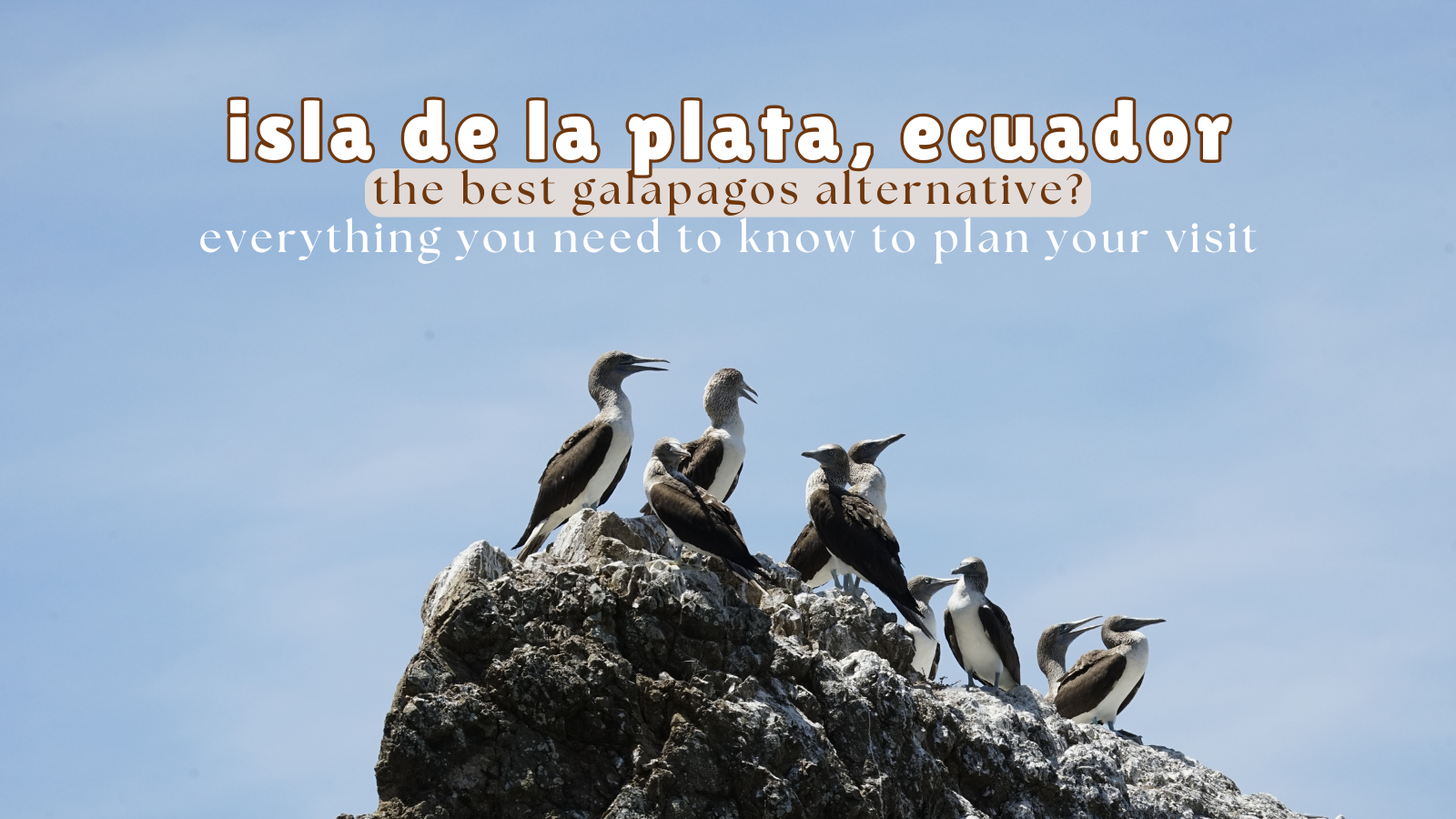
Isla de la Plata, Ecuador – often called the “Poor Man’s Galapagos” is one of the best budget wildlife experiences in South America. Located off the coast of Puerto López inside Machalilla National Park. This island is famous for blue-footed boobies, humpback whales, snorkeling and affordable day tours from mainland Ecuador. If you’re wondering whether Isla de la Plata is worth visiting, how to get there, what wildlife you can actually see and whether it compares to the Galapagos, this guide covers everything you need to know.
We unfortunately had to skip the Galapagos on this trip to Ecuador. Instead, we swapped it for this island. It is a great alternative to the Galapagos without breaking the bank. Of course you will have to miss out on certain experiences but that shouldn’t deter you from visiting.
Disclaimer: Some links earn me a small commission – same price for you, slightly less tragic bank balance for me.
So tell me more about Isla de la Plata…
Isla de la Plata is often called Ecuador’s “Poor Man’s Galapagos”. Naturally, I was intrigued. Unlike the Galapagos, Isla de la Plata is visited as a day trip from the Ecuadorian mainland, from Puerto Lopez… making this a much more affordable alternative. You do spot similar wildlife as the Galapagos, with some differences – I will delve into that later on. The island sits within a protected marine reserve so wildlife encounters can happen surprisingly close. We found plenty of blue-footed boobies nesting beside the trails.
Ideally, Isla de la Plata is for those of us who can’t afford to visit the Galapagos (yet), don’t quite have enough time or just want to see some wildlife without leaving the mainland.

What is Isla de la Plata?
Isla de la Plata is a small protected island located off the coast of Puerto López. The island is part of Machalilla National Park, an important protected coastal ecosystem.
Despite its nickname Poor Man’s Galapagos, it’s not really a miniature Galapagos. Unfortunately, there are no giant tortoises or marine iguanas wandering. The Galapagos Islands are also entirely volcanic, whereas Isla de la Plata was once part of the mainland and isn’t composed of volcanic rock. However, there is still an incredible concentration of birdlife, seasonal whale watching and manta ray visits. The most similar feature to the Galapagos is actually the blue footed boobies and male magnificent frigatebirds. Whilst I have never been to the Galapagos, I thought it was a genuinely worthwhile alternative.
Isla de la Plata vs Galapagos
Don’t get me wrong, Isla de la Plata is not a replacement for the Galapagos Islands. The Galapagos is in a different league in terms of biodiversity and endemic species. But Isla de la Plata offers a much cheaper, mainland based chance to see iconic wildlife like blue-footed boobies and frigatebirds for under USD $100. Think of it as a budget-friendly glimpse of Galapagos style wildlife, not a substitute for the real islands.

Where is Isla de la Plata?
The island sits 40 km off the coast of Puerto Lopez, located off Ecuador’s central coast. Almost all visitors reach the island via guided boat tours departing in the mornings from Puerto López harbour.
Puerto López itself is a small fishing and surf town that has become the gateway to Machalilla National Park. The town evolves on the weekends and public holidays from a laidback atmosphere to a bit of a party town. Regardless, it serves excellent seafood and direct access to beaches, whale watching and nearby national park attractions.
Is Isla de la Plata worth visiting?
Depends. If you are visiting the Galapagos, then you can probably skip Isla de la Plata since you’ll be seeing similar species and more. However, if the Galapagos is out of your budget and you love wildlife, it is a good alternative. Especially since seeing blue-footed boobies, considering most people associate these birds exclusively with the Galapagos!
The boat journey itself is part of the experience. We saw a pod of dolphins on our way to the island. During humpback whale season (June – October), sightings are extremely common. During this time, there are plenty of whale tours. You can go snorkelling in the waters. However, conditions vary depending on currents and weather. We had terrible visibility but was informed that when the weather is on your side, the water is crystal clear with many seeing tropical fish, sea turtles and rays in the surrounding waters.

How to get to Isla de la Plata
The journey begins in Puerto López. Most travellers arrive here by bus from destinations: Quito, San Domingo, Guayaquil, Montañita or Manta. Ecuador’s coastal bus network is inexpensive. Getting to most places isn’t an issue but it takes time.
The only way to visit the island is via guided tour. Independent visits are not allowed as the island is in the protected part of Machalilla National Park. You can easily book a guided tour online or once you get to Puerto Lopez. Booking a tour in person is a lot more straightforward than online. Tours leave every day and plenty of different agencies – they do work together, so if your chosen agency isn’t going, they will find you another agency that will.
Tours generally leave early in the morning and return in the late afternoon. Most include:
-
- round-trip boat transport
- a certified guide
- snorkeling equipment
- lunch
- and park entrance fees.
A note about the boat journey
The crossing to Isla de la Plata takes about an hour in the open seas. So, sometimes it’s a really rough journey. If you’re prone to seasickness, it might be worth taking some medication to help with the journey. Sitting toward the centre or back of the boat can also help. And most importantly, look out at the horizon if you start feeling woozy.
Best time to visit?
Wildlife can generally be seen all year round. However, the best time to see whales is June – October as the humpback whales migrate along the coast and are really commonly around Puerto Lopez. We visited in April and whilst we didn’t see any whales, we saw dolphins and the bright red, inflatable throat sac of the magnificent frigatebird.
What happens on an Isla de la Plata tour?
The day starts in Puerto López around 0900hrs, where you meet your tour group before heading down to the pier. After a short wait, you board the boat around 0930hrs and set off by 1000hrs. This is usually the first chance to spot humpback whales or dolphins along the way!
By around 1100hrs you arrive at Isla de la Plata for a short briefing before starting the hike. The first viewpoint is about a 20 – 25 minute walk, leading into exposed trails across the island. Around 1140hrs, the path splits. We personally choose the longer of the two routes – Sendero Fragatas for blue-footed boobies and magnificent frigatebirds along the cliffs.
You’ll return to the beach around 1315 – 1330hrs for a break before heading back onto the boat. Snorkelling follows around 1400hrs, depending on conditions, before you begin the return journey around 1500hrs. By 1600hrs you’re back in Puerto López and the day trip is finished.

A timeline
-
- Morning departure from Puerto López (around 0930 – 1000)
- Boat ride and wildlife spotting (1000 – 1100)
- Arrival + briefing on Isla de la Plata (1100)
- Hiking to viewpoints and wildlife areas (1110 – 1330)
- Lunch / beach break (1330 – 1340)
- Snorkelling stop (1400 – 1500)
- Back at Puerto López (1600)
What is the Sendero Fragatas Hike like?
There are two hikes on Isla de la Plata that you can opt for. We opted for Sendero Fragatas for the blue-footed boobies and to see the red sacs of the male magnificent frigatebirds.
The hike to the viewpoint is quite flat to begin with before you start the incline. It’s quite steep but manageable. But it’s the heat that makes the hike up quite unbearable. The landscape is dry, rocky and exposed with very little shade. Throughout the day, you should expect strong sun.
Continuing on the Sendero Fragatas trail, it’s not technically difficult. Some sections can feel uneven but if you just watch your footing, it’s completely fine. The Sendero trail is actually relatively flat. Just make sure to have decent footwear, lots of sunscreen and plenty of water. I opted for a UV shirt and a hat to shelter me from the harsh sun. The island hike is relatively moderate but hot. The entire trail takes about 1.5 – 2 hrs to complete.

What is the snorkelling like?
After hiking, most tours stop for snorkeling somewhere near the island. Visibility changes dramatically depending on ocean conditions. We had really rough currents and really bad visibility but others have clear water and abundant marine life! Sea turtles usually found nearby and there are tropical fish present. Although, it’s worth noting that if you’ve visited places like Indonesia or the Maldives, you should keep expectations realistic. Isla de la Plata is more about the overall wildlife experience.
What to pack for a day at Isla de la Plata
At minimum: sunscreen, a hat, sunglasses, swimwear, a towel and water. My personally recommendation is wearing a UV shirt or a lightweight long sleeved shirt to protect against the strong sun during the hike. A dry bag would be useful for protecting your things or electronics during the trip. Most importantly, do not forget motion sickness medication if you are sensitive to boats.
To wrap it up:
-
- Sunscreen
- Sunglasses
- Hat
- Reusable water bottle
- Dry bag
- Swimsuit
- Towel
- Motion sickness tablets
- Waterproof phone pouch (optional)
Wildlife on Isla de la Plata

The wildlife is unquestionably the main reason to visit. Blue-footed boobies are the stars of the island. Their bright blue feet have made them famous worldwide. Outside of the Galapagos, Isla de la Plata is one of the easiest places to see them. Frigatebirds are another highlight, especially during breeding season when males have a bright red sac that they inflate.
Depending on the time of year, keep your eyes peeled for:
-
- Nazca boobies
- Albatrosses
- Dolphins
- Sea turtles
- Humpback whales
- Manta rays or other types of rays
How much does Isla de la Plata cost?
Generally, the tour agencies set their tours at the same prices. Most day tours to Isla de la Plata from Puerto López estimate at USD $45. Although, prices can vary if it’s during peak season or not. It is worth comparing operators in town rather than choosing the very cheapest option immediately. Boat comfort, group size and guide quality can vary!
Should you book online or in person?
For flexibility, I’d recommend booking in Puerto Lopez. There are many agencies along the beachfront offering tours daily. However, it’s generally advisable to book a day or two ahead during long weekends, Ecuadorian holidays and peak season.
Is Isla de la Plata safe?
Generally, yes. Puerto López is considered a relaxed backpacker and beach town. But generally, basic precautions still apply. Keep your valuables protected and avoid isolated beaches at night. It’s also important to use reputable tour operators because boat safety standards vary slightly between operators, so choosing established agencies is worthwhile.

Can you stay overnight on Isla de la Plata?
No, while there used to be a hotel on the island, it’s been converted to be staff quarters now. Visitors can only access the island through organized day tours.
TL;DR? Quick facts about visiting Isla de la Plata
Why is Isla de la Plata called the “Poor Man’s Galapagos”?
Because you can see wildlife similar to the Galapagos at a much lower price.
Can you stay overnight on Isla de la Plata?
No. Visitors arrive only via guided day tours.
Are there blue-footed boobies on mainland Ecuador?
Yes!! Isla de la Plata is one of the few places in mainland Ecuador to see them.
Is Isla de la Plata good for snorkeling?
I’ve been told it’s good! However, we didn’t have great weather conditions… so the snorkelling conditions were not great.
Is the boat ride rough?
It can be extremely rough depending on ocean conditions! It is an hour boat ride out to the island.
Can you see whales year round?
Unfortunately, no. Whale season is from June to approximately October.
Is Isla de la Plata better than the Galapagos?
While it is called Poor Man’s Galapagos, it’s nothing like the islands. It is dramatically cheaper and easier to access, though.

Is Isla de la Plata worth it?
If you’re not able to visit the Galapagos islands, then yes it is. Just go with the right expectations, don’t expect the Galapagos for $45, you’ll probably leave disappointed. But if you’re after a realistic, budget-friendly wildlife experience on mainland Ecuador, Isla de la Plata is genuinely worth doing.
Seeing blue-footed boobies nesting beside the trails, spotting dolphins in the open ocean and watching frigatebirds inflate their bright red throat sacs felt pretty surreal considering we never even made it to the Galapagos on this trip. For us, Isla de la Plata ended up being an unexpectedly great part of our days along Ecuador’s coast. A reminder that you don’t always need the most famous or expensive destination to have a good wildlife experience.

Leave a Reply