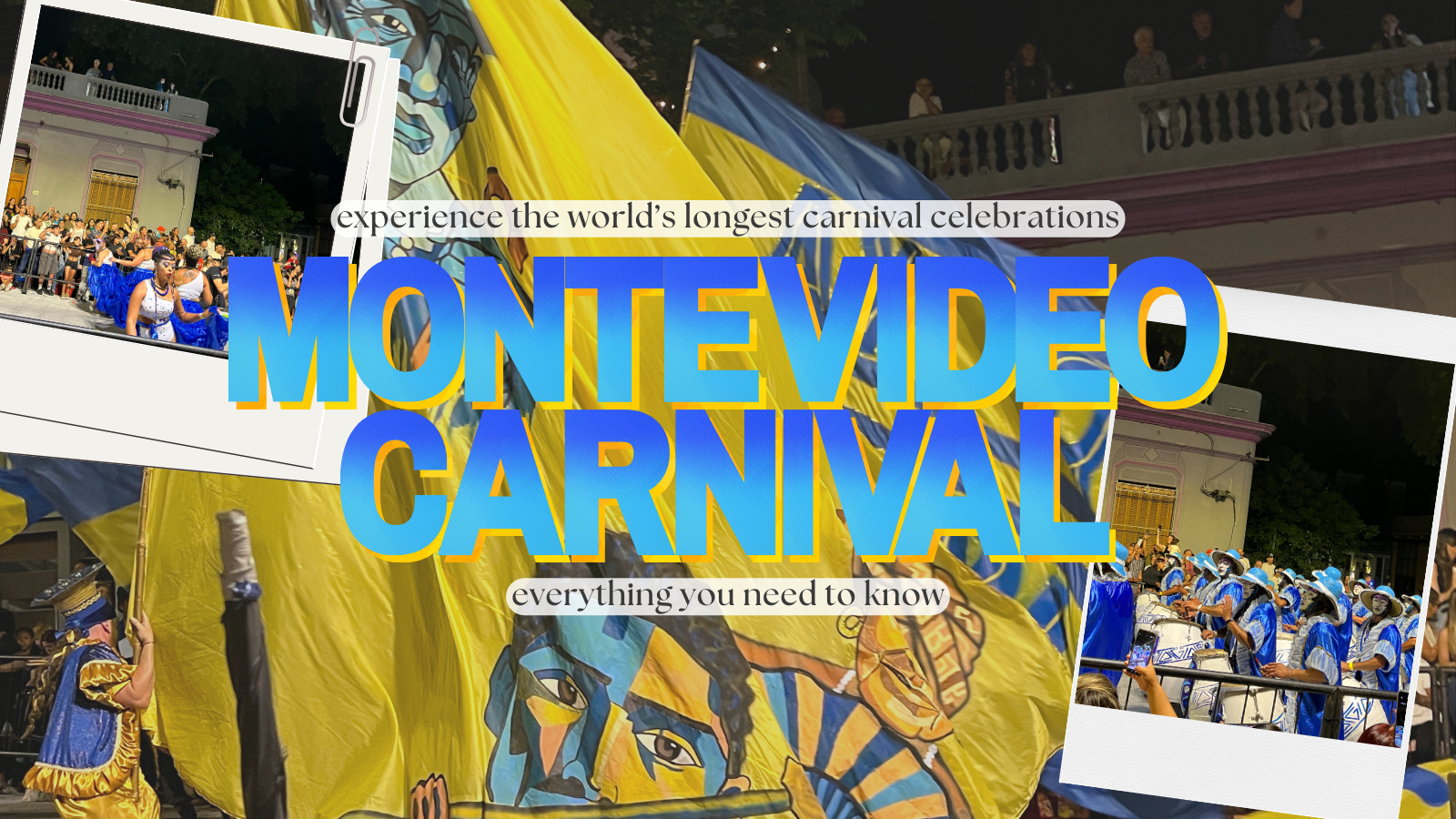
Updated for 2026 travel season: all you need to plan, book and experience Montevideo’s hidden Carnival gem.
Everyone talks about Rio Carnival but it’s far from the only Carnival out there. Montevideo Carnival or Carnaval as locals call it, is one of Uruguay’s best kept secrets.
It holds the title for the longest carnival celebration in the world. While Rio may steal the spotlight, Montevideo offers a completely different and far more local experience. From late January to mid-March, the Uruguayan capital comes alive for over 40 nights. Streets filled with drum led parades, local theatre productions and celebrations throughout the neighbourhoods that unfold across Uruguay’s capital and feel unapologetically local.
In all honestly, we stumbled across this. I visited the Museo del Carnaval in Montevideo and by chance found some information about a some neighbourhood performances and a local carnival parade. There truly isn’t much information online, let alone any information in English… so I’ve compiled everything that I know into this post to help you plan your trip for Montevideo’s Carnaval.
Disclaimer: Some links earn me a small commission – same price for you, slightly less tragic bank balance for me.

Is the Montevideo Carnaval worth travelling for?
Well, depends! I think it is such a unique carnival to witness first hand. Travelling to Montevideo or Uruguay isn’t necessarily the most straightforward. The easiest is if you’re already visiting the region. For me personally, it felt very local. During the tablados, we didn’t meet any other travellers… and heard potentially <5 travellers during the Desfile de Llamadas. If this isn’t a sign of how off the beaten path this festival is, then I don’t know what would be an indicator!
It’s the longest carnival celebration in the world. Hopefully if you’re visiting during carnival period (late Jan to mid March), you’ll be able to either catch a parade or tablado show.
This is a communal showcase of cultural rooted in Uruguayan history and deeply loved by locals.
When It Happens
Let’s break this down a little. According to my research, there are a few events scattered across the capital. Most weekend nights, you’ll be able to find Tablado de Barrio (neighbourhood stages) and two main parades.
- Desfile Inaugural: Official opening parade.
22 January 2026 - Desfile de Escuelas de Samba: Samba school parade
23 January 2026 - Desfile de Llamadas: Llamadas Parade
6 – 7 February 2026 - Tablado de Barrio: Neighbour stages & performances
Various dates but mostly over the weekends.
Main Carnival Events Explained
Okay, so we know when the events are… but WHAT are they?! Don’t fret, here’s a little Cliff’s Note for ya.
Tablado de Barrio (Neighbourhood stages): Nightly Carnival Shows

These are temporary performance venues located throughout neighbourhoods. They are essentially stages created, organised and decorated by the residents and different carnival troupes perform on them. The one we had seen at the Tablado de Museo had a set lasting approximately 45mins with different components.
The troupes wear brightly coloured costumes with intricate headpieces and their act is a mix of:
- Murgas: satirical musical theatre with humor and commentary
- Humoristas: stand-up comedy meets carnival
- Parodistas: parody performances
- Revistas: variety show spectacle
- Comparsas/Sociedades de negros y lubolos: music and dance troupes rooted in afro-Uruguayan history
The acts obviously are spoken in Spanish, the national language of Uruguay. But don’t let that prevent you from experiencing it. My Spanish is conversational at best but you can infer what they are speaking about. The Tablado can be used for performances that are satire or denouncing political power and events throughout the year. They can act as a voice of the people.
Desfile Inaugural: The Opening Carnival Parade
The carnival season launches with a big gala parade down Avenida 18 de Julio (Montevideo’s main avenue) weaving through Plaza Independencia to Plaza Cagancha. Thousands gather for performers and all major carnival groups. To my knowledge, there are also floats.
The event itself is free for the public – just go early to secure a good spot. However, you can purchase tickets in the bleachers/grandstand to get a better overview of the event.
Desfile de Llamadas: Rhythm of Candombe
Candombe is a cultural expression in Latin America associated with drumming. It has roots with the arrival of enslaved Africans to the continent. The Desfile de Llamadas is the biggest celebration of the Black community in Uruguay. The Candombe rhythm is the basis of the songs that the performers dance to during the parade. It truly is something amazing and worth watching.
According to the locals, the Desfile de Llamadas is THE event Uruguayans wait the entire year for. It is what I would describe as the cultural heart of the Carnaval. It is electrifying and a beautiful parade through the historic Sur and Palermo neighbours of Montevideo. The procession goes down Isla de Flores.
The event is free. You can purchase seats in the bleachers or seats alongside the procession. Although, like Desfile Inaugural, if you arrive early, you’ll be able to get yourself a good spot!

Tickets: Where and How to Buy
If you are planning to visit the Montevideo Carnaval, you might prefer to buy seated tickets to get the best view. These are some of the outlets I found that you’re able to purchase them from.
- Abitab outlets: Uruguay’s main ticketing network. When it’s close to Carnaval, you’ll be able to find tickets here.
- Box offices at venues: Many tablados sell daily tickets (often until event start).
- RedTickets / RedPagos: Common local platforms for event listings and ticket purchases.
Tip: Tickets for events like Desfile de Llamadas and Desfile Inaugural go on sale about mid-December and they do sell out. So if you know roughly that you are interested in going, it might be worth purchasing tickets. Although note – they are non refundable.
What to Bring & Tips for Travelers
- Water & snacks: Shows last hours! We even saw locals bringing in coolers of food.
- Alcohol: Unfortunately they don’t sell alcohol on the streets. But if you want, you are able to bring in your own supply!
- Cash (UYU): Street vendors and smaller tablados often don’t take cards.
- Comfortable shoes: Nights are long and involve lots of walking/dancing.
- Local SIM & carnaval schedule — Apps or PDFs help you track nightly show lineups.
- Ear protection: Candombe drums are amazing but loud.
Short Cultural History
Uruguay’s Carnival didn’t start as a big, polished event… it grew out of the streets. Back in the 19th century, Montevideo’s version of Carnival was loud, very much a free-for-all, shaped by combining European traditions and the rhythms brought by Afro-Uruguayan communities. Over time, candombe drumming became the heartbeat of it all, spilling through neighbourhoods and pulling people together night after night.
As the years went on, those street celebrations turned into something uniquely Uruguayan: satirical songs, theatrical performances, and neighbourhood stages where humour, politics and everyday life all collide. Today, Carnival stretches across 40 nights, not as a tourist spectacle, but as a deeply local tradition. One for the locals who show up for it year after year.
The Key Characters of Uruguay’s Carnaval
If you watch a candombe parade or a comparsa closely, you’ll start to notice that every person has a role. It’s not random! Especially if you had visited the Museo del Carnaval, you’ll see that they are actually characters to the story.

The Flag Bearer (Abanderado)
The flag bearer leads the comparsa and carries its identity. This represents the group’s history and neighbourhood. It’s treated with serious respect. You’ll often see the flag being spun, lowered or saluted. This role sets the tone for everything that follows.
The Broom Maker (Escobero)
The broom maker dances out in front, twirling and throwing a broom into the air with surprising agility. Traditionally, this character symbolises clearing the path, warding off bad energy and opening the way for the drums and dancers behind. It’s part ritual, part performance.
The Dance Troupe (Cuerpo de Baile)
This is the larger group you see dancing near the front of the comparsa.
Their role is to set the vibe. They translate the rhythm of the drums into movement and pull the crowd in before the heavy sound of the cuerda arrives. Their choreography is more collective and rhythmic. Lots of grounded steps, hip movement and footwork.
They represent community. This is Carnaval as a shared, neighbourhood-led celebration rather than a performance for a stage. When you see them, it feels accessible, like anyone could jump in and dance along.

The Gramillero and Mama Vieja
These two characters add humour, symbolism, and storytelling.
- The Gramillero is usually an elderly man figure, often exaggerated and playful, representing ancestral wisdom and Afro-Uruguayan heritage. He carries a bag of herbs (gramillas), referencing traditional healing practices.
- The Mama Vieja represents the matriarch. elegance, authority and memory. Her dance is expressive and theatrical, often interacting with the Gramillero in a way that’s both funny and symbolic.
Together, they connect Carnival to its roots… reminding everyone that this celebration carries history, not just rhythm.
The Vedettes
These are a handful of standout dancers just before the drumline, usually dressed more extravagantly, often with feathers or wing-like costumes. Their job is very different. The vedettes are the stars of the comparsa. They dance directly to the drummers, responding in real time. This is less choreography and more dialogue, a physical conversation between dancer and drum.
They represent celebration, sensuality and performance. Historically, this role evolved with theatrical influence and became a way to spotlight individual skill, confidence and presence. They’re meant to command attention and build anticipation just before the drums hit full force.
The Drummers (La Cuerda de Tambores)
This is the heart of it all. The drumline made up of chico, repique, and piano drums drives the entire parade.
- The chico keeps time
- The repique improvises and calls changes
- The piano provides depth and power
Without the drummers, nothing moves. They don’t just play music, they control the pace, energy and emotion of the whole comparsa. When you feel Carnival in your chest, it’s because of them.

Montevideo Carnaval FAQ
What is Montevideo Carnaval?
A very cultural and local event in Montevideo, Uruguay spanning 40 days. Full of celebration, music, threatre and parades.
When does it take place?
Late January through early March.
Do I need tickets for the Desfile de Llamadas?
No! The event itself is free, however you would not be able to have any seats. For the grandstands and seated parts (designated for the best viewing section), do require a ticket.
Where can I buy carnival tickets?
Mainly at Abitab, RedTickets, box offices. I will link these when Carnaval 2027 comes around!
What are tablados?
Neighbourhood stages where carnival troupes perform.
Can foreigners attend?
Absolutely! Montevideo Carnaval is public and welcoming to international visitors. Although, the information may be few and far between.
What should I bring?
Water, cash, phone/schedule, comfortable shoes, ear protection.
Montevideo Carnaval, As the Neighbourhoods Intended
Montevideo’s Carnaval isn’t loud in the same way Rio is. It doesn’t try to impress you. It doesn’t package itself neatly for visitors. And that’s exactly what makes it special.
This is a Carnival that belongs to its neighbourhoods. One where people show up night after night because it means something to them… not because it’s on a bucket list. If you’re already travelling through Uruguay or the wider region between late January and mid-March, Carnaval is absolutely worth building your plans around. You don’t need to see everything. Even catching one parade or one neighbourhood performance gives you a window into a side of Montevideo most travellers never see.
Hopefully this guide fills the gap I ran into and helps you experience Carnaval with a bit more confidence and context. Show up curious, stay open-minded and let the drums do the rest.
Because once you hear candombe live, it’s quite the experience. If this post made planning your Montevideo Carnival trip a little easier, why not fuel the next guide with a coffee? ☕



Leave a Reply